Join our Newsletter
If you like The NakedJournal, you'll enjoy my weekly newsletter about deconstruction, freedom, and life in general.
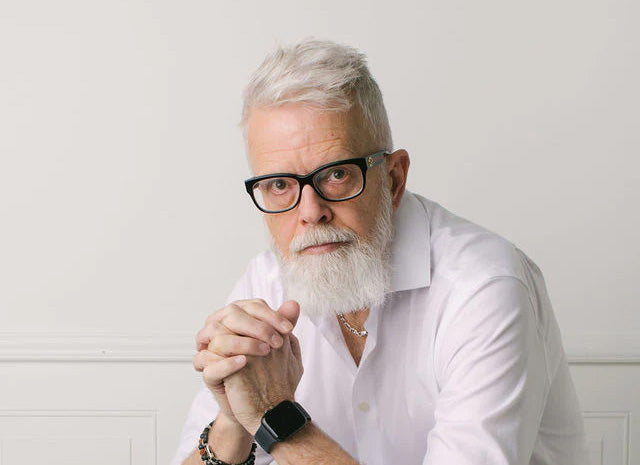
I'm David, aka NakedPastor. I've been blogging about spirituality, deconstruction, and religious freedom since 2006.
I'm an ex-pastor turned full-time artist. You can check out my cartoons, paintings, and merch in the NakedPastor Shop.
If you like The NakedJournal, you'll enjoy my weekly newsletter about deconstruction, freedom, and life in general.
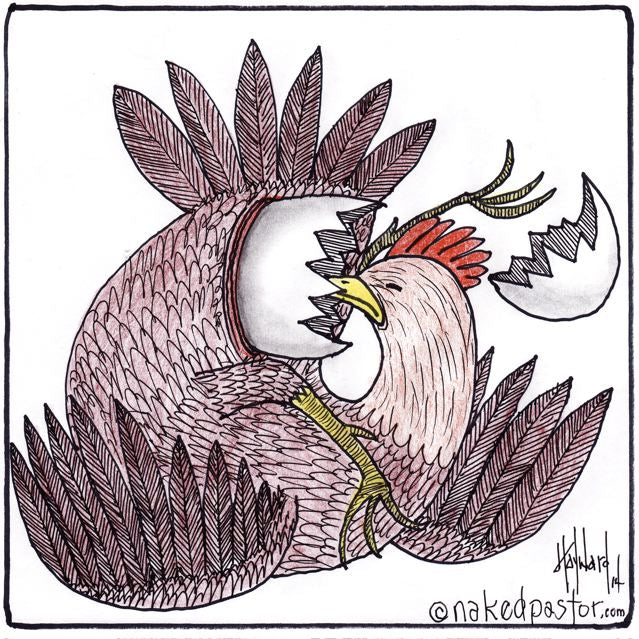
This drawing is inspired by the Ouroboros Snake... of the snake eating its own tail.

What came first? The chicken or the egg? What came first? The thug or the theology? I read Tony Jones' thoughts on Mark Driscoll.
Jones has always admired Driscoll, maybe envies him a little, wants the best for him, believes he can be redeemed, and suggests that things can be restored.
What I found most interesting though is that Jones believes the problem with Driscoll is theological.
That is, did Driscoll become the focus of concern because of his theology? Or was it because of his behavior?
I'm concerned that Jones' post reflects the refusal of the church to understand spiritual abuse. It neglects the pathology of its abusive leaders. I don't think this is being fair to the victims or the perpetrators of spiritual abuse. People are victims of not just a bad theology, but a pathological cruelty.
I don't think Driscoll's theology made this happen. Driscoll "embraced" his toxic version of theology because it aligned with his moral compass. It fit his personality. It worked for him to achieve his goals. Then it manifested the worst in him. Then he continued to develop his toxic theology in order to make more room for his pathological behavior. Mars Hill Church too.
Jones' sentence, "It could have happened to any of us." is true, because I believe we all participate in this dynamic. Theology is our creation. It is a reflection of our drives and desires.
Then, not satisfied to only be the product of our drives and desires, it also becomes the producer of them. Theology is a vicious cycle of our desperate need to understand and control our universe.
Step into this cycle at any point and you can see that we are both the root and fruit of our theology and pathology.
And yes, it spins out of control by manifesting itself in toxic, controlling, and abusive behavior. Nothing can be done about bad theology because of free thought and speech.
But we can do something when this manifests itself in bad behavior. Cruel theology is a nuisance. Cruel behavior is unacceptable.
When Driscoll thinks bully to his people, we can say please stop. But when he actually bullies people, we can step in and say you will stop now!
I don't think this is a theological issue. I think it is a pathological one. Not just for Driscoll and Jones, but for the entire church.
If we would be healed, our theology would take care of itself.





1080 comments
Thank you again for your advice Tim. I do find it very helpful.
This is Alex (AnImpartialObserver), and I am dropping the psuedonym, though no, I’m still not comfortable enough with the folks in this forum to tell you my last name. Like you Tim (and others here who have maintained their relative anonymity) I like my personal space.
I don’t really have much more to say though, since I’m not really interested in rejoining this conversation at this point. David and others have made it clear to me that I misunderstood the nature of the thread. I don’t have any personal stories of trauma to share and I was never hurt by any emergent people, so I’m not really sure what else is left to say then. I misinterpreted what was going on here and asked unwelcome questions, and I have apologized for that. This wasn’t the place to get the answers I was seeking. I would still like to have that other conversation somewhere at some point, but I’m not really sure where would be the best place for that anymore. Perhaps it’s not time for it yet anyway. I don’t know.
Anyhow, again, I’m sorry for disturbing the peace. Feel free to ignore my ineptitude and return to what you all were doing before.
What’s your last name? Let’s start there. Thank you, Alex for providing your last name as the vast majority of us have. Thank you.
Yes David, as I admitted above, I did indeed misunderstand the nature of this conversation, and for that I have apologized. My original thought was that since numerous serious accusations had been made against a wide group of public figures, that this forum would be an appropriate venue for discovering more of the facts and details around those accusations. You have since made it clear that it is not and I accept that. I do, however, still believe that discovering those facts and details would be very important thing for all of us to do at some point before passing any final judgments. So if not here, then in what forum would you recommend?
“I’m also not sure why it’s okay for Julie and others to mention these other scandals, but it’s not okay for me to ask them to be more specific. "
It is not about proving anything to you. That is where all this is breaking down for the emergent apologists like Brad Cecil, etc. So what is an appropriate venue for people to tell their stories when they have been silenced? The bottom line is that many don’t want the other side told at all. Even in snippets.
Another problem with stories like Julie’s is they involve a very clever narcissist and people do not understand how an NPD operates. They want a rational chronology of events that make rational sense and there is an obvious pattern of one person being the wrong doer. That is not how dealing with a narcissist works at all. In fact, before it is all done, the narcissist has used many people who don’t even know they were used! And if they figure it out they don’t want it outed for various reasons. The narcissist can do hundreds of covert bad things but if the other party does one stupid thing it is heralded to the roof tops and “proves” their point. That is just how it works. They are deceivers and quite good at it. And they use other people’s goodness, justice and transparency against them.
This just feeds right into ministry celebrity stuff. The good guy on stage saying the right things and people believe that is who they really are when they really have no clue who they are at all. Cult of personality is a huge problem in Christendom. And growing daily.
Alex,
I think your part in this conversation may be recoverable. I may be wrong. Much of it will depend on what you do next. Much will depend on how others react. (I have no desire to control either of these.)
I have some suggestions to share with you and others in the conversation. They’re for discussion – again, not rules, just some starting points.
I’m not here to embarrass you, but what I suggest may well leave you feeling awkward, confronted, or out of your depth. If so, it will pass – as you work through it. Or you can take a break whenever you want.
Disclosure:
Either you have a document you really shouldn’t have, or you have a connection you’re concealing, or both.
You seem to be operating on the basis of journalistic ethics: never disclose a source.
But in this context, it looks less than transparent.
It may restore trust if you cede control of this document to Julie, it’s author.
I don’t know exactly what this looks like (that’s up to Julie).
But I just can’t see how you posting it, after she has clearly expressed her refusal to post her copy, could be anything but a very, very bad move.
It may restore trust if you name your connection, or how you received the document.
But, again, best to confirm with Julie how she wants this communicated.
And finally, my own disclosure: I also operate on a first name basis publicly, out of a desire to preserve a safe space for me and for others. (I need a little breathing room around my spaces. Trust me on this.)
Presentation:
It may help to restore trust if you share a little of your story. Whatever you’re comfortable with. But it’s about this context, and your experiences. Contribute to the conversation. Make it personal. Listen. Sympathise.
It can be genuinely difficult at first, but it does get easier.
Oh, and if you’re tempted to post anything even remotely demanding or inquisitive – give us a few days to recover, please.
P.S. If you shorten the length of your posts, you’ll get early feedback, before you overwhelm people with content. The responses will likely be less intense. But, again, I may be wrong.
P.P.S. Oh, and whenever I see the word “impartial”, I can’t help but see someone suffering under the delusion of rationalism. Do you understand postmodern theory or deconstructionist critiques? (In your industry, I think the closest equivalents would be witness/source bias, or journalistic bias. You could be subject to both.)
Whatever your metanarrative, the fact remains that you’ve pretty convincingly outed yourself as being close enough to events to receive far more information than most on this thread. (In comparison: I live a long way away, I’ve read some books, been around a bit, and I inflicted and had inflicted on me some poor patterns. And despite this disconnection, I would never dare claim to be impartial.)
Given both epistemology and recent posts, I would personally react better if you dropped the pseudonym. But please do it in a transparent way. (If it was me, I’d make a self-deprecating reference in my first post under a new name…)