The Naked Journal
Thoughts, musings, and meanings behind NakedPastor Art.
The Naked Journal

Navigating Love and Changing Religious Beliefs
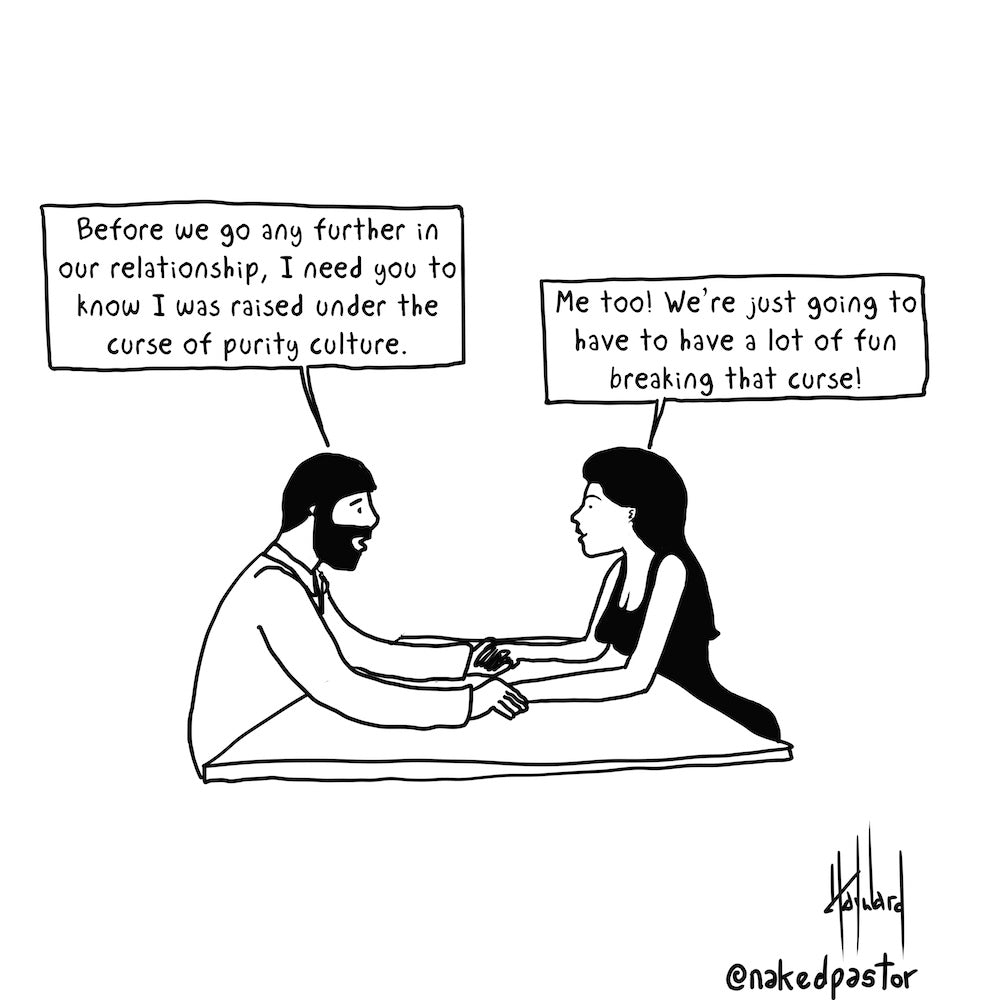
This couple has a story. They were young believers.They fell in love.They got married. Then they started… oh no… deconstructing! That is… their beliefs started changing. They were still in love, but things had become challenging. Their relationship wasn’t as easy as before. There were questions, awkward moments and silences, arguments, confusion, disappointment, and fear. Sometimes they wondered if they were going to make it. They realize they were in a kind of mixed marriage because they didn’t believe the same. They had to renegotiate their relationship.They had to reassess what their love for each other meant. They came to realize a few things: They are not their beliefs. Beliefs are simply thoughts we especially cling to and adore. They are like ripples on the surface of the water. They’re not the body of water itself. The surface always changes. Thoughts always change. They fell in love with the person… not just their thoughts and beliefs. They remembered when they first met and how love happened, even before they really knew each other’s minds. They committed to change. Remember the marriage vows? For better or for worse, richer or poorer, In sickness and in health, etc? That means they committed to each other as they and things change. Which they will! Including how we look, feel, and think. They discovered love embraces the other in all their authentic uniqueness. In fact, love encourages the other to find and discover and manifest their authentic uniqueness in a safe and secure environment. Here’s one secret ingredient to a passionate marriage: polarity. Like a battery with a positive and negative pole that creates the energy, so does difference and diversity in a relationship. When Lisa and I first met, I was a naïve Canadian boy and she was a fiesty Alabama girl. We were so different from one another in so many ways. But the passion in our relationship was on fire and still is. Yes, in many ways we merged, integrated, became entangled and enmeshed, but over time we had to learn how to individuate. This happened later in our marriage. But oh my the sparks flew and reignited our romance. Always remember… you fell in love with them, not their beliefs.
Read more
Are You Ashamed of Your Body and Sex?
There are many ways purity culture can affect your sex life, and one of the most damaging is how it ingrains shame around our bodies and sexuality. 1. The first story in the Bible teaches us that being naked is shameful. When Adam and Eve sinned, they became aware of their nakedness and were ashamed. I was always taught that being naked was a source of embarrassment. How many of us have had dreams where we are naked in a room of people? It’s humiliating. At this point, it isn’t even necessarily about our bodies, but just that we are naked, because just being naked is bad.2. This is further complicated by our culture’s obsession with the shape of our bodies. We are blasted with images of our culture’s idea of a perfect body. If my body doesn’t conform to my culture’s ideal of what a perfect body is, then I’m going to feel embarrassed by it. This dynamic has an enormous impact on our confidence when it comes to getting naked with the one we love and are having sex with. Even in the presence of someone who loves us and who wants to be sexually intimate with us, we are embarrassed that our bodies don’t fit with what we think they desire. We hide ourselves and our bodies from the gaze of our lovers so as not to disappoint them and embarrass ourselves even further.3. Purity Culture has also taught us that sex is dirty, that it is a sinful manifestation of our carnal nature. I was taught that sex didn’t begin until after the Fall, meaning that it was inevitably an expression of our fallenness. We learn that to lose ourselves in sexual passion is an unholy fleshly act. It is a demonstration of our body’s sinful urges, an indication of lust, and a lesser aspect of being human. Holiness and sex can’t be imagined together. Sex is an aberration. It’s something that we do to procreate, not something we do for pleasure, intimacy, and connection alone.Doing it from under the covers and in the light would be a brazen flaunting of lasciviousness and a brazen rejection of our spiritual nature.When in fact it is an embracing of our humanness and our healthy desire to connect with another in a most intimate and vulnerable way.
Read more
5 Ways Religious Trauma Can Affect Your Sexuality (and how to heal)
Many people who attended church for a long time suffer from Religious Trauma. It’s becoming more visible to more and more people as more of us are talking more openly about it. Religious Trauma is often wound up with Purity Culture, which can have a disastrous affect on our attitudes about sex. People who are survivors of Religious Trauma and Purity Culture often struggle to acquire healthy attitudes about sex and feel comfortable with their sex lives. Add to that... if a person suffers these things plus spiritual abuse, there's a lot of healing that needs to happen because these all affect their lives at a deep and fundamental level, including sexually. Here's a couple stuck in a religious mindset caused by Religious Trauma. (Click on this image for a digital download, or click HERE!) 5 Ways Religious Trauma Can Affect Your Sexuality Religious Trauma makes us feel guilty for enjoying our bodies. Christianity, like many religions, castes our bodies and the flesh in a bad light. I was taught that my body was my enemy and something I always had to deny and beat into submission. I had to crucify it daily. The affect this had on my attitudes about sex was that I felt guilt any time I was enjoying my body or being in my body. For some people it’s even worse: they can never have any pleasure because it’s blatantly sinful, goes against scripture, and displeases God. Religious Trauma makes us feel like we’ve got our priorities wrong. For those of us who grew up in intense religious environments, the goal was to always be thinking about God and spiritual matters. Our minds had to be first and foremost stayed upon God, and to allow anything else to creep in was to allow something else to dethrone God from our minds and lives. We could never, to use an analogy, take a vacation and just enjoy ourselves because we were to be “on” 24/7. Even in our sleep, we had to pray for protection so that we wouldn’t stray from this strict path. As a result, when some people are enjoying sex, there can be a deep sense of putting something ahead of God that may anger him, or at least disappoint him. Religious Trauma makes us feel insecure about being confident about our sexuality. Religious Trauma teaches us not to trust our bodies. This is deadly for good sex. One of the most important things for a good sexual relationship is confidence. For sex to be fulfilling for each partner, each one must feel confident in their bodies and have some confidence in knowing or discovering what is pleasurable for their partner. Insecurity and a lack of confidence can kill passion and eliminate a feeling of joy and fulfillment. Religious Trauma makes us second guess enjoying our bodies as not spiritual enough. Religion dichotomizes the world. There’s good and evil, invisible and visible, light and dark, spirit and flesh. And these are always at war with one another. As a result, for many people coming out of a strict religion, when we are making love with someone we love, there is confusion about what’s happening. If their minds are on their body and their loved one’s body and the love and passion taking place, it can feel less than spiritual and therefore, somehow, even sinful, secular, fleshly, or worldly. We can heal ourselves from Religious Trauma. We can educate ourselves by giving ourselves therapy and going to get therapy. We can come to a place where we understand that our bodies aren’t evil, aren’t our enemies, aren’t less than spirit, and not unimportant. When we realize our bodies are good and to be dignified and enjoyed, we are on our way to healing and healthy attitudes about sex and on to enjoying healthy sex lives.
Read more
Can You Be Spiritual Abused In A Marriage?
Before we address what spiritual abuse in a marriage is we must first unpack the definition of spiritual abuse itself. What Is Spiritual Abuse? Spiritual abuse is when spiritual leaders abuse their power and spiritual ideas to create a toxic culture of shame and control to fulfill their own desires. Just like physical abuse uses physical means, or financial abuse uses financial means, or sexual abuse uses sexual means, etcetera, to achieve their ends, spiritual abuse uses spiritual means to achieve its ends... like positions of church power, the Bible, theological ideas such as the threat of excommunication or shunning or Hell, it uses these to terrify people into submission. It is both of these: abuse of power AND the self-serving use of spiritual ideas. Both of these are fueled by theology or dogma. I think this cartoon, Spiritual Abuse in a Picture, sums it up very well. What Is Spiritual Abuse In A Marriage? Spiritual abuse occurs in a marriage when one partner manipulates or controls the other by using their spirituality. Can You Be Spiritual Abused In A Marriage? So let's talk about spiritual abuse inside a marriage. Is it possible. Yes it is. Spiritual abuse can occur in any type of relationship, including a marital relationship. It is possible in a marriage, as in any relationship, due to a combination of factors related to power dynamics, manipulation, belief systems, and control. 5 Examples of Spiritual Abuse in Marriage and Relationships Examples of spiritual abuse in marriage and relationships can vary widely, but they all involve the misuse of religious or spiritual beliefs to control, manipulate, or harm the other person. Here are some specific examples: 1. Forced Religious Conversion This is when one partner pressures or coerces the other into converting to a different religion or spiritual belief system, disregarding their own beliefs and autonomy. They might say, "I can't marry you (or stay married to you) if you don't convert to my religion!" This person is uncomfortable with diversity in beliefs, and is requiring their partner to conform to their belief system with the threat of separation if they don't. 2. Manipulation Through Fear Using spiritual teachings to instil fear and control in the other person, making them believe that certain actions will lead to divine punishment or negative spiritual consequences. I knew a couple where the woman kept making her husband believe he must be demon-possessed when he made her unhappy or frustrated her in any way. She was using the fear of demons to control his behaviour and make him submit to her demands. 3. Isolation and Separation Demanding that the other person cut ties with friends, family members, or social circles that don't share the same spiritual beliefs, isolating them from sources of support and community. I've seen this a lot in some church communities I have observed or even be a part of. When one partner realizes that their partner's relationships outside of their marriage might have what they think is a negative influence on them, they will try to cut them off from those relationships to ensure that their partner stays on the straight and narrow of their expectations. We see this happen a lot in cults. 4. Control Over Spiritual Practices Dictating how the other person should pray, meditate, or engage in spiritual practices, and punishing them if they don't adhere to the abuser's prescribed rituals. Some people have very rigid ideas of what their religion should look like, and that everyone must do it the same way. If they bring this attitude into a marriage, it's going to cause tension, friction, and division, because it requires conformity over personal authenticity and uniqueness. If one partner feels they always have to sacrifice their own ideas and practices to prevent their partner from getting upset, this will make for a toxic marital relationship. 5. Emotional Blackmail Leveraging spiritual beliefs to emotionally manipulate the other person, using guilt, shame, or spiritual teachings to force compliance with the abuser's demands or desires. If a partner is constantly using the bible and theology to shame and guilt their partner into submission to their expectations, this will quickly lead to resentment and a shallow relationship that often won't last long.It's important to recognize these signs and seek help if you or someone you know is experiencing spiritual abuse. The Impact Of Spiritual Abuse In A Marriage The impact of spiritual abuse in a marriage can be as severe as any kind of spiritual abuse leading to religious trauma that has a profound and far-reaching effect on a person's well-being. We see this happen a lot in marriages concerning the issue of sex. The patriarchal culture of Christianity which demands that women submit to their husbands sexually, is particularly damaging. I've seen Christian husbands over and over again force their wives to have sex because the bible teaches that their wives' bodies belong to them and not their wives. Many women have equated this with marital rape, and they're not wrong. It’s so hard to identify or find validation that spiritual abuse has occurred or is occurring. We make excuses, we see issues swept under the rug, we experience our stories of abuse being invalidated again and again. Admitting that you that you were or are abused is an important first step in healing from spiritual abuse.
Read more
An Ultimate Guide To Spiritual Independence
The first time I mentioned the idea of spiritual independence, I received quite a backlash from some of my readers. People preferred that I had said "interdependence" because we shouldn’t be alone. But independence doesn’t mean being alone. I can be independent while interdependent with another. In fact, healthy interdependence depends on healthy independence. The Different Reactions to My Call for Spiritual Independence One was that Christians are supposed to be in fellowship and not alone. Another reaction was that it is spiritually healthy and necessary to be in submission to someone in authority for guidance. Yet another one was that we all need to be accountable to someone. I believe these are all misunderstandings of spiritual independence. So I will address each one. Does Spiritual Independence Mean Being Alone? “Christians are supposed to be in fellowship and not alone.” We should not confuse independence with loneliness. They are two different things. Yes, it’s possible to be independent and alone. But it’s not necessary. For example, every country wants to be independent. But this does not mean it wants to be isolated. It wants to be autonomous, self-directing, and free, but it also wants to decide which countries to enter into a relationship with. It’s the same for you and for me. I want to be independent, autonomous, self-directing and free. However, I also want to decide who to be in a relationship with. No, I don’t want to be alone. But I’m willing to be if that’s the only way I can be independent. Do We Really Need to be in Submission to a Spiritual Authority? It is spiritually healthy and necessary to be in submission to someone in authority for guidance.” I do not disagree with this. But, we have to be very careful with what we mean by this. I’ve believed in spiritual independence for a long time. I’ve also put myself in submission to spiritual directors, guides, and coaches. But that’s the key: I put myself there. I chose them, and they decided to agree to help me. I insist that we should be able to choose who to receive our guidance from. Of course, when we are young in life and in our spirituality, it’s wise to listen to those who are in authority over us and to take good advice from trusted people. But they should be training us to learn how to choose for ourselves. Parents should teach children to be able to live without them. The best teachers are those who don’t teach their students a bunch of facts, but teach them how to study for themselves. Similarly, spiritual leaders should teach their people to be able to be spiritually healthy without them as well. Does Being Spiritually Independent Mean Not Being Responsible? “We all need to be accountable to someone.” When I first left the ministry and the church as a faithfully attending member, many people expressed their concern that I was no longer under an umbrella of protection or under the shepherding of a pastor or under a spiritual covering. They feared I was now vulnerable to demonic attack, error, and apostasy. Having been a pastor who hung out with other pastors for decades, I knew these ideas are carefully manicured and published by those in authority to fence the flock into the fold with fear. I agree that it’s true that when we are young in life or immature in our spirituality, we should willingly learn from those more mature. But you have the right to make yourself accountable to someone if you want to, and it’s your choice who that can be. To go out on your own is only dangerous if you’re not prepared for it. Preparing for independence is normal and healthy.When we talk about independence, we usually mean these things When we talk about independence, this is what we mean: free from outside control not dependent on another’s authority self-governing not dependent on another for subsistence free-standing We should agree that every person should aspire to this independence. We should also agree that every parent, teacher, and spiritual leader should aspire to guide their children, their students, and their people to this same independence. We can be the captains of our own ships, the masters of our own destiny, and the authorities over our own lives. This leads us to another reaction I often receive when I talk about spiritual independence. This one is important. Some people say that they prefer to be interdependent rather than independent. We Shouldn't Confuse Independence with Interdependence Independence and interdependence are two different things. They are related but mutually exclusive. You can’t be healthily interdependent unless you are first healthily independent. Yes, you can be independent while interdependent with others. A healthy person is able to move into an interdependent relationship without losing their independence. I use the relationship Lisa and I have as an example. We’ve been married for years. We have a healthy relationship. We’ve worked hard for it. It’s not easy, but the rewards make it worth it. It has required a ton of personal growth for each of us, as well as a ton of growth in how to form healthy relationships. We had to learn how to be independent adults who choose to love each other. I have to be healthy as an individual. Lisa has to be healthy as an individual. When these two healthy individuals choose to interrelate, then, it is functional and healthy, rather than toxic, codependent, and dysfunctional. We choose to be interdependent. There are different kinds of dependencies: There’s dependence. There’s codependence. There’s independence. There’s interdependence. I think it is healthy to move through these different kinds of dependencies. What is Dependence? We all start as children dependent upon our caregivers. This is not only natural, but necessary. But we gradually learn how to fend for ourselves as we are cared for. We grow up, hopefully under the wise and gentle oversight of those who care for us. But we shouldn’t stay there. (Unless we aren’t able.) What is Codependence? “Codependency is a relationship imbalance where one person enables another person’s addiction, poor mental health, immaturity, irresponsibility, or under-achievement. Among the core characteristics of codependency is an excessive reliance on other people for approval and a sense of identity.” (Wikipedia) This can start at a very early age. But unfortunately it can continue on into adulthood. Many parents have a codependent relationship with each other as well as with their children, and vice versa. If the children are raised well though, they learn self-confidence, autonomy, and their own healthy sense of identity. They can pass through or even avoid codependence and move on to the next stage. What is Independence? Independence is as mentioned previously. It means that you are free from outside control, that you are self-governing, that you are not dependent on another’s authority, and that you are not dependent on another for subsistence. Of course, we all should aspire to this. As codependence is closely related to dependence, so is independence closely related to interdependence. What is Interdependence? Healthy interdependent relationships depend on healthy independent individuals. This is as true in a church as it is true in a marriage. The first spiritual director I ever had was the best I ever had. I sought one out and found Sister Marie, an Abbess of a monastery who was willing to meet with me once a week. We met for two years. The reason why she was the best was because even though I willingly submitted myself to her spiritual direction, she taught me how to become spiritually independent. She taught me how to think for myself, make decisions for myself, and decide for myself how I wanted to be spiritual. Even though she suggested what I should read, how I could meditate, who to study and contemplate, and how to be spiritual, at every moment I was free to walk away or free to accept her guidance and obey it or free to say that particular suggestion wasn’t for me. I remember one day, with deep exasperation, I said to her, “I feel like such a stick in the mud!” She gently responded, “What does it feel like to be a stick in the mud?” No judgment.No need to harness me into her spiritual style.No obsession with aligning me with her idea of perfection or progress. For her, what was most important and what she respected most was my autonomy and my ability to explore and find my own way to be spiritual. Actually, what I mean is she encouraged me to find my own way to be me! I did find it. I’m still finding it. And I’m living my own life now. I’m also free to choose who I am in a relationship with, how to recognize unhealthy relationships and how to form and nurture healthy ones. I’m able to decide how to be spiritual not only for myself, but for those I choose to be interdependent with. This is healthy. This is what I mean by spiritual independence.
Read more
Can A Marriage Survive A Change In One Partner's Religious Beliefs?
This post is sad but it’s real. Buckle up!When faith deconstruction strikes a marriage it can be devastating. By deconstruction, I mean the changing of spiritual beliefs, the loss of faith, or leaving the church. By strikes a marriage, I mean when one or both partners experience deconstruction.I am not going to sugarcoat the reality. My observation is most marriages don’t survive when one partner changes their belief system. I get messages from people all the time who are struggling in their marriages and relationships because they have changed their faith or religious beliefs. One thinks it's still okay to believe in God and the other thinks it's stupid to. One still loves the faith and the other hates Christians. One is perplexed by what they think is their partner’s naïve beliefs, the other is perplexed by what they think is their partner’s dangerous unbelief. So their relationship falls under strain, and they may end up separating and divorcing. This not only happens in marriage but in all our relationships. When Lisa and I started deconstructing our faith and beliefs well into our marriage, we had no idea what to expect. We had been madly in love for many years. We met in Bible College and served churches as a team for a long, long time. Our marriage almost didn't survive when I left the ministry. Feeling suddenly free from all limitations, I began being more authentic about my spirituality. We felt we were no longer on the same page, or the same book, or library! But time taught us that we were in the same story. Our story proved that we can grow together. We learned that compatibility of beliefs wasn’t the glue of our marriage. Love and the mutual respect love fosters was! Our relationship is richer for it. Here are 5 reasons why many marriages don’t survive spiritual deconstruction 1. They realize the only reason they got married was to have sex legally. They wanted to have sex, but the only way was to get married. Now, years later and starting to question everything about the faith and the church, they admit getting married just to have sex isn’t a good enough reason to stay together. Especially if sex is no longer an important part of the relationship. 2. They discover that they’re not really in love. They thought they were in love because of pressure from the church to behave as though they were. It takes a lot of self-awareness and honesty to say, “You know what? I don’t love him/her. I never really did!” Once they can admit that, then they realize there’s no reason to keep trying to make this work. 3. They conclude that it’s not worth the effort required to fix it. They realize they’ve changed so much and that they no longer feel compatible. Sometimes people realise that the person they are with is not the person they married, and they don’t have the energy or the time to try to fall in love with this version of their partner! They feel so out of sync with each other that the happiness is gone and there’s no point in continuing. Unfortunately, this happens. 4. They want to leave anything to do with their religious past. This may include their spouse. I’ll be honest with you: this was one that nearly broke up my marriage. I wanted to run from everything. I escaped religion and the church, abhorred the thought of feeling trapped, and considered walking away from my wife, my family, my home. Everything! It was one of the most confusing times of my life. Some don’t survive this impulse and do leave everything associated with their past, including their marriage. 5. They decide they got married too young. They've never known anything but married life. Some people who get married very young feel they have never colored outside the lines, and were never allowed to live authentically without being responsible to or for another. Related to this are people who discover they’re not monogamous or heterosexual or their assigned gender, etcetera. Often the woman decides she will longer participate in a misogynist or sexist relationship. Many go their separate ways in order to live their own way, something they’ve never done before. Only you can decide if your marriage is worth saving Sometimes, when deconstruction hits you and you change your beliefs, you might realize that you were never really in love in the first place, or that your love has died, or that the pressure and expectations of your church forced you to marry and stay together even though it wasn't right. The veil lifts, you see your marriage for what it is, and you decide that it might be better to go your separate ways. This is not failure. It’s self-awareness!Sometimes divorce is, sadly, the better option. However, a huge part of the problem is the stigma of divorce that survives in our minds from our religious days. In your mind, you think: God hates divorce and I should suffer long even in a terrible marriage because that’s always better than divorce. But, I do not judge anyone going through this or for the decision they make. Religious deconstruction is always messy. It’s never clear or clean.If you want to end your marriage, do it as well and as kindly as you can. The goal is the personal well-being of each person and taking the steps necessary to make sure that happens. If both partners want to make the marriage work, it’s not easy but it can be done. Ask me, I know! Here are 5 ways you can help your marriage and yourself survive spiritual deconstruction Don't be rash. When you were on the same page there was no need for patience. You had what you wanted: one hundred percent agreement. But as each person in the marriage begins to grow, mature, and change, disagreement is bound to and ought to occur. When one partner in a relationship changes, it forces the other to change. Marriage is like a crucible of transformation. We influence and change each other. This is what love does, actually. We make compromises (translate: improvements) in order to make our partner happy and our relationship more pleasant. So, when our partner starts to change, don't prematurely and immaturely dash out the door and abandon your partner or the relationship. Give it time: they will change again and so may you! Don't compromise too much. This one goes against a lot of info out there but it needs to be said (it’s also why it’s a longer section than the others). If your partner can no longer tolerate you, gives you ultimatums, or gets impatient and angry with you, and decides to leave, that's their problem, not yours. Their attempts to pressure you into a certain way of thinking is controlling and unfair. You didn't require that of them, and they shouldn't require it of you. The best and healthiest growth is natural and unforced. Everyone knows that. So don't compromise yourself too much by becoming what they demand you to be just so they'll be happy and stay with you. It's not worth it, because you are more important than the marriage. What I mean is, the healthiest relationship is between two consenting adults who don't manipulate or coerce one another. When you promised to take one another in sickness and in health, this meant spiritually too. So if they can't love you as you are right now, and as you are in your own spiritual process, then that's their problem, not yours. Don't sacrifice your essential self on the altar of their selfish insecurities and fears. Stay open-minded and curious rather than judgemental. As adults mature, they begin to understand what true love is - a safe space to grow individually without judgement. You don’t need to understand your partner’s religious beliefs or even agree with them to show your partner respect. Instead of pushing to shift their perspective, lean into curiosity. Ask, listen, and really try to see where they’re coming from. It’s not about winning an argument or being right— it’s about opening a door to deeper understanding and letting your connection grow stronger. Realise you are not alone in this and it’s not wrong. Thousands of couples navigate the complexities of different religious beliefs every day. There’s nothing wrong with you or your partner; it’s just part of the journey. There are plenty of resources out there, from books to professional counselors. Seeing a therapist can make a world of difference. But, a word of advice, look for someone impartial, who understands both sides without taking one. If you get a counselor who shares one partner’s faith, the therapist will struggle to stay neutral and focus on helping you grow together. Love with humility and respect. I was going to say love means tolerance, but tolerance has the ring of superiority to it‚ like, because I am right and you are wrong, I will tolerate you in your error until you finally see the light like I did and come around to my way of thinking! I definitely don't mean that. I mean love is humble and doesn't think of itself too highly. When we acknowledge that life is full of mystery, and all knowledge, beliefs, theories and conclusions are transitory and provisional based on incoming information, we can be humble about our own beliefs and respectful of our partner’s. Good scientists take this approach. Good partners do too. In mature, loving relationships, there’s a mutual respect that goes deeper than held beliefs. That is, we must trust our loved one to take care of themselves intellectually and spiritually. The beliefs are just thoughts rippling on the surface of a deeper reality called the self, and we trust their self to their own search and discoveries. When we trust each other and leave our insecurities and fear of judgment aside, we can discover a whole new and more authentic version of our relationship that is deeply rewarding. But only if we are brave, patient, honest, and open-minded. More resources for marriage and deconstruction of faith You can read my personal story on this blog post - How My Wife and I Survived Religious Deconstruction.You can watch this video, with Monica Alhbin from the G(ud)-Punkten podcast, where I talk about the terrifying experience of not knowing if my marriage would survive spiritual deconstruction. You can read my book, Til Doubt Do Us Part: When Changing Beliefs Changes Your Marriage.
Read more
Doing Life While Deconstructing
I think the intensity of our deconstruction from religion losing our religion, changing our beliefs, deconverting, etcetera, corresponds with the intensity of the religious devotion we had. (Click on image for a digital download of it, or click HERE!) If religion was a superficial hobby for you, then deconstruction might be mild and easy. If religion was your everything, then deconstruction might be intense and difficult.For some, it's just a crossroads. For others, it's a crisis.For some, it's a slight turn. For others, it is a tragic accident. I've also experienced and observed different kinds of deconstruction: social and philosophical. That is, there is a deconstruction from the church and all that goes with it: family, friends, spouses, activities, responsibility, loyalty, spiritual abuse, etc. Then, there is a deconstruction from the beliefs we held: purpose in life, destiny, meaning, hope, afterlife, a sense of being loved, protected, and cared for, etc. Both are hard. If you do them simultaneously, good luck! Just like belief and church overwhelms your life, so does the deconstruction from them. It affects your mental health, your body, your appetite, your relationships, your sense of meaning and purpose, and your worldview. Everything! Nothing goes untouched. Just trying to do life seems impossible. It feels like we're being birthed into a new world where there is no oxygen. Nothing's the same. The trauma is total! Many don't understand those of us who experience it as trauma. So what? The important thing is to take care of yourself. One of the things you are going to have to deconstruct from is that you always have to worry about offending other people. That came with the theological and church territory. We were told that we could never ever offend anyone. If anyone was offended" by us, it was our fault and we had to fix it. That's false, and you will learn this during your deconstruction. You have to take care of yourself no matter what other people think. You have to find your own way post-church and post-belief. I tell this to anyone who talks with me about it: take your own sweet time. Do it your way. You will learn how to best take care of yourself. You are your own best caregiver. It's now time to start employing that aspect of yourself. Take care of yourself. You have permission.
Read more
Deconstructing and How to Change in Front of Your Kids
This is a letter I wrote for someone deconstructing with kids. Here's the letter (slightly edited): I'd been looking forward to working on this letter and sending it to you today. Many people have been asking me to write about this issue. Obviously it is an important one that occupies many of our minds and evokes concern in our hearts. It's about our children. How do we deconstruct with our kids? (***NOTE: This doesn't just apply to our kids. You can apply these principles to any loved one‚ a partner, a family member or a friend. One thing I've learned: The way you do one thing is the way you do everything. The way you treat anybody is the way you treat everybody.) I'm going to talk about how to deconstruct with your children. As parents we like to appear that we are in control of our lives and by inference the lives of our kids. We like to be responsible. So when we experience the deconstruction of our faith and beliefs and experience confusion, how do we take care of the spiritual lives of our own children? How do we oversee the spiritual development of our kids when we can't even oversee our own? Here are a few suggestions that are more about themes than advice. Relinquish Control But Not Responsibility Many people grow up in very tightly controlled homes where their spirituality is assigned. When I became a father I wanted to do it differently and help my children find their own selves and their own paths. We relinquished control. At the same time, we saw ourselves as gentle guides‚ like spiritual sherpas‚ showing our kids where the possible pitfalls and the safest pathways were, what foods were good and what wasn't, and who and what to trust or not. When Lisa and I left the church, our children were already in their older teens, so they were already well on their way. We could hold adult conversations with mature themes. When Lisa and I were talking about this topic the other day, she said our kids were already deconstructing before we were because we allowed them to question from an early age. They had the ability, without our baggage, to be honest about what was real, authentic and true, and the strength to reject what didn't pass that test. They were far more sensitive to control and nonsense than we were because they were raised differently than we were. So when we started deconstructing, they were already prepped for it. We had obviously raised our kids in the Christian faith. We still have a collection of children's bible story books that we used read from them every night. They grew up in the church so they knew the stories, the traditions and what church means. But we never required them to believe this or that. Like the sower with the seeds, we cast the seeds everywhere, knowing that what was good would stick and what wasn't wouldn't because it depended on what kind of soil their own hearts were. They'd develop their own spirituality and therefore find the special food that needed to feed it. In 2002 Lisa's father had come to live with us because he was dying of cancer. This was when we were in New Hampshire planting a church for a ministry. The day before Christmas, Lisa's father died. Our approach to it was to try to understand it theologically, and we had our long-held world-views and the ministry people to bolster this attempt. Not our kids! They loved their papa, and when they watched him die in our house despite all the prayers and promises, they immediately questioned what all those prayers and promises claimed to be. So they not only questioned that, but they went to the source: God! They realized that the idea of God everyone talked about and what actually is are completely different things. The ministry fired me the next day and the church I planted and all the staff ignored us. We never saw them again. This, for my kids, was inexcusable. So they saw the church for what it was: just another collection of disappointing human beings. Not to say that they don't think people and our groups can't be good, but that the church has no divine right to claim that it is good by default. If you say you're good, you have to walk the talk. So we continued relinquishing control, but kept our responsibility by allowing them to process this trauma in their own way. When our kids, who were very attached to papa, cried "I don't believe in God anymore!", we didn't try to correct or balance them or even affirm their developing belief. We just let them say it and deal with it in their own way. As a result, years later, they have their own spirituality that is uniquely theirs. It isn't the same as ours, and this is as it ought to be. We saw that they required a spirituality free of smoke and mirrors, magical thinking, and horse-and-pony shows. Acknowledge Their Intellectual Curiosity And Honesty Without Surrendering Yours: When our children asked hard questions we found it very tempting to give easy answers. Sometimes we're just too exhausted to explain everything. Sometimes we're just too confused. Sometimes we're afraid and just want them to believe the magical thinking that religion is so good at nurturing. Sometimes we just couldn't care. Lisa and I sometimes fought. We decided when they were young that we wouldn't pretend that our marriage was out of Disney, but the struggling union of two, real flesh and blood people. Lisa and I have been married 35 years. So our kids have seen us fight. Our strategy was to let them see us argue, but also let them see us resolve it. If I offended Lisa and the kids saw it, we would also let them watch me apologize and see us reconcile (yes, it was honestly usually my fault). So when we went through our own deconstructions, we let our kids watch. When our kids questioned the existence of the rescuing God that our Christianity promoted, this affected us. We didn't interpret it as a rebellion, backsliding or foolishness. We recognized the fear that their questions invoked in us. It's terrible to think your children are forsaking your path and taking their own instead. But we had to believe that they, like us, would find their way. We would continue to point out dangers and make suggestions, but primarily we trusted that if their intelligence had integrity, they would make it. Relationships are formed and transformed in a crucible. When one person changes, it forces the other to change. Otherwise the relationship will fail. It's the same with the relationship with our kids. If they change, it forces us to change. If we change, it forces them to change. It's a perpetual dance. So when our kids changed direction theologically, we had to in some ways go their way while at the same time not forsaking our own. When we changed, if they wanted to remain in relationship with us, they had to adjust their steps as well without forsaking their integrity. Unlike the homes many people grow up in, it wasn't My way or the highway! It was an intersection of our own highways weaving in and out of each other. As a result, we hopefully fostered a respect for their journeys and in them a respect for ours. That still holds. Respect Their Discoveries And Conclusion But Allow For Cross-pollination Our children formed opinions that differed from ours. So in our house their was the fascinating interplay of five different opinions. This isn't to say that the five world views blended together to become one syncretistic stew called Haywardism. Instead, our different beliefs were uniquely our own in a home that fostered a mutual respect for the other. And when I say different, this could even mean contradictory. It is like a United Nations of Spirituality. But Lisa and I learned early in our relationship that it wasn't compatibility of beliefs that held us together. It was a love that respected the other no matter where they were. Lisa and I believe very differently, but we love each other. That's the glue that binds us. There have been difficult times when our differences created sparks that could have possibly turned into a raging fire that might have incinerated us. But we learned how to negotiate those heated moments in ways that enabled us to put the fire out, divert it, or let it burn off the dross and change us. Without a doubt, our kids learned from us. Without a doubt, we learned from them. Perhaps our kids learned from us how to be persistent, steadfast and faithful through difficult times. Perhaps we learned from our kids how to be honest, independent and outspoken through times of pressure to conform. While we taught our kids to think for themselves and believe what they believe with integrity, they also forced us to do the same. We told them our version. They've told us theirs. We've told them our stories. They've told us theirs. We pollinated them. They pollinated us. Like a hardy apple that has developed over the years through cross-pollination, we have fed off each other and developed traits that hopefully help us to survive even in the harshest of conditions. Conclusion I don't want to give the impression that we are a perfect family. We are not perfect! We have our issues and problems as individuals and collectively. But there is a love and mutual respect that keep us together. There have been moments and seasons of unbelievable stress and confusion. There have been terrors and tensions. There have been separations and reconciliations. But so far we have survived them. I was tempted at first to give maybe a 10 point list of advice for parents going through deconstruction in front of their kids... things like let them see the books you read and answer their curiosities about them; teach your kids how to think, not how to believe; tell them everything you're going through and let them deal with what it means for them; ask them what they believe and listen objectively and engage in conversation about it; openly share your struggles with what you're going through with the church and let them process it themselves, and so on. Rather, I thought I would give the three points above as sturdy blocks that help build an authentic, honest and thoughtful life. I hope you find this helpful. Have a great day, and peace on your path and the path of your kids! David
Read more