The Naked Journal
Thoughts, musings, and meanings behind NakedPastor Art.
The Naked Journal


Can You Be Friends With Someone Who Believes Differently Than You Do?
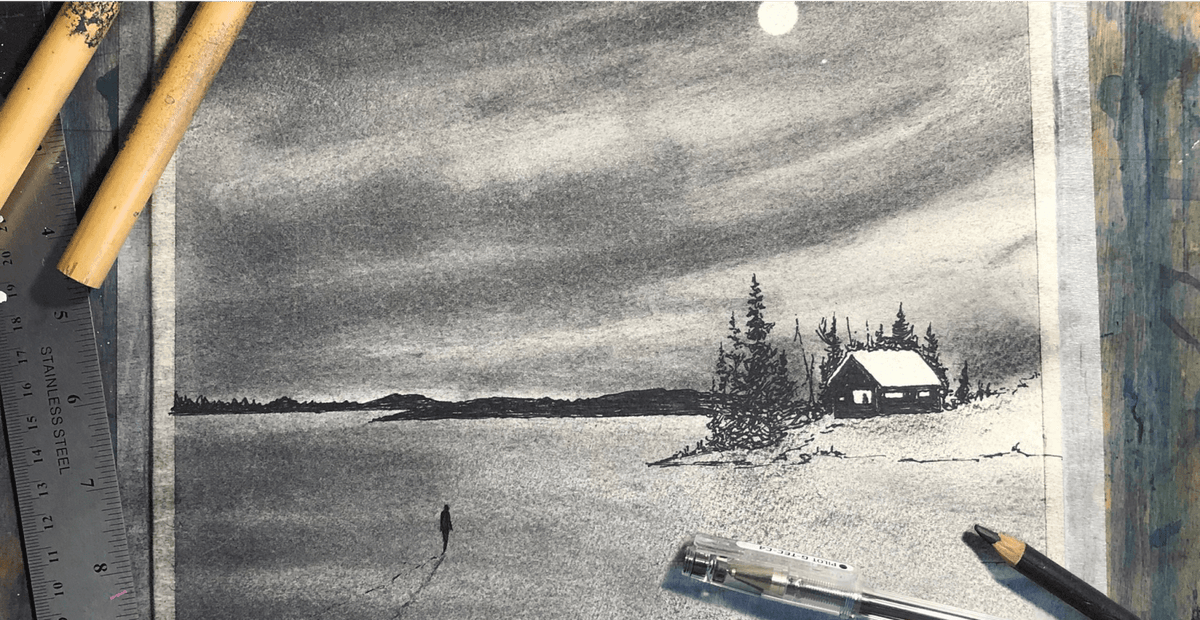
Is it possible to be friends with someone who believes differently than you do? Short answer? Yes. I think a lot of people from my old church could use this reminder. Lisa and I lost everything when we left the church. We lost our friends. They couldn't see that, even though our beliefs were different from theirs, we could still be friends. I have loved and been loved by people who believe very differently than I do. It's because we put our humanity before our beliefs. We prioritize love over ideas. In fact, if we were identical, where's the fun in that? Difference creates diversity, and this creates polarity, which in turn creates energy, which can create a dynamic relationship. Lisa and I don't even believe the same things in the same way. Yet our relationship has lasted years and continues to deepen. That's because we respect one another, trust one another with our own spiritual journeys, give space for each other to be our most authentic selves, and honor one another's paths. (This is my charcoal drawing titled We Can Still Be Friends. It's available as a print on my website HERE.) There's this idea that is growing out there that unless we are all identical in every way, we cannot get along and cannot live together. It's turning the world into a divisive and unhappy place. Homogeneity is boring. But diversity is a more accurate expression of the complexity and mystery of life. Rather than trying to force everything into one tiny little idealogical box, we want to celebrate life in all its wondrous diversity. It's not only possible to love someone different than you. It's also necessary. And also more joyful!
Read more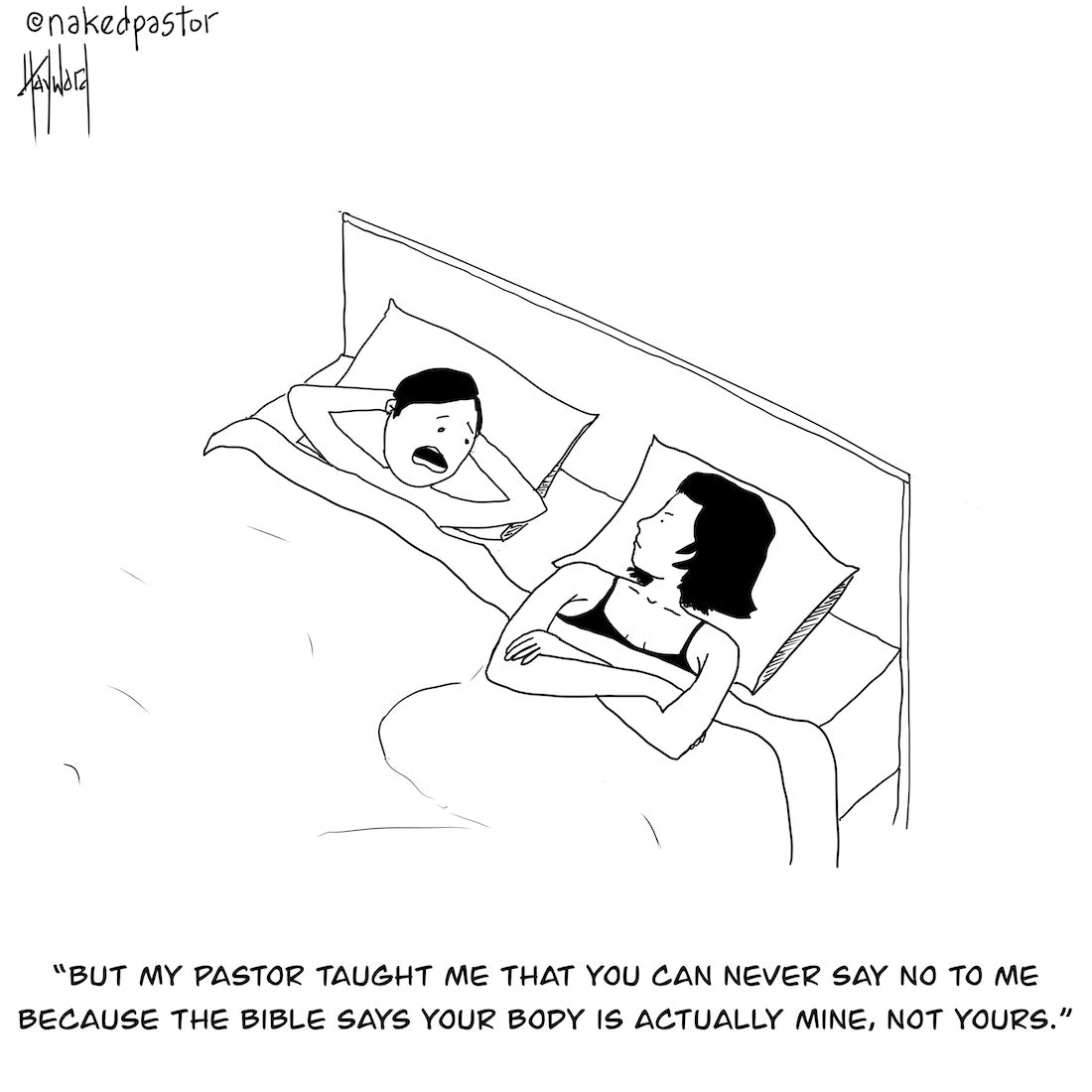
Love, Desire, and Consent: Rethinking Purity Culture Narratives
You Can Never Say No I hope this isn’t too triggering for some of you. But I bet it might be because this theology is so prevalent in the church. It is in society too where men just think it is their right to take a woman’s body. Religion and purity culture takes this patriarchal, male-dominant idea to a whole new level by weaponizing scripture, theology, and spiritual authority to govern and afflict women. (Download a digital copy of this cartoon by clicking on the image or HERE.) This man is in for an important lesson. And it is this: This woman has autonomy over her body, she knows it, and she won’t surrender it. I’ll be honest with you guys. I grew up with this theology that our bodies are not our own. But the thing is, I never saw this… ever… in all my decades in the church and in the ministry… I never saw this used against men. It was always used against women. Basically, it is used to pressure and even force wives to have sex when they didn’t want to. And we all know what sex without consent is. I learned this lesson very early in our marriage. But the lesson wasn’t I had to resentfully wait until Lisa wanted it. It’s deeper and more important than that. What I learned was there is context that we both need to work on. Context like trust, vulnerability, health, mood, communication, connection, intimacy, flirting and wooing, knowledge, practice, experimenting, learning, discovering. All that and more! Sure, there were plenty of what we called quickies. But they too happened against the backdrop of love and all the context I mentioned above. Never a demand. Never a requirement.Never nonconsensual. Drawn together by love and desire is where it’s at. This takes work.My observation: Too many men aren’t willing to do the work. But like most good work, it bears good fruit, and fruit that will last. I know!
Read more
Why Purity Culture's Number One Tool is Fear
How many of you have heard this one? I call this purity culture cartoon, The Spirits of Past Relationships. Purity culture's number one tool is fear. Purity Culture wants you to be afraid to think, feel, or do anything to spoil your virginity for your wedding night. It is claimed, and I believe it, that this is especially targeted to women. Purity culture is a patriarchal endeavor to produce and provide virgins for its men. I was told, when I was young, that if you masturbated, hair would grow on the palms of your hands. Stupid. But it made me afraid because I didn't want hair on my palms, but mostly I wouldn't want others to see it and know what was going on. How many fear tactics were used on you to maintain your "Purity"? Were you told you were like ABC gum (Already Been Chewed) if you were physical with anyone before you were married? Were you told that every time you were physical with someone, it took a little more out of your "account" so that on your wedding night you wouldn't be able to operate at full capacity? Were you told that every time you were physical before marriage it let a little more demons in? Or, like this cartoon, were you told that every single person you were ever physical with, you carried their spirit with you for the rest of your life, even into the bedroom? That is a fear tactic meant to control you. Plain and simple. Before you can can start to heal from purity culture is to identify the messages you were told and how they continue to impact you Related Purity Culture Resources 5 Ways Puriture Culture Can Affect Your Sex LifeHow Purity Culture Creates A Fear Of Sex
Read more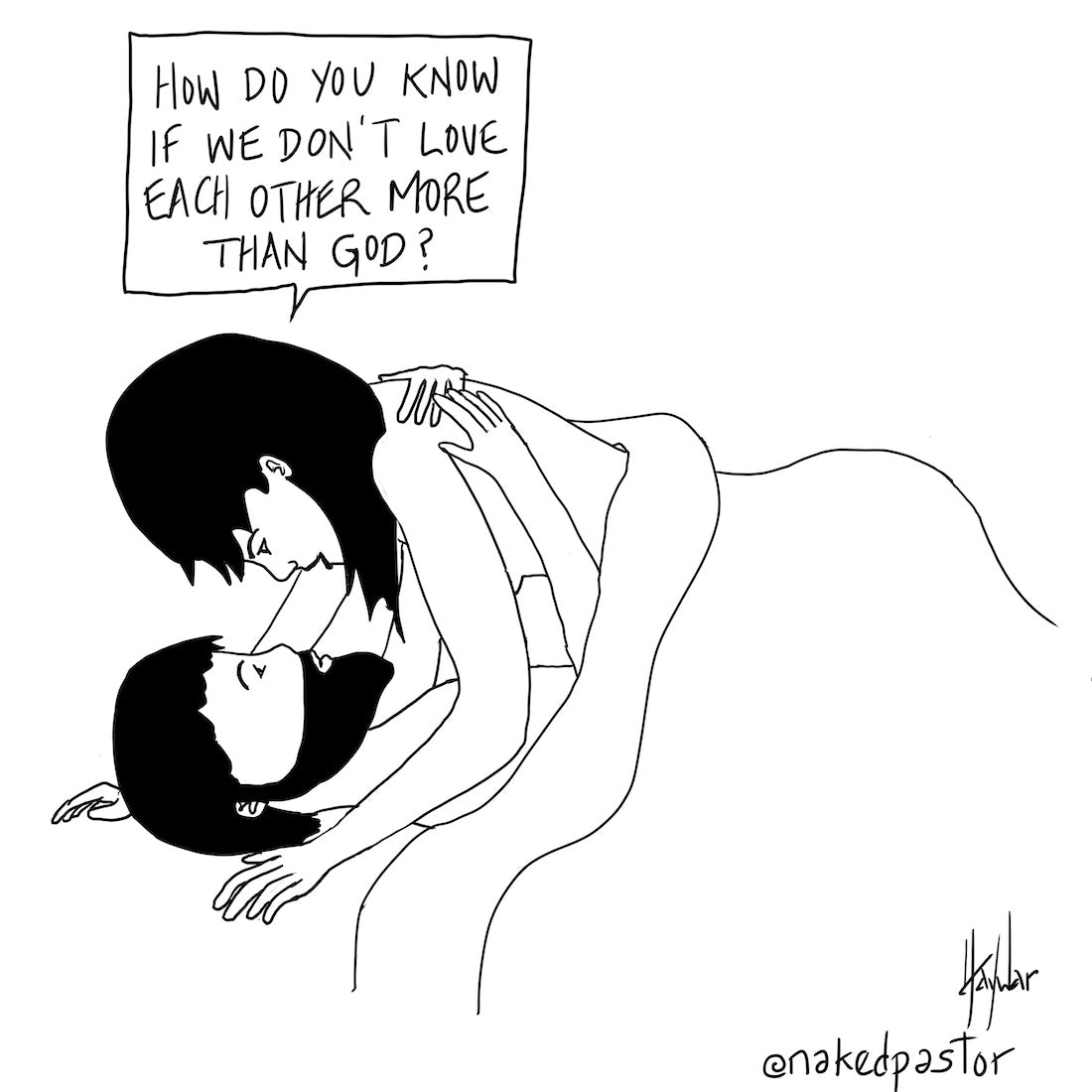
Can You Love Each Other More Than God?
Lisa and I met at a Pentecostal Bible College. We fell madly in love. I was 20 and she was 18. Within a couple of weeks we knew we’d get married. (Click on image or HERE for a digital download!) We found our soul mate. I don’t know if there is such a thing or if it’s necessary. My ideas of romantic relationships and marriage has opened up a lot. So I want to tell you this is my story. Our story. We fell hard for each other. It was magical. Is magical. And the love is very deep and very strong. I believe romantic love is a part of the big “true love”. Not something separate. But I also believe romantic love is a fascinating and complex mix of this true love, but also psychology, projection, fantasy, desire, lust, eroticism, sexuality, intimacy, passion, friendship and polarity, and so much more. I believe that when I found Lisa, I had found the perfect embodiment of my deepest desire, my anima… my female aspect… in real life. And the opposite is true for Lisa with me. How often does this happen? Not very, I don’t think. But how did the Purity Culture we found ourselves in react to it? Yes, I received warnings that I shouldn’t love her more than I loved God. That God is a jealous God and will not be displaced by anyone! I needed to be careful not to allow my love for Lisa dissuade or distract me from my love for Jesus. I needed to make sure I spent at least as much time with the Lord as I did with Lisa. I need to beg God to help me tame my passion and carnality around Lisa. We needed to repent because we love each other too hard. And so on. I didn’t obey. Because, somehow, our passionate love for each other felt a part of the whole of love. It didn’t feel separate or wrong, but part and parcel of the union of all things. We felt that we were, and still are, participating in the bigger picture of universal love, or, as some call it, divine love. Because with love there is no competition or domination. All belongs.
Read more
Are You Ashamed of Your Body and Sex?
There are many ways purity culture can affect your sex life, and one of the most damaging is how it ingrains shame around our bodies and sexuality. 1. The first story in the Bible teaches us that being naked is shameful. When Adam and Eve sinned, they became aware of their nakedness and were ashamed. I was always taught that being naked was a source of embarrassment. How many of us have had dreams where we are naked in a room of people? It’s humiliating. At this point, it isn’t even necessarily about our bodies, but just that we are naked, because just being naked is bad.2. This is further complicated by our culture’s obsession with the shape of our bodies. We are blasted with images of our culture’s idea of a perfect body. If my body doesn’t conform to my culture’s ideal of what a perfect body is, then I’m going to feel embarrassed by it. This dynamic has an enormous impact on our confidence when it comes to getting naked with the one we love and are having sex with. Even in the presence of someone who loves us and who wants to be sexually intimate with us, we are embarrassed that our bodies don’t fit with what we think they desire. We hide ourselves and our bodies from the gaze of our lovers so as not to disappoint them and embarrass ourselves even further.3. Purity Culture has also taught us that sex is dirty, that it is a sinful manifestation of our carnal nature. I was taught that sex didn’t begin until after the Fall, meaning that it was inevitably an expression of our fallenness. We learn that to lose ourselves in sexual passion is an unholy fleshly act. It is a demonstration of our body’s sinful urges, an indication of lust, and a lesser aspect of being human. Holiness and sex can’t be imagined together. Sex is an aberration. It’s something that we do to procreate, not something we do for pleasure, intimacy, and connection alone.Doing it from under the covers and in the light would be a brazen flaunting of lasciviousness and a brazen rejection of our spiritual nature.When in fact it is an embracing of our humanness and our healthy desire to connect with another in a most intimate and vulnerable way.
Read more
5 Ways Religious Trauma Can Affect Your Sexuality (and how to heal)
Many people who attended church for a long time suffer from Religious Trauma. It’s becoming more visible to more and more people as more of us are talking more openly about it. Religious Trauma is often wound up with Purity Culture, which can have a disastrous affect on our attitudes about sex. People who are survivors of Religious Trauma and Purity Culture often struggle to acquire healthy attitudes about sex and feel comfortable with their sex lives. Add to that... if a person suffers these things plus spiritual abuse, there's a lot of healing that needs to happen because these all affect their lives at a deep and fundamental level, including sexually. Here's a couple stuck in a religious mindset caused by Religious Trauma. (Click on this image for a digital download, or click HERE!) 5 Ways Religious Trauma Can Affect Your Sexuality Religious Trauma makes us feel guilty for enjoying our bodies. Christianity, like many religions, castes our bodies and the flesh in a bad light. I was taught that my body was my enemy and something I always had to deny and beat into submission. I had to crucify it daily. The affect this had on my attitudes about sex was that I felt guilt any time I was enjoying my body or being in my body. For some people it’s even worse: they can never have any pleasure because it’s blatantly sinful, goes against scripture, and displeases God. Religious Trauma makes us feel like we’ve got our priorities wrong. For those of us who grew up in intense religious environments, the goal was to always be thinking about God and spiritual matters. Our minds had to be first and foremost stayed upon God, and to allow anything else to creep in was to allow something else to dethrone God from our minds and lives. We could never, to use an analogy, take a vacation and just enjoy ourselves because we were to be “on” 24/7. Even in our sleep, we had to pray for protection so that we wouldn’t stray from this strict path. As a result, when some people are enjoying sex, there can be a deep sense of putting something ahead of God that may anger him, or at least disappoint him. Religious Trauma makes us feel insecure about being confident about our sexuality. Religious Trauma teaches us not to trust our bodies. This is deadly for good sex. One of the most important things for a good sexual relationship is confidence. For sex to be fulfilling for each partner, each one must feel confident in their bodies and have some confidence in knowing or discovering what is pleasurable for their partner. Insecurity and a lack of confidence can kill passion and eliminate a feeling of joy and fulfillment. Religious Trauma makes us second guess enjoying our bodies as not spiritual enough. Religion dichotomizes the world. There’s good and evil, invisible and visible, light and dark, spirit and flesh. And these are always at war with one another. As a result, for many people coming out of a strict religion, when we are making love with someone we love, there is confusion about what’s happening. If their minds are on their body and their loved one’s body and the love and passion taking place, it can feel less than spiritual and therefore, somehow, even sinful, secular, fleshly, or worldly. We can heal ourselves from Religious Trauma. We can educate ourselves by giving ourselves therapy and going to get therapy. We can come to a place where we understand that our bodies aren’t evil, aren’t our enemies, aren’t less than spirit, and not unimportant. When we realize our bodies are good and to be dignified and enjoyed, we are on our way to healing and healthy attitudes about sex and on to enjoying healthy sex lives.
Read more
Understanding The Loneliness Associated with Being Authentic
No one warned me how lonely freedom and authenticity that came with my deconstruction process could be. In Moorjani’s book “Dying to be Me” she shares a near death experience that changed her. Maybe you experienced a near death experience in your spiritual life that changed you. I call it deconstruction… when we see the light and come back different. A big change in Moorjani’s life is that she’s lonelier than before her experience: “… although I have made some new friends… I seem to have difficulty reconnecting with many of my old ones. I’m not as social as I was in the past, and I don’t enjoy the same things. I had a lot of friends before, but now I only let a very, very few people into my private life, many of whom I met through an NDE group over the last few years… “I’m also still devoted to my immediate family members– my husband, mother, and brother. They were with me right through my crisis and my hours of need, and I feel very attached to them. It’s become difficult for me to feel that close to others. “It’s not that I try to be a loner…” Because she’s fearlessly herself, there are few who understand her. Can you relate to this? I can. Have you lost that connection with some friends and family because they do not understand you anymore? Your loneliness is often the consequence of being authentic and true to yourself. There are only a few who get you, who are welcomed into your inner life because they don’t constantly judge you. You can relax with them. Your previous self died and you came back different and now you can make new friends who’ve had a similar experience. Like me! Much love my friends!
Read more
An Ultimate Guide To Spiritual Independence
The first time I mentioned the idea of spiritual independence, I received quite a backlash from some of my readers. People preferred that I had said "interdependence" because we shouldn’t be alone. But independence doesn’t mean being alone. I can be independent while interdependent with another. In fact, healthy interdependence depends on healthy independence. The Different Reactions to My Call for Spiritual Independence One was that Christians are supposed to be in fellowship and not alone. Another reaction was that it is spiritually healthy and necessary to be in submission to someone in authority for guidance. Yet another one was that we all need to be accountable to someone. I believe these are all misunderstandings of spiritual independence. So I will address each one. Does Spiritual Independence Mean Being Alone? “Christians are supposed to be in fellowship and not alone.” We should not confuse independence with loneliness. They are two different things. Yes, it’s possible to be independent and alone. But it’s not necessary. For example, every country wants to be independent. But this does not mean it wants to be isolated. It wants to be autonomous, self-directing, and free, but it also wants to decide which countries to enter into a relationship with. It’s the same for you and for me. I want to be independent, autonomous, self-directing and free. However, I also want to decide who to be in a relationship with. No, I don’t want to be alone. But I’m willing to be if that’s the only way I can be independent. Do We Really Need to be in Submission to a Spiritual Authority? It is spiritually healthy and necessary to be in submission to someone in authority for guidance.” I do not disagree with this. But, we have to be very careful with what we mean by this. I’ve believed in spiritual independence for a long time. I’ve also put myself in submission to spiritual directors, guides, and coaches. But that’s the key: I put myself there. I chose them, and they decided to agree to help me. I insist that we should be able to choose who to receive our guidance from. Of course, when we are young in life and in our spirituality, it’s wise to listen to those who are in authority over us and to take good advice from trusted people. But they should be training us to learn how to choose for ourselves. Parents should teach children to be able to live without them. The best teachers are those who don’t teach their students a bunch of facts, but teach them how to study for themselves. Similarly, spiritual leaders should teach their people to be able to be spiritually healthy without them as well. Does Being Spiritually Independent Mean Not Being Responsible? “We all need to be accountable to someone.” When I first left the ministry and the church as a faithfully attending member, many people expressed their concern that I was no longer under an umbrella of protection or under the shepherding of a pastor or under a spiritual covering. They feared I was now vulnerable to demonic attack, error, and apostasy. Having been a pastor who hung out with other pastors for decades, I knew these ideas are carefully manicured and published by those in authority to fence the flock into the fold with fear. I agree that it’s true that when we are young in life or immature in our spirituality, we should willingly learn from those more mature. But you have the right to make yourself accountable to someone if you want to, and it’s your choice who that can be. To go out on your own is only dangerous if you’re not prepared for it. Preparing for independence is normal and healthy.When we talk about independence, we usually mean these things When we talk about independence, this is what we mean: free from outside control not dependent on another’s authority self-governing not dependent on another for subsistence free-standing We should agree that every person should aspire to this independence. We should also agree that every parent, teacher, and spiritual leader should aspire to guide their children, their students, and their people to this same independence. We can be the captains of our own ships, the masters of our own destiny, and the authorities over our own lives. This leads us to another reaction I often receive when I talk about spiritual independence. This one is important. Some people say that they prefer to be interdependent rather than independent. We Shouldn't Confuse Independence with Interdependence Independence and interdependence are two different things. They are related but mutually exclusive. You can’t be healthily interdependent unless you are first healthily independent. Yes, you can be independent while interdependent with others. A healthy person is able to move into an interdependent relationship without losing their independence. I use the relationship Lisa and I have as an example. We’ve been married for years. We have a healthy relationship. We’ve worked hard for it. It’s not easy, but the rewards make it worth it. It has required a ton of personal growth for each of us, as well as a ton of growth in how to form healthy relationships. We had to learn how to be independent adults who choose to love each other. I have to be healthy as an individual. Lisa has to be healthy as an individual. When these two healthy individuals choose to interrelate, then, it is functional and healthy, rather than toxic, codependent, and dysfunctional. We choose to be interdependent. There are different kinds of dependencies: There’s dependence. There’s codependence. There’s independence. There’s interdependence. I think it is healthy to move through these different kinds of dependencies. What is Dependence? We all start as children dependent upon our caregivers. This is not only natural, but necessary. But we gradually learn how to fend for ourselves as we are cared for. We grow up, hopefully under the wise and gentle oversight of those who care for us. But we shouldn’t stay there. (Unless we aren’t able.) What is Codependence? “Codependency is a relationship imbalance where one person enables another person’s addiction, poor mental health, immaturity, irresponsibility, or under-achievement. Among the core characteristics of codependency is an excessive reliance on other people for approval and a sense of identity.” (Wikipedia) This can start at a very early age. But unfortunately it can continue on into adulthood. Many parents have a codependent relationship with each other as well as with their children, and vice versa. If the children are raised well though, they learn self-confidence, autonomy, and their own healthy sense of identity. They can pass through or even avoid codependence and move on to the next stage. What is Independence? Independence is as mentioned previously. It means that you are free from outside control, that you are self-governing, that you are not dependent on another’s authority, and that you are not dependent on another for subsistence. Of course, we all should aspire to this. As codependence is closely related to dependence, so is independence closely related to interdependence. What is Interdependence? Healthy interdependent relationships depend on healthy independent individuals. This is as true in a church as it is true in a marriage. The first spiritual director I ever had was the best I ever had. I sought one out and found Sister Marie, an Abbess of a monastery who was willing to meet with me once a week. We met for two years. The reason why she was the best was because even though I willingly submitted myself to her spiritual direction, she taught me how to become spiritually independent. She taught me how to think for myself, make decisions for myself, and decide for myself how I wanted to be spiritual. Even though she suggested what I should read, how I could meditate, who to study and contemplate, and how to be spiritual, at every moment I was free to walk away or free to accept her guidance and obey it or free to say that particular suggestion wasn’t for me. I remember one day, with deep exasperation, I said to her, “I feel like such a stick in the mud!” She gently responded, “What does it feel like to be a stick in the mud?” No judgment.No need to harness me into her spiritual style.No obsession with aligning me with her idea of perfection or progress. For her, what was most important and what she respected most was my autonomy and my ability to explore and find my own way to be spiritual. Actually, what I mean is she encouraged me to find my own way to be me! I did find it. I’m still finding it. And I’m living my own life now. I’m also free to choose who I am in a relationship with, how to recognize unhealthy relationships and how to form and nurture healthy ones. I’m able to decide how to be spiritual not only for myself, but for those I choose to be interdependent with. This is healthy. This is what I mean by spiritual independence.
Read more
Social Media vs Reality: Can you really know me if I'm still getting to know myself?
I love the internet and social media. But it can be tricky. Our personal social media can give the impression that we've got it all together and life is all unicorns and rainbows.Our posts are like, literally, snapshots of our lives and we get to choose which one you see at any given moment. So, even though I post several times a day and I hear from some people that I seem like I've got my life all figured out, I want to assure you I don't. I talk about mystery a lot, and my life is just as full of it as yours, and sometimes it's hard to live with. One of the things I struggle with is a kind of imposter syndrome. I can't believe I'm actually making a living with my cartoons, books, art, and speaking. On the one hand, I know how hard I work. But on the other hand, I know that I am very fortunate and feel very lucky and sometimes even undeserving for being here.I'm not sure if I'm afraid of failure or success. I think about this a lot.We all have work to do. Personal work. You have yours. And I know I have mine. But that's why I call myself the NakedPastor. What you're going to find here is not someone who has it all together and is going to tell you how to do it. Instead, you're going to find someone being raw, honest, transparent, and vulnerable about his own journey. I think maybe it might inspire you to be your own authentic self too. Thanks for listening.
Read more