The Naked Journal
Thoughts, musings, and meanings behind NakedPastor Art.
The Naked Journal


The Journey Of Healing Trauma and Embracing Wholeness
Let me try to explain these cartoons because I think it’s important. Concepts like this are crucial for your spiritual health and growth! Victor Frankl said, “Between stimulus and response there is a space. In that space is our power to choose our response. In our response lies our growth and our freedom.” I’ve also been reading Mattieu Ricard, considered the happiest man on earth. Through reading about him I discovered that he, through meditation, etc., trained himself to collapse this space between stimulus and response so that even auto-responses, like squinting the eyes at a loud noise, are controlled. It’s not that there isn’t a response, it’s that the space between stimulus and response collapses to almost imperceptibility. I think this is where love is, true love. I’m reminded of an ancient Tibetan monk who had many disciples. His son died, and he went into a cave to mourn. He didn’t come out for many weeks. His disciples were perplexed and challenged their master: “You taught us that all suffering is an illusion, yet you mourned for so long! Why?” He responded, “Because this illusion was very convincing.” I love is vulnerability, authenticity, and honesty! Sometimes collapsing that space, as well as integrating what we think or feel happened, takes what we perceive as time. (Click on the cartoon for a digital download of it!) This also relates to theories about time… that it is not real, but a human construct to help us cope with our experience of reality. One idea is that time is simply a series of nows. A series of nows, linked, we perceive as linear time. But the fullness of time is now. Now. Now. Forever, the space between nows, perceptibly collapsed, is all now. There is no past because it doesn’t exist now. There is no future because it doesn’t exist now either. Infinity is fully present now. So, the narrative may go like this: we feel we are not broken. But then we experience trauma, even trauma caused by spiritual abuse. Then we heal. Then we are back to the feeling of not broken. Our ability to collapse this space between feeling not broken to feeling not broken is an important process to learn, otherwise we get stuck in this in-betweenness of not feeling whole. I use the word “feeling” on purpose because I truly believe we are not broken, but we can certainly feel it when we are traumatized. I think this traumatization is a fluctuation in our mental state that can be temporary. Like Sinéad O’Connor’s therapist told her; the reason you go to therapy is to find out there’s nothing wrong with you. Sure, there's a ton of work that occurs in this space. Research. Writing. Theorizing. Therapy. Self-awareness. And so on. All to build or believe a narrative that makes sense to us of how we got from point A… not broken, to point B… not broken… but with an impressive in-between experience that seems to challenge this not-brokenness. What about all those feelings of loss, suffering, pain, struggle, alienation, grief, all of that, and feeling broken? So we build or believe a narrative that helps us make sense of it all. We choose a narrative that works. This is why I think collapsing that space is crucial to a speedy feeling of recovery, of not-brokenness. (Click on image or here for a digital download.) This reminds me of another story. In the film The Last Samurai, there is a Samurai lord who has spent his whole life searching for the perfect cherry blossom. Without success. (Spoiler alert!) On his last day, dying on the battlefield, a wind picks up and blows thousands of cherry blossoms across the field. Some land in his hand, and he says, “Perfect! They are all perfect!” I knew this to be true. But how did he get from point A… a beautiful cherry blossom is just a beautiful cherry blossom, to searching for the perfect one… to point B… all cherry blossoms are beautiful cherry blossoms? Because he finally knew that they are all perfect. Stay with me. I’m going somewhere with this that relates to the cartoon communicating that you’re not broken. This is how I view all salvation narratives. Yes, all of them! They are all attempts to explain what we think happens in the in-between of perfection and perfection that we call our life experience and all of history. Let’s take the Christian one, which is the one I grew up with. The narrative goes something like this: We start in the Garden whole. Then we fall. Then we are rescued, repaired, and reconciled. Then we are whole again! From not broken to not broken. This is the Christian salvation narrative. The collapsed version. What about all that happened and happens in between… all those feelings of temptations, sin, rejected by God, alienated from God, fear of punishment, enmity between people? All the Christian narratives attempt to do just this, all in their own unique ways. But the collapsed version of this is very simple… not broken to not broken. The space in between these two realties that are really one reality, is where the narrative tries to make sense of it. The seemingly long salvation narrative, collapsed into imperceptibly, collapsed into one now, is that we are not broken. I listened to Gabor Maté on a video where he says, “So healing is actually recognizing our wholeness… and when we do, and realize that nothing was ever broken, and that if nothing was ever broken, therefore there was nothing ever bad that ever happened to us… If our wholeness was never destroyed then there was no damage. And if there was no damage, then there’s no sinners, there’s no perpetrators.” (@raisethevibration on Tiktok). So my claim is that our salvation narratives as well as our therapy narratives are our ways of coming to this understanding of our wholeness, our unbrokenness. You are not broken. This is good self-love. Two disclaimers: This isn’t to devalue the narratives we construct to explain our pain, or the narratives we construct to explain our spiritual struggle. We value them. But we can learn to collapse them into imperceptibility. This also isn’t to assume that what I just wrote isn’t just another narrative I built and believe to attempt to explain something I think is true. Related Blog Posts The Healing Power of Acknowledging Spiritual HurtWhy We Need Companionship During Difficult Times
Read more
3 Drawings that Capture the Beauty of Vulnerability
To live in the present moment with authenticity takes courage, no matter who you are. There’s an art to being vulnerable. I’ve talked before about how powerful vulnerability is and the importance of it but it's also something I focus on in my art. Here are 3 of my favorite drawings that capture the beauty of vulnerability. Sophia Vulnerable (Click on the image to see the print, or click HERE!) One stage in the transformation process that we can’t skip is vulnerability. In this Sophia piece, I wanted to show her vulnerability more graphically. As she sits next to a baby seal, one of the most vulnerable animals on the planet, she is naked, exposed and vulnerable. They are both in that space, together. But there is also something very strong and courageous about her. Mysteriously, her vulnerability and her strength aren't mutually exclusive. She's beginning to learn to combine these two and embrace them both. Sophia teaches us that, usually, we have to bare it all in order to repair it all.Here’s to your vulnerability and strength. Sophia Metamorphosis (Click on the image to see the print, or click here!) I always come back to Sophia Metamorphosis because it speaks to so many truths about our lives. We are vulnerable when we transform. Surrounded by beautiful possibilities but still vulnerable. Some people never step out of their cocoon. Going into a new phase of your life means new possibilities AND new vulnerabilities. I say that we take that combination and give every new phase of our transformation our best shot. Nothing beautiful came from staying in our dark, cozy cocoons. Sophia Wild (Click on the image to see the print or click HERE!) Sophia Wild is about being your most authentic self, even when it feels scary. There’s a real risk in exposure. Emotional exposure and physical exposure to new situations, people and feelings.This is a reminder that you can be rooted in your power, even when you feel like there is nothing between you and the elements.
Read more
What Is Spiritual Bypassing? (And How To Heal From It)
What Is Spiritual Bypassing? Spiritual bypassing was coined by John Welwood to describe a process he saw happening in the Buddhist community he was in. So, yes, spiritual bypassing happens in all kinds of spiritual contexts not just religious ones or Christian ones. It is now a commonly used term that describes attempts to use spirituality and spiritual practices to avoid facing and dealing with unpleasant emotions, experiences, and realities in order to feel good and avoid discomfort and painful truths. Although spiritual bypassing can be tempting it's important to know it doesn't work. Over the years many experts have added to the conversation on spiritual bypassing. Psychologist Ingrid Clayton highlights that spiritual bypassing is like a sneaky way our minds protect us. She explains, "It's a bit like putting up a barrier to avoid facing reality, shutting off our emotions, and avoiding the bigger picture. It's more about escaping than facing things head-on, and the difference is so small that we usually don't even realize we're doing it." It's important to note that spiritual bypassing is not limited to any particular community; rather, it can manifest wherever there's an emphasis on spiritual advancement without addressing the complexities of human experience. Examples Of Spiritual Bypassing I’m Not Lonely. I Have Jesus. Pray Your Depression Away Everything Happens For A Reason I'm Just Being in the Present Moment I'm Focusing on the Light, Ignoring the Darkness Why Spiritual Bypassing Is So Tempting Spiritual Bypassing is tempting because it seems like an easy way to escape from pain. But bypassing your emotions will never work. Experiencing our emotions and vulnerability is a fundamental part of our human experience. Using spiritual bypassing is just a way of kicking the can down the road. How To Heal From Spiritual Bypassing Recovering from spiritual bypassing can vary greatly from person to person, depending on the specific kind of spiritual bypassing they went through and how deeply it affected them. For those in religious groups who have suffered years of spiritual abuse., they might find themselves struggling to heal from religious trauma. The work of overcoming this takes time and will look different than those who experienced spiritual bypassing in yoga and mindfulness circles or toxic self-help movements. Every flavour deserves focused attention to heal.Here are a 3 ways to heal and confront your experience with spiritual bypassing regardless of the community you've experienced it in. Admit That You Have Suffered From Spiritual Bypassing. Just as with healing from spiritual abuse, admitting that it happened is the first step to recovery. Don’t deny or minimize or dismiss it. You must acknowledge that it happened and the effect it had on you. Avoid labeling emotions as good or bad. Understand that emotions arise naturally and aren't inherently labeled as positive or negative. Permit yourself to experience them without passing judgment, acknowledging that every emotion holds important insights into your inner condition. Be Kind To Yourself. When faced with an undesired feeling, your initial reaction might be self-criticism or avoidance. However, neither approach is effective. Instead, try to offer kindness to yourself for experiencing this emotion. Understand that it likely has a purpose. That purpose is for your healing and wholeness. Start A Journal. Socrates said it well in saying, "The unexamined life is not worth living". Journaling is a great tool for self-Awareness. In journaling you will learn that you are a very complex person, deep and wise in your way, and even more compassionate because you are aware… aware of your surroundings and yourself. (Me writing in my journal.) Related Resources on Healing Why Is It Important To Be Vulnerable?The Power of Vulnerability for Healing Religious TraumaHealing From Religious TraumaInner Child Healing After Deconstruction
Read more
3 Reasons We Hide Our Light: Religious Trauma & Self Worth
I’m observing an online friend of mine who is enjoying some success in her life. She’s truly amazing, and it’s fun to watch her enjoy her amazingness being appreciated. I’m thinking, “Girl, you have no idea how amazing you are! You just wait!” Marianne Williamson has said, “Our deepest fear is not that we are inadequate. Our deepest fear is that we are powerful beyond measure. It is our light, not our darkness that most frightens us. We ask ourselves, 'Who am I to be brilliant, gorgeous, talented, fabulous?’” I exactly know this feeling. And even though the sayings of Jesus often get turned into evangelistic propaganda, such sayings as, “Don’t hide your light under a bushel” or “A city set on a hill cannot be hidden”… are powerful messages to our selves and how we can live courageously, authentically, and openly. Like my cartoon illustrates, we only reveal a tiny bit of ourselves. As amazing as we are, we dare expose only a fraction of our amazing selves. Why is that? I think about this a lot. 3 reasons why I think we hide our light: We Don’t Even Think We're Amazing Socrates said the unexamined life is not worth living. I see it all the time… when we start examining our lives, we discover an infinite universe of who we are. So many people I know have no idea how amazing they are. To be honest, I’ve come to conclude that I am far more amazing than I already think I am. That’s funny to say, and sounds egotistical, but it’s true! I know I have some amazing qualities and can do amazing things. I admit that. I own it. I embrace it. But I know enough about human nature that there is unfathomable amazingness waiting for me to discover and uncover and reveal to you. And I already know this is one hundred percent true about you too! The Church Taught Us Not to Appear Proud I had a friend who was a carpenter. He did excellent work and was in high demand. He did very well financially. So he bought a nice pickup truck fully loaded. Beautiful! But the response from the locals was like, “Look at that guy! Who does he think he is? Some kind of big shot!” You know what I’m talking about. I was always instructed to keep my head down unless I wanted it shot off. Society is a powerful levelling force that we all obey for fear of being singled out, ridiculed, and rejected. We don’t want people to think we are proud, arrogant, and haughty. We know we are good at what we do, but we are afraid to say so because we’ll quickly be put in our place. We Don’t Want to Admit to Ourselves How Amazing We Are This is the hardest one to grasp. From childhood I was taught to be humble and not proud. Even to admit, “I’m good at this!” was a no-no. My biggest revelation that this dynamic was at play in my life was illustrated best in my Sophia drawing Angel. She realizes she is amazing, but is embarrassed to admit it. Do you know this feeling… where you suddenly realize you are beautiful, you are talented, you are wise, you are whatever… and you’re almost ashamed of it? I sure do! It’s too bad we do this to ourselves because ultimately, we aren’t just creating a barrier between ourselves and our Selves, but also between ourselves and others. Yes, we need ourselves as we are in all our fulness, but they need us too… in all our fullness. Disregard the Attempts of Others to Dull Our Shine There are too many of us who make ourselves small. We shrink to fit into the shadows of others. Especially when healing from religious trauma. I hope you put yourself first and work on your spiritual healing. And, if you're in need of some vulnerability art, you know where to find me! Own your light and let it shine!
Read more
3 Reasons You Should Start Journaling
"The unexamined life is not worth living" (Socrates). Journaling helps me examine my life and provides a peaceful daily ritual for me. In this blog, I’m going to tell you about why I journal and three reasons why you should journal too. But first, a couple of side notes: First, we can all agree that faithfully writing in a journal can make one a better writer, a better storyteller, and a better thinker. Second, what style of journal you write in is your preference. I've come to learn that my favorite journal is the Moleskin-lined one. I love them. They are attractive, well-made, and durable. Okay. Preliminaries out of the way. Here’s what made me pick up a notebook and pen, to begin with. Why I Started Journaling The reason I started journaling was because Thomas Merton did. He was a Trappist monk famous for his published journals, all of which I have in my library. I aspired to be like Merton not only because he changed my life through his spiritual writing but because, for me and many others, he exemplifies the height of human spiritual progress. Now, let’s get to the benefits that I think are the most important. 1. A Preserver of Memory One of the basic benefits of keeping a journal is that you are documenting your life. I have journals that go way back to 1987. They all fill a couple of huge boxes. I can go back and read about what was happening and how I was experiencing and processing it decades ago. For example, I can go back to the day of my ordination into the Christian ministry – that’s the first entry – or I could read about the days our three kids were born. Or when Lisa and I went on a certain vacation. Or when a certain tragedy happened. I can relive every one of these moments again and again. I can also go back to the notes I’ve taken from books I’ve read. When I read a book, if I come across a really good line or section, I record it in my journal. I may also add my thoughts. This has become very useful so many times in my life. Sometimes I think to myself… just imagine if you entered all this into a software program. I could search for quotes, moments, and memories. Or maybe even publish the best bits of my notebooks as an autobiography! When you record your life in a notebook, you are creating an actual document of your life. 2. A Tracker of Progress If you are interested in your personal growth, then journaling is a necessary exercise. I can read back years ago in my spiritual life and see where I was and where I am now. The funny thing is, most often, I have the shocking realization that I haven’t changed that much. I’m still basically the same guy! On the other hand, I can see some kind of progress, development, or growth. I’m not sure what to call it now because I’ve concluded that growth isn’t linear or in stages. I believe growth is spatial in that we expand to become larger in spirit. Therefore, we do not reject our former selves or lives or even our darkness, our shadows. Somehow, in healthy growth, all that has gone before or all that is uncovered gets folded in to integrate with who we are becoming… our most authentic selves. I wouldn’t have come to this realization if I hadn’t journaled. This leads me to my next point. 3. A Tool for Self-Awareness This is the most important fruit that journaling bears. As I noted above, I wouldn’t have realized how personal and spiritual growth works if it wasn’t for journaling. So, instead of me naïvely and proudly thinking that I have somehow made significant progress and become someone different, a new and improved me, I can see that, on a more complex level, I have become a little deeper and, therefore, wiser. I’ve become a little stretched and, therefore, more spacious and a little more empathetic and compassionate. Do you see? You will learn, through journaling, that you are the main character in your story. And as good main characters demonstrate, you will learn that you are a very complex person, deep and wise in your way, and even more compassionate because you are aware… aware of your surroundings and yourself. (Click on the cartoon for a digital download or click HERE!) Those are the three reasons I think you should start journaling: to preserve your memories, to track your progress, and to become more self-aware. I hope that journaling gives you everything you need to examine and then embrace the life ahead of and behind you. Do you journal already? I would love to know if it’s helped you. If not, when are you going to start?
Read more
Why You Need Nature in your Creative Process
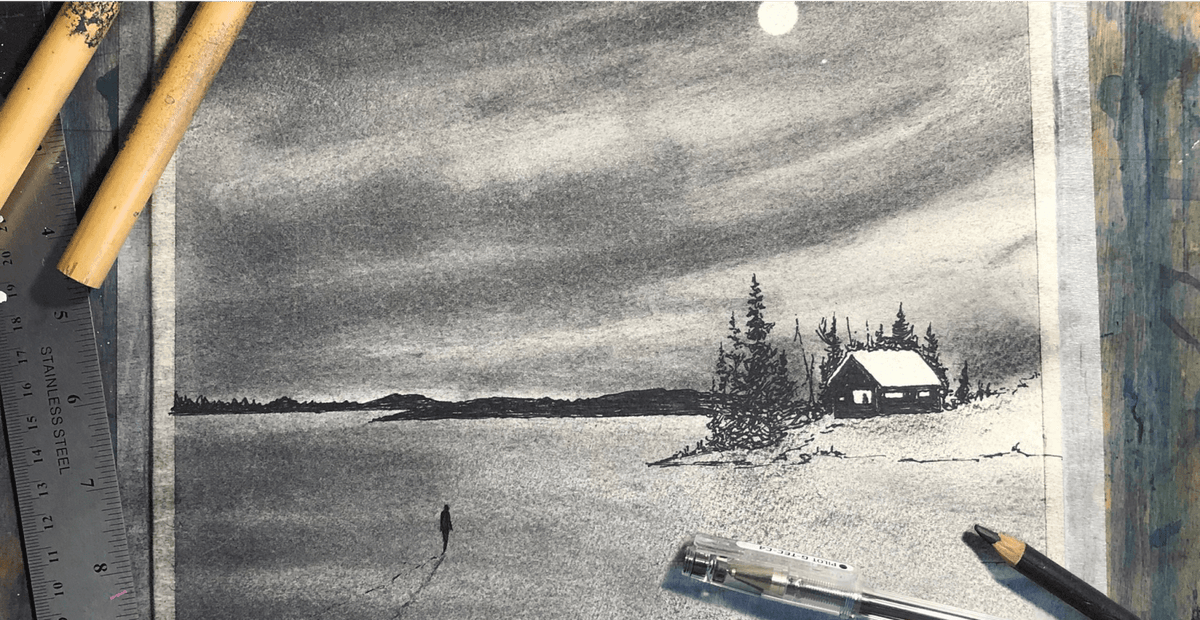
These trees near my home are the inspiration behind many of my tree-themed artworks. I love how they reach proudly to the sky and, no matter the weather or the mood, they are always there and (hopefully) will be there for a long time. My surroundings in Canada have helped me learn mindfulness, inner peace, and the importance of becoming one with nature and the world around me. I want these artworks to help you by showing the beautiful solitude you’ll find on the journey towards personal freedom. Some people find it hard to believe that the person who draws the controversial NakedPastor cartoons is the same person who creates these contemplative paintings and charcoal drawings. But they are all an expression of my passion for personal freedom... mine and yours! My paintings depict what freedom looks and feels like to me. It’s spacious but not empty. Solitude but not lonely. One but one with all things. I try to get into nature daily. It's important to my creative process. This painting above are in my shop. It's titled, All I Need Is A Small Clearing. It's about the certainty that there is always an opening where light and beauty are waiting for you. There will always be stars in the sky and they will never lose their magic. Related Resources
Read more
Social Media vs Reality: Can you really know me if I'm still getting to know myself?
I love the internet and social media. But it can be tricky. Our personal social media can give the impression that we've got it all together and life is all unicorns and rainbows.Our posts are like, literally, snapshots of our lives and we get to choose which one you see at any given moment. So, even though I post several times a day and I hear from some people that I seem like I've got my life all figured out, I want to assure you I don't. I talk about mystery a lot, and my life is just as full of it as yours, and sometimes it's hard to live with. One of the things I struggle with is a kind of imposter syndrome. I can't believe I'm actually making a living with my cartoons, books, art, and speaking. On the one hand, I know how hard I work. But on the other hand, I know that I am very fortunate and feel very lucky and sometimes even undeserving for being here.I'm not sure if I'm afraid of failure or success. I think about this a lot.We all have work to do. Personal work. You have yours. And I know I have mine. But that's why I call myself the NakedPastor. What you're going to find here is not someone who has it all together and is going to tell you how to do it. Instead, you're going to find someone being raw, honest, transparent, and vulnerable about his own journey. I think maybe it might inspire you to be your own authentic self too. Thanks for listening.
Read more
Why Growing Spiritually Can Mean Disappointing People
Why do we struggle with disappointing people? A necessary part of spiritual growth is knowing you will disappoint people. Which means you will fail their expectations. The Church taught me that I should never cause people to stumble. It’s okay to disappoint the world. Just don’t disappoint the Church and those in authority. But that thought invaded every part of my life. I never really disappointed my parents.I never really disappointed the Church.I never disappointed anybody I couldn’t disappoint them. I struggled with the idea of failing anyone, in any small way, even at the cost of myself. I placed everyone first and placed myself last, thinking it was a spiritually sound way of operating. Why is disappointing people important for spiritual growth? I started disappointing others when I was 27. A spiritual crisis changed me. I knew I was going to disappoint their hopes for me. Not because I wanted to, but because I had to take care of myself first. Allowing disappointment in my life also opened the door for me to grow outside of their expectations for me. I committed myself to personal transformation. I stopped disappointing myself rather than others. When you decide to be true to yourself, you’re going to disappoint people, especially the ones who care about you. You must commit to authenticity and the change this requires. Then you must accept that this will disappoint others. Your commitment to yourself may threaten relationships you care about because you’ve let go of the people-pleasing, peace-making side of you. When someone says, “I’m disappointed in you!”, just know it is their problem and they’re trying to make it yours by asking you to fall back in line. They’d rather you do the work to change back than them do the work to change forward. Why can spiritual growth lead to disappointing people? Spiritual growth can mean you grow outside of the boxes people put you in. You change from who they thought you were, or wanted you to be. Their disappointment is based on an illusion anyway. It was not the real you. Their expectations are their hopes and fantasies for you, that they projected. These really have nothing to do with you, but with them. Maybe this will help some of you: in the gospel narratives we see that Jesus made a career of disappointing people. Not because he wanted to but because he had a higher calling than theirs to fulfill for himself. Commit to change. You will disappoint others.But you won’t disappoint yourself. And that's what ultimately matters!
Read more
5 Stages Of Faith Deconstruction
Religious deconstruction is all about taking an honest look at the beliefs, doctrines, and practices you grew up with and breaking them down to see what still makes sense to you. Faith deconstruction is not as uncommon as you would think, although many suppress their changing beliefs or don’t voice them because they are scared of judgment or of losing faith-linked friends, family and community. Why religious deconstruction can feel like death Spiritual beliefs are a fundamental anchor to reality and our perception of the world. So when we shed them, it’s like death. And where there is death, there is grief and, eventually, rebirth. I’ve been through countless ups and downs on my journey toward spiritual freedom and authenticity (you can read how it all started here). To try to help other people who are on this same path, I’ve adopted Kübler-Ross’s 5 stages of grief and applied them to spiritual deconstruction. The Stages of Deconstruction Digital Cartoon Also, I have to tell you that the stages of religious deconstruction are not always linear. And each stage also has mini-stages within it. Life, people, thoughts, and growth are not always neat, tidy, and predictable (which is beautiful, actually). 1. Denial of our doubts In the first stage of religious deconstruction, we try to ignore what is happening. We’ve been faithful believers, and now everything is crumbling. It's like cancer—we can't believe it's real. We may deny that our beliefs are changing, but they are. People often deny their changing beliefs because they don’t want to think about it; it's easier to avoid the discomfort. There's also the fear of being judged by others, especially by family and friends who might not understand. Questions lead to more questions, and that uncertainty can be overwhelming. Plus, many of us were taught that blind faith is the good kind, so admitting doubt feels like a betrayal of everything we've ever known. 2. Anger with ourselves and the church In the second stage of religious deconstruction—anger—we find ourselves furious with the church or with God for not helping us. We feel abandoned and let down by the very institutions and beliefs we once trusted. There's also anger directed inward, as we blame ourselves for not being "good" believers anymore. We thought we were better than this, and backsliding wasn't part of the plan. How could this happen? This frustration stems from a sense of betrayal and confusion, leaving us questioning the very foundations of everything we’ve ever believed..Bargaining We try to figure out another way to be a believer. We might promise God we’ll work harder at being a good Christian if God would just restore our faith. We look for alternatives. Liberal? Agnostic? New Age? We’ll figure out how to fix this! 3. Bargaining with God and trying to fix our faith In the third stage of deconstruction—bargaining—we desperately try to find another way to hold onto our beliefs. We might promise God that we will work harder at being a good Christian if only our faith could be restored. It’s a frantic attempt to regain some sense of control and certainty, as we think, "We’ll figure out how to fix this!" We might even try different versions of Christianity or church or other spiritualities to help us feel like we’re still okay. This stage is filled with negotiations and compromises as we grapple with our guilt for being “a bad Christian” and the loss of our former beliefs. 4. Depression and mourning our loss In the fourth stage of deconstruction—depression—things feel the darkest. This is when we realize we can’t go back and we don’t want to go forward. We’re stuck in a desert of doubt and fear. We face the death of our beliefs and our spiritual life as we knew it. Is this life now? Everything we enjoyed and found comfort in is gone, leaving us to gaze into a bleak future with no appealing options. It's a time of profound sadness and loneliness, as we mourn the loss of our former faith and struggle to find meaning in what comes next. Acceptance of our true beliefs Acceptance is a welcome relief from the struggles of faith deconstruction. We accept our beliefs have changed and our faith is dying or transforming. It’s not giving in to fate, but neither is it necessarily joyful. Just a serene acceptance of what is. This is a transition into a new way of being. Each moment is treasured. It’s a tranquil and wise phase. You face your future with dignity, poise, and a sense of fullness. Deconstruction is not bad. It’s growth into a deeper spirituality and a more beautiful way of living. It’s personal growth. It’s not easy but it is worth it in the end. Going through Christian deconstruction and need some support? It took me years to deconstruct. Like…DECADES. And in that process, I learned a lot. I believe that everyone deserves to deconstruct safely, without judgment, and with as much support as possible, which is why I've decided to share my deconstruction course for free on YouTube. You can watch all the videos now starting with this one. You may also want to join my online community of people experiencing deconstruction too… www.thelastingsupper.com
Read more