The Naked Journal
Thoughts, musings, and meanings behind NakedPastor Art.
The Naked Journal


How the Church Rebrands Spiritual Abuse
No church will admit it is spiritually abusing its people. It's because it doesn't believe it is! ( Here are 10 questions the church can ask to see if it's fostering a culture of spiritual abuse) It does believe in using whatever means necessary to make you the kind of Christian they think you should be though. Here are some ways it renames, or rebrands, what it's doing to make it look acceptable and even necessary: Shaming = ConvictingControlling = MentoringBrainwashing = InstructionGuilt = RepentanceCoercion = PersuasionAbuse = Discipline How Spiritual Abuse Gets Repackaged Rebranding and repackaging is part of a pattern of behavior that shifts responsibility away from the abuser and onto the victim. This isn't isolated to a few churches. The church’s culture often creates an ideal breeding ground for spiritual abuse. Read more here: 10 Reasons Why the Church Is the Perfect Culture For Abuse. Spiritual abuse thrives in environments where authority figures wield unchecked power. When the church rebrands harmful behaviors with euphemisms, it makes it harder for individuals to recognize and resist them. The language becomes a tool of control, camouflaging toxic dynamics as acceptable practices. Hate Can Sound Eloquent It's important to recognize that hate can often be disguised in eloquent language. You can read more about this in my post, Hate Can Sound Eloquent, where I discuss how hate speech is often dressed up in persuasive and emotional words. If you'd like to read more on spiritual abuse I've written this blog post What is Spiritual Abuse? And how to recognize when it is happening to you.
Read more
Do you have a narcissist in your life that you are forced to deal with?
I just finished an excellent book on narcissism by Dr. Ramani Durvasula, It’s Not You: Identifying and Healing from Narcissistic People. It was an urgent read for me because I finally realized that one of my so-called close relationships was probably with a narcissist. Reading this book confirmed it for me. He’s definitely a narcissist. So I wrote a letter to my email subscribers, and I thought I would share it with you now. (Hey... while we're here, sign up for my weekly newsletter!) Here it is: Do you have a narcissist in your life that you are forced to deal with? Suddenly, I do. I mean, I’ve had narcissists in my life many times. Many of them were pastors or abusive spiritual leaders. I learned how to distance myself from them. That was always very painful because they make you pay for that. They say terrible things about you, and they will do terrible things to you to make your life miserable. I’ve experienced that many times. But it wasn’t terribly sad because they didn’t mean that much to me. It hurt. Yes. But I wasn’t sad that they weren’t in my life anymore. I was happy they were gone! Now, though, I have someone in my birth family who is causing “antagonistic relational stress” on a level I’ve never experienced before. It’s mind-blowing. I mean… What do you do if they are in your family, or if they are in your church, or if they are your boss? It’s not that easy to just walk away. Is it? (Get a print of "The Need to Leave" by clicking on the image, or HERE.) I’m experiencing a lot of emotions. Exhaustion. Confusion. Anger. Concern. And sadness. Because I’m going to have to sever all ties to them. It’s interesting how spirituality and deconstruction play into all this. Not all that long ago, I would have felt that it was wrong to sever ties with a family member. Or really anybody. That turn-the-other-cheek theology runs deep so that we feel we need to suffer long… long-suffering… believing that they will change one day. This person’s been bullying me for a couple of years now. But their level of antagonism has reached a feverish pitch and it’s time to cut ties. I used to hope they would see the error of their ways, feel bad about it, and change. But, as Durvasula claims, narcissists don’t change. It’s time to cut ties. I hope there’s peace and quiet on the other side of this. But I have to do what I can to ensure that this is so. Are you dealing with a narcissist right now? Or have you in the past?
Read more
What You Can Expect When You Speak Up Against Spiritual Abuse
I get it every day that I'm negative and must have a root of bitterness. This is just a feeble attempt to shut me up. It's not true. I mean, I am negative against spiritual and church abuse. And there have been times I've been bitter. But I'm not bitter right now. I am vocal. And I will continue to be as long as churches and their authorities continue to abuse their members. I rejoice that there are some communities that are really attempting to gather together in healthy ways. So I just want to encourage you to do what this woman in the cartoon is doing. (Click on image for a digital download, or click HERE!) Stand up! Speak up! Your self-care will inspire others to do the same thing. Resources on Spiritual Abuse Here are a list of other blog posts I've written on Spiritual Abuse. 10 Reasons Why The Church Is The Perfect Culture For Abuse 5 Steps to Recover from Spiritual Abuse 10 Questions You Can Ask A Church To See If It's Spiritually Abusive What is Religious Trauma and How To Recognize It?
Read more
What Is Spiritual Bypassing? (And How To Heal From It)
What Is Spiritual Bypassing? Spiritual bypassing was coined by John Welwood to describe a process he saw happening in the Buddhist community he was in. So, yes, spiritual bypassing happens in all kinds of spiritual contexts not just religious ones or Christian ones. It is now a commonly used term that describes attempts to use spirituality and spiritual practices to avoid facing and dealing with unpleasant emotions, experiences, and realities in order to feel good and avoid discomfort and painful truths. Although spiritual bypassing can be tempting it's important to know it doesn't work. Over the years many experts have added to the conversation on spiritual bypassing. Psychologist Ingrid Clayton highlights that spiritual bypassing is like a sneaky way our minds protect us. She explains, "It's a bit like putting up a barrier to avoid facing reality, shutting off our emotions, and avoiding the bigger picture. It's more about escaping than facing things head-on, and the difference is so small that we usually don't even realize we're doing it." It's important to note that spiritual bypassing is not limited to any particular community; rather, it can manifest wherever there's an emphasis on spiritual advancement without addressing the complexities of human experience. Examples Of Spiritual Bypassing I’m Not Lonely. I Have Jesus. Pray Your Depression Away Everything Happens For A Reason I'm Just Being in the Present Moment I'm Focusing on the Light, Ignoring the Darkness Why Spiritual Bypassing Is So Tempting Spiritual Bypassing is tempting because it seems like an easy way to escape from pain. But bypassing your emotions will never work. Experiencing our emotions and vulnerability is a fundamental part of our human experience. Using spiritual bypassing is just a way of kicking the can down the road. How To Heal From Spiritual Bypassing Recovering from spiritual bypassing can vary greatly from person to person, depending on the specific kind of spiritual bypassing they went through and how deeply it affected them. For those in religious groups who have suffered years of spiritual abuse., they might find themselves struggling to heal from religious trauma. The work of overcoming this takes time and will look different than those who experienced spiritual bypassing in yoga and mindfulness circles or toxic self-help movements. Every flavour deserves focused attention to heal.Here are a 3 ways to heal and confront your experience with spiritual bypassing regardless of the community you've experienced it in. Admit That You Have Suffered From Spiritual Bypassing. Just as with healing from spiritual abuse, admitting that it happened is the first step to recovery. Don’t deny or minimize or dismiss it. You must acknowledge that it happened and the effect it had on you. Avoid labeling emotions as good or bad. Understand that emotions arise naturally and aren't inherently labeled as positive or negative. Permit yourself to experience them without passing judgment, acknowledging that every emotion holds important insights into your inner condition. Be Kind To Yourself. When faced with an undesired feeling, your initial reaction might be self-criticism or avoidance. However, neither approach is effective. Instead, try to offer kindness to yourself for experiencing this emotion. Understand that it likely has a purpose. That purpose is for your healing and wholeness. Start A Journal. Socrates said it well in saying, "The unexamined life is not worth living". Journaling is a great tool for self-Awareness. In journaling you will learn that you are a very complex person, deep and wise in your way, and even more compassionate because you are aware… aware of your surroundings and yourself. (Me writing in my journal.) Related Resources on Healing Why Is It Important To Be Vulnerable?The Power of Vulnerability for Healing Religious TraumaHealing From Religious TraumaInner Child Healing After Deconstruction
Read more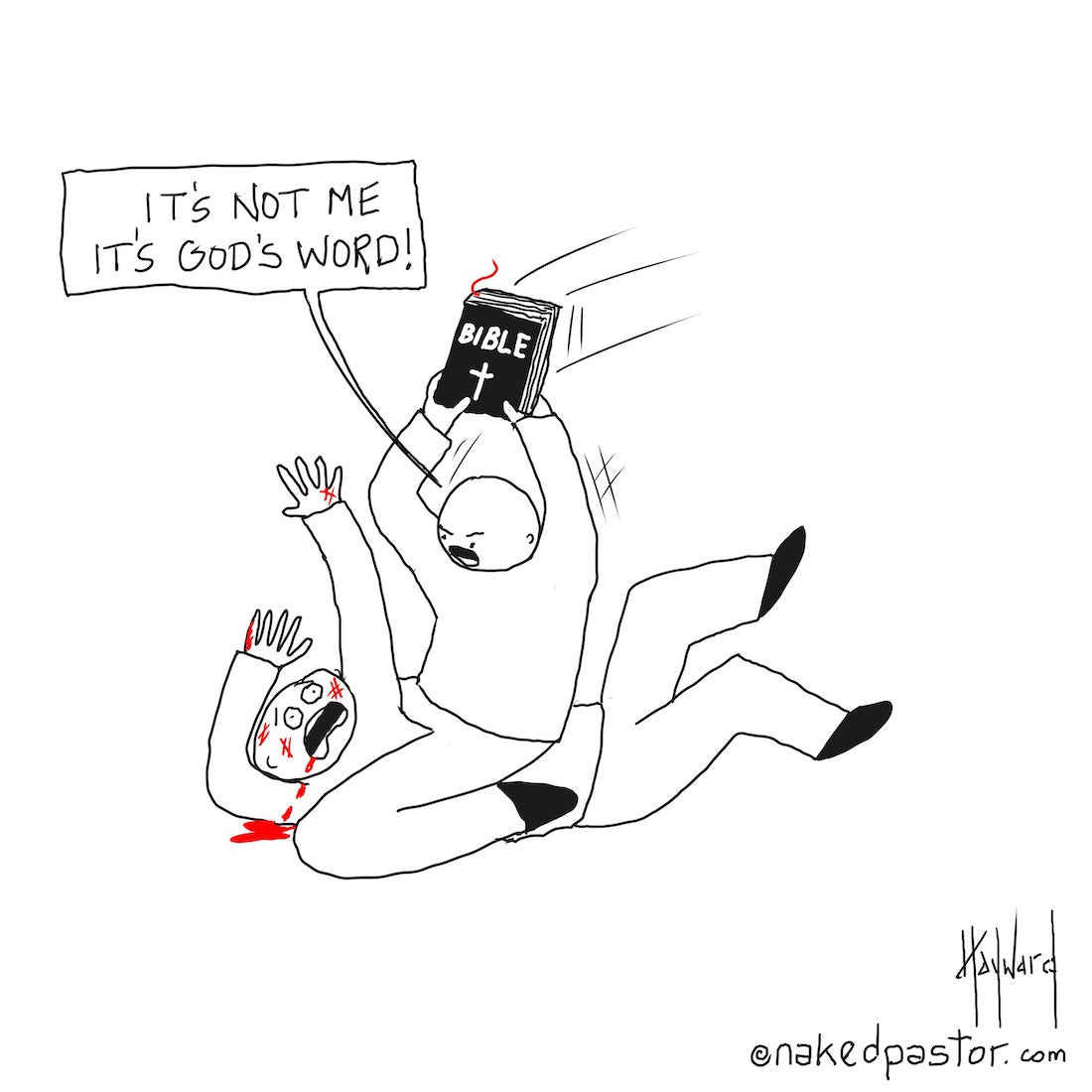
3 Types Of Spiritual Bypassing
What Is Spiritual Bypassing? Spiritual Bypassing describes attempts to use spirituality and spiritual practices to avoid facing and dealing with unpleasant emotions, experiences, and realities in order to feel good and avoid discomfort and painful truths. 3 Types Of Spiritual Bypassing Spiritual Bypassing As A Way To Avoid Personal Responsibility People often use the Bible and their beliefs to hurt you and inflict spiritual abuse on you. They don't think they're being cruel. They think they're being righteous. They think they must somehow make you a better person. Some people may intentionally want to hurt you, so they find a holy excuse to do so.Have you experienced this? This is a form of spiritual bypassing. This cartoon is titled, It's Not Me It's God's Word, and is available as a digital download. Spiritual Bypassing As A Way To Avoid Taking Action You've heard the expression "Thoughts and prayers!" Thoughts and prayers diverts our attention away from the inaction of those who use it. They might mean well, but for many of us it's a signal that they're not going to actually do anything. It diverts our attention away from their lack of actionable concern. And sometimes it's a way to divert our attention away from their greed for more money and power. This cartoon is titled, Meaningless Thoughts and Prayers, and is available as a digital download. Spiritual Bypassing As A Way To Avoid Our Own Negative Emotions Spiritual bypassing often manifests itself as a defence mechanism instead of facing difficult feelings like pain, anger, or sadness in an honest way. Some people pretend to be positive and distant, using spiritual ideas to hide from these uncomfortable feelings. But this only gives a temporary feeling of relief and stops real emotional growth and self-understanding. Some call this "toxic positivity". Examples of this would be "Good Vibes Only" or "God Is Always Good". Once you’ve seen the signs of spiritual abuse and spiritual bypassing and recognize it, that’s actually the first step of your journey into healing and freedom. These are just 3 examples of spiritual bypassing but there are so many more. Feel free to leave other examples of spiritual bypassing in the comments below.
Read more
Can You Be Spiritual Abused In A Marriage?
Before we address what spiritual abuse in a marriage is we must first unpack the definition of spiritual abuse itself. What Is Spiritual Abuse? Spiritual abuse is when spiritual leaders abuse their power and spiritual ideas to create a toxic culture of shame and control to fulfill their own desires. Just like physical abuse uses physical means, or financial abuse uses financial means, or sexual abuse uses sexual means, etcetera, to achieve their ends, spiritual abuse uses spiritual means to achieve its ends... like positions of church power, the Bible, theological ideas such as the threat of excommunication or shunning or Hell, it uses these to terrify people into submission. It is both of these: abuse of power AND the self-serving use of spiritual ideas. Both of these are fueled by theology or dogma. I think this cartoon, Spiritual Abuse in a Picture, sums it up very well. What Is Spiritual Abuse In A Marriage? Spiritual abuse occurs in a marriage when one partner manipulates or controls the other by using their spirituality. Can You Be Spiritual Abused In A Marriage? So let's talk about spiritual abuse inside a marriage. Is it possible. Yes it is. Spiritual abuse can occur in any type of relationship, including a marital relationship. It is possible in a marriage, as in any relationship, due to a combination of factors related to power dynamics, manipulation, belief systems, and control. 5 Examples of Spiritual Abuse in Marriage and Relationships Examples of spiritual abuse in marriage and relationships can vary widely, but they all involve the misuse of religious or spiritual beliefs to control, manipulate, or harm the other person. Here are some specific examples: 1. Forced Religious Conversion This is when one partner pressures or coerces the other into converting to a different religion or spiritual belief system, disregarding their own beliefs and autonomy. They might say, "I can't marry you (or stay married to you) if you don't convert to my religion!" This person is uncomfortable with diversity in beliefs, and is requiring their partner to conform to their belief system with the threat of separation if they don't. 2. Manipulation Through Fear Using spiritual teachings to instil fear and control in the other person, making them believe that certain actions will lead to divine punishment or negative spiritual consequences. I knew a couple where the woman kept making her husband believe he must be demon-possessed when he made her unhappy or frustrated her in any way. She was using the fear of demons to control his behaviour and make him submit to her demands. 3. Isolation and Separation Demanding that the other person cut ties with friends, family members, or social circles that don't share the same spiritual beliefs, isolating them from sources of support and community. I've seen this a lot in some church communities I have observed or even be a part of. When one partner realizes that their partner's relationships outside of their marriage might have what they think is a negative influence on them, they will try to cut them off from those relationships to ensure that their partner stays on the straight and narrow of their expectations. We see this happen a lot in cults. 4. Control Over Spiritual Practices Dictating how the other person should pray, meditate, or engage in spiritual practices, and punishing them if they don't adhere to the abuser's prescribed rituals. Some people have very rigid ideas of what their religion should look like, and that everyone must do it the same way. If they bring this attitude into a marriage, it's going to cause tension, friction, and division, because it requires conformity over personal authenticity and uniqueness. If one partner feels they always have to sacrifice their own ideas and practices to prevent their partner from getting upset, this will make for a toxic marital relationship. 5. Emotional Blackmail Leveraging spiritual beliefs to emotionally manipulate the other person, using guilt, shame, or spiritual teachings to force compliance with the abuser's demands or desires. If a partner is constantly using the bible and theology to shame and guilt their partner into submission to their expectations, this will quickly lead to resentment and a shallow relationship that often won't last long.It's important to recognize these signs and seek help if you or someone you know is experiencing spiritual abuse. The Impact Of Spiritual Abuse In A Marriage The impact of spiritual abuse in a marriage can be as severe as any kind of spiritual abuse leading to religious trauma that has a profound and far-reaching effect on a person's well-being. We see this happen a lot in marriages concerning the issue of sex. The patriarchal culture of Christianity which demands that women submit to their husbands sexually, is particularly damaging. I've seen Christian husbands over and over again force their wives to have sex because the bible teaches that their wives' bodies belong to them and not their wives. Many women have equated this with marital rape, and they're not wrong. It’s so hard to identify or find validation that spiritual abuse has occurred or is occurring. We make excuses, we see issues swept under the rug, we experience our stories of abuse being invalidated again and again. Admitting that you that you were or are abused is an important first step in healing from spiritual abuse.
Read more
What is Religious Trauma and How To Recognize It?
What is Religious Trauma? Religious trauma is the deep emotional and mental pain that comes from hurtful or damaging experiences within religious or spiritual environments. It often stems from continuous spiritual abuse. It can leave scars on a person's soul, leading to feelings of fear, guilt, and even a struggle with one's faith. It's like a storm that shakes the foundation of your beliefs and leaves you questioning everything. This cartoon is one of my most popular. It's titled Church PTSD and is available as a print or digital download. What is Religious Trauma Syndrome? Religious Trauma Syndrome refers to the psychological and emotional distress that can arise as a consequence of religious trauma or spiritual abuse. The term was a term coined by Marlene Winell in 2011. Although not included in the Diagnostic and Statistical Manual of Mental Disorders, this term has been increasingly recognized and acknowledged. Studies have shown that around one-third (27‒33%) of U.S. adults have experienced religious trauma at some point in their life. 5 Signs of Religious Trauma Persistent anxiety or fear stemming from religious teachings, rituals, or beliefs. Intense guilt, shame, or depression associated with perceived violations of religious rules. Struggles with cognitive dissonance and internal conflict over religious beliefs. Social isolation or withdrawal due to fear of judgment or rejection from religious community. Difficulty forming a personal identity or finding meaning after leaving a restrictive religious group. Healing From Religious Trauma Healing from religious trauma involves unearthing and confronting the harmful beliefs that once confined you, while embracing a newfound freedom to explore your own spirituality and beliefs that resonate with your authentic self. Seek supportive communities, challenge old dogmas, and nurture a compassionate relationship with yourself as you embark on this transformative journey. In this blog post, I unpack more on how to heal from religious trauma and spiritual abuse.You can heal yourself. Support can speed it up.
Read more
The Unforgivable Sin: Have You Blasphemed Against the Holy Spirit
I get comments from people who just can't believe my stories. If they would bother reading the comments of people who've experienced the same as I have, then maybe they wouldn't be so skeptical. As I grew up in the church, this verse was one of the bible verses that terrified me the most. (Click on image for a digital download of the cartoon, or click HERE!) Because no one KNOWS what it means. When you read or hear peoples' theories, you must realize they are all guesses. No one KNOWS what blaspheming against the Holy Spirit means. And no one KNOWS why, out of all the "sins" in existence, this one is the only one that is unforgivable. Of course, I, being the diligent disciple that I was, desired to please God completely one hundred percent of the time. But I never knew if I was successful. I even remember anxiously talking to my pastor about it. His response was basically, "Well David you never know, do you? You'll just have to stay on your toes at all times!" And he had me! Right where he wanted me. An obsessively obedient and submissive servant who could never do enough for his master. Am I alone here?
Read more
A Tribute To A Fearless Artist, Sinéad O'Connor.
“Truthfulness offended power” (Aiweiwei, "1000 Years of Joys and Sorrows"). Sinéad O’Connor died yesterday. I loved her and always have. I remember when she tore the photo of the Pope. You should read her autobiography “Rememberings” to comprehend the layers of meaning beneath that passionate and prophetic act. Here I've drawn a cartoon where I've replace the Pope with the Church... which is what it all meant for me. And I… being deep inside the bowels of the Church…I admired her for it. I was in awe of her courage.But I knew she was going to get blowback. When I heard the news yesterday,first I felt deep sadness.Then anger. Anger at the Church.Anger at the Music Industry.Anger at Society.Anger at all the Principalities and Powersthat intend to dehumanize usand try to crush us. She rose to stardom and used her platform to address abuses.She was severely chastised for it. Her truthfulness offended power. So she suffered. She lost her son Shane last year to suicide.I can’t imagine how a parent gets over that.I lost a brother to suicide a few years ago.I miss Mark every day and have to process grief and anger over what might have lead him to it. Sinéad struggled with mental health.She went to therapy. In her book, she wrote about one of her therapists: “What I liked about Dr. Schatzman was he said you come to therapy to find out there’s nothing wrong with you.” I agree. And I think she had to wrestle with that truth because the Church, Society, and Industry told her otherwise… that there was something deeply wrong with her. Many people know me as a critic of the Church. If they’re right, they have Sinéad to thank for inspiring me. I loved knowing she was in the world. Good-bye Sinéad.
Read more