The Naked Journal
Thoughts, musings, and meanings behind NakedPastor Art.
The Naked Journal

10 Questions You Can Ask A Church To See If It's Spiritually Abusive
What is Spiritual Abuse? Spiritual abuse is when religious or spiritual beliefs are used to harm, control, or manipulate individuals. It involves the misuse of power by religious leaders or groups, often causing emotional, psychological, or physical harm to people by imposing strict rules, guilt, fear, or shame. Why Do We Need To Talk About Spiritual Abuse? I think it is important for churches to establish rules concerning how it treats its members. In any relationship, those involved need to constantly ensure that they are treating the other fairly, compassionately, and justly. This includes churches. Please. I've come to believe that all churches are prone to spiritual abuse. In fact, I claim that the dehumanization of people is the gravitational pull of all institutions and organizations. So we must be always on guard to ensure that they resist this tendency. It takes a lot of diligence, honesty, and hard work. 10 Questions You Can Ask A Church To See If It's Spiritually Abusive I've assembled 10 questions you can use as a spiritual abuse test to see if a church is spiritually abusive or not. If any of these apply, I would claim that this particular church is not a healthy one and should be avoided. 1. Does it use guilt, shame, or fear to motivate me? Everyone should know by now that although guilt, shame, and fear can motivate people, we also know that it is not the best motivator for human behaviour. True, to use any of these to prevent a person from harming another, for example, works at the time. But to motivate others to do good in the world, the motivators should be good too. 2. Does it elevate its wellbeing over mine? When the organization is more important than the people who belong to it, then then people will suffer. This is a very real dilemma for churches, because the number one mission of an organization is to survive… just like people! But the people should always come first. 3. Does it employ peer-pressure to make me behave a certain way? I believe diversity makes the healthiest communities. Unfortunately, most organizations prefer homogeneity. Conformity to its desired standard is expected of all its members. This will crush your individuality, authenticity, and self-expression. 4. Does it believe it possesses the truth and I don’t? This is what makes a cult a cult. When any person or organization claims to have the truth and therefore you need them, this demands that you become a mindless sheep, an obedient follower, and a silent recruit. 5. Does it speak to me before it listens to me? If any person or organization doesn’t listen to you and your needs and desires, its because it is not interested in them. In fact, they will inform you of what you need and want. As a result, you will have to hide your true self in order to belong. 6. Does it try to distance me from my other relationships? Setting oneself apart often turns into separating oneself from all outside influences. At first, it may appear that you are just caught up in the excitement of the community. But over time you realize that you no longer have any contact with people who loved you. Isolation is a key strategy of abusers. 7. Does it punish me with demotion, isolation, or silent-treatment if I question anything? Questioning authority is hardly ever appreciated by authority. But in order for you to be free, it must be done. If you raise legitimate questions and there are negative repercussions, this is abuse. 8. Does it trivialize or dismiss my feelings? Your feelings don’t matter in an abusive relationship. In fact, your feelings can get in the way of the church’s agenda. In abusive relationships, we are taught to distrust our feelings and blindly trust the ones in authority over us. 9. Does it get jealous if I seek spiritual aids elsewhere? Abusers are very jealous. They don’t want you going anywhere else for anything. In fact, they claim they will meet all your needs. This is another form of isolation. Abusers want you all for themselves. 10. Does it always blame me when something goes wrong? If anything bad happens, it’s always your fault. Either you as an individual or the people as the community. Never the leader’s! And because our self-esteem has been so eroded over time, we believe them and accept all blame for anything bad that happens. You know you can take these same spiritual abuse test and apply them to any relationship. Even your marriage, family, or friendship! For example, "Does he use guilt, shame, and fear to motivate me?” "Does he trivialize or dismiss my feelings?" If you can answer yes to any of these questions, then there’s a high probability that it is abusive. If all 10 can be answered with yes, then run. Resources on Spiritual Abuse Here are a list of other blog posts I've written on Spiritual Abuse. 10 Reasons Why The Church Is The Perfect Culture For Abuse 5 Steps to Recover from Spiritual Abuse What is Religious Trauma and How To Recognize It?
Read more
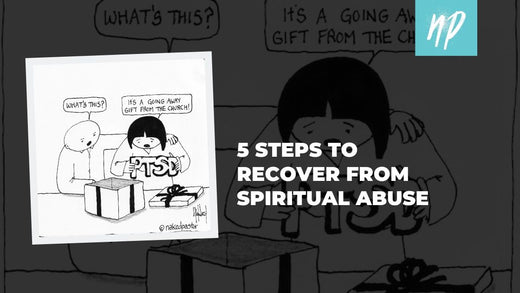
3 Steps to End Being Spiritual Abused
Description: A woman leaves a church and says to the pastor on her way out, “You will never see me again because I refuse to be abused any longer!” 3 Steps to End Being Spiritual Abused Here are 3 easy steps that I think are most important: 1. Tear back the mystique surrounding your abuser. Reject the idea that a pastor is a holy and untouchable being, who lives in a different moral atmosphere, can never do something wrong, and who even if they do something you wonder about you believe it must be God whose ways are higher than our ways so it must be okay. Pastors are people too and live on the same ethical plain as you. No halos! 2. Learn emotions. Many people do not understand emotions, can’t name them, and can’t tell what they are feeling. Emotional intelligence! There are courses for it. If you can’t name your feelings, read about them and learn to tell when you’re feeling hurt, vulnerable, used, angry, afraid, shamed, and helpless. Then, when someone is spiritually assaulting you, you can discern it for what it is: abuse! 3. Walk away! Do it when you’re safe to do so. But the bottom line is you don’t have to suffer abuse. I’ve walked away. Many times. Yes it’s hard. There are ramifications. But these are the choices I made for myself rather than being the victim of someone else’s choices. You don’t deserve abuse. You don’t have to tolerate abuse. You don’t have to protect the abuser’s feelings or reputation. Walk! Or run! That’s it! I hope this helps.If you're not sure if you've been spiritually abused I wrote a blog post titled, What is Spiritual Abuse? And how to recognize when it is happening to you.
Read more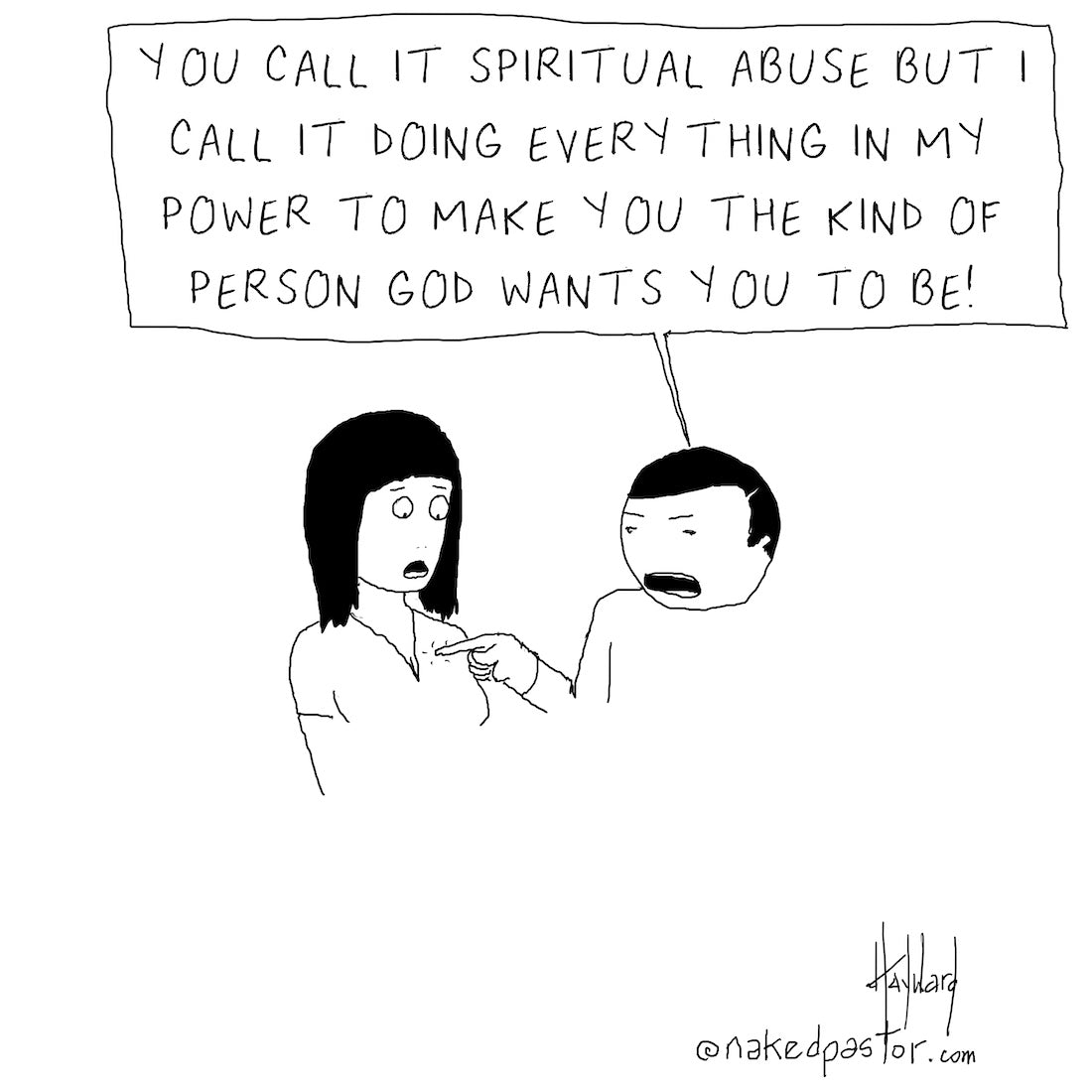
10 Ways Spiritual Abusers Think
What Is Spiritual Abuse? Spiritual abuse is when someone uses religion to control, manipulate, or harm others. It can happen in churches, religious groups, or personal relationships. This can include fear, guilt, shaming, or cutting people off from outside support. Victims often struggle with self-worth, faith, and emotional wounds. This cartoon on spiritual abuse reveals many of the dynamics of spiritual abuse. You may also like this cartoon illustrating a venn diagram on spiritual abuse 10 Ways Spiritual Abusers Think They think they are doing some good or at least what’s necessary. They think you are a deficient person. They think you should surrender your own personal agency. They think they are agents of God’s will. They don’t think you can or should guide your own life. They don’t think and don’t want you to think you can discern good from evil. They don’t want you to trust your own intuition, mind, or body. They want you to feel guilt and shame for resisting them. They will bully anybody, but especially women. They violate your space… physical, spiritual, sexual, etcetera. Have you experienced this? I have many times and I know so many others here have too. There are many reasons why we allow abusive leaders to continue. I hope my cartoons illustrating spiritual abuse make you feel seen and remind you that you are not alone in your experience. I wrote a blog post titled, 10 Reasons Why The Church Is The Perfect Culture For Abuse to highlight just how common this is in the church and why.
Read more
Spiritual Abuse in a Picture
I believe this sums up spiritual abuse pretty succinctly. Spiritual abuse is when spiritual leaders abuse their power and spiritual ideas to create a toxic culture of shame and control to fulfill their own desires. It is both of these: abuse of power AND the self-serving use of spiritual ideas. Both of these are fueled by theology or dogma. Spiritual abuse is not always obvious from the outside. Sometimes it is embedded in systems, language, and policies that appear normal but function as control. How many here know they've been victims of this? Or how many here are just realizing it? I've drawn a lot of cartoons on spiritual abuse over the years. These cartoons function almost like a spiritual abuse test helping us recognise patterns we might otherwise miss. Why I keep Speaking and Drawing Cartoons About Spiritual Abuse This was the first spiritual abuse cartoon I ever drew. It's 13 years old. I remember how much rage I stirred up to be so blatant about pointing out the accepted prevalence of spiritual abuse. But I also remember the gratitude from so many people who felt seen. So I kept drawing and talking about it. If you've been a victim of spiritual abuse it's important to remember that it is not your fault. Fault lies with no one except the abuser and the system of enablers. There is never an excuse for spiritual abuse.This cartoon is thirteen years old! I remember how much rage I stirred up to be so blatant about pointing out the accepted prevalence of spiritual abuse. But I also remember the gratitude from so many people who felt seen.Since then, we've heard more and more about abuse in churches. Unfortunately, including physical and sexual abuse. Lots of stories of sexual harassment. Resources on Spiritual Abuse Here are a list of other blog posts I've written on Spiritual Abuse. What is Spiritual Abuse? And how to recognize when it is happening to you. 10 Reasons Why The Church Is The Perfect Culture For Abuse 5 Steps to Recover from Spiritual Abuse 10 Questions You Can Ask A Church To See If It's Spiritually Abusive
Read more
Can Women Be Pastors?
Can women be pastors? Of course! Here's something else I think: If we really want something, we will figure out how to find a way to do it. Therefore, I KNOW that if men really wanted women to be pastors, they would either say: 1. Paul was wrong.2. Paul didn't mean it the way it sounds.3. Paul is dated, just like stoning for working on the Sabbath is. Or some other way. Instead, they dig their heels in and find anything that justifies, validates, and endorses their sexism and misogyny... including Bible verses. Like I've always said... we all find a theology that suits our biases, and then that theology informs our biases, and then the biases informs our theology. That's how it always works. Period. This cartoon is titled Can Women Be Pastors. It's available as a digital download or you can purchase the original which comes with a letter of authenticity.
Read more
Does Deconstruction Of Your Faith Have to be Sad?
Does deconstruction of your faith have to be sad? Recently someone said he prefers my funny cartoons and that I shouldn’t focus so much on negative things about the church. Maybe this cartoon shows I haven't lost my sense of humor. In the popular poem "Footprints in the Sand” Jesus says, "The times when you have seen only one set of footprints is when I carried you." I think he said, “This is where I dragged your ass!”Carl Jung said, "Walk your path or be dragged." When I do cartoon and write about, say, spiritual abuse, I'm helping people embrace their experiences, trust their guts, find their voices, muster their courage, and liberate their lives. But I also want to help people find happiness and to know that deconstruction is a positive sign of healthy spiritual growth. They can be happy about it. Generally I’m a happy person. And I help people laugh or at least smile every day. A misconception about people deconstructing is that we’re a bunch of vindictive victims, a wailing wall of woe-is-me, a bathtub of bitterness, a coven of complainers, a world of whiners. In fact, the people I know who are deconstructing or already have are happy even though they can be serious. Sure, we go through periods of sadness. But it's possible to be happy. I dare say even inevitable if we press on. Deconstruction can be both scary and happy at the same time and that's okay. I’m happy. You can be happy too. Even if you experienced abuse.Even if you’re deconstructing.Even if you’re leaving the church. I’m happy. When we recognize our path, own it, walk it, and master it, we experience a kind of fulfillment that produces the happiness we long for. “Walk or be Dragged” is available as a print and a digital download. If you're in the thick of deconstruction and looking for guidance, you're not alone. I've spent the last 15 years creating content about deconstructing our beliefs. I've shared more about my own hesitations and four books that might help in this post on books for deconstruction. It’s honest, a little conflicted, and might just offer the nudge—or the caution—you need.
Read more
Challenging Victim-Blaming: Understanding Spiritual Abuse Survivors
I drew this cartoon as a commission piece. It’s a man trying to teach about abuse. His points are in black ink. But a woman is correcting what he’s saying with red ink. (This was a commissioned piece. If you want a commission of your own, let me know. Click HERE!) He says, “Look at these poor people!” She says, “We don’t need your pity. Just hear and believe us!” He says, “They’ve suffered abuse!”She says, “We’ve experienced abuse!” He says, “They are victims!”She says, “We are survivors!” He says, “Their lives are ruined!”She says, “Our trauma doesn’t define us!” He says, “What’s to be done?”She says, “Radical revolution!” One of the biggest problems around spiritual abuse is it is either not believed, or it is dismissed, or it is minimized. A lot of victim-blaming occurs. Like women who have been raped: “Why did you wear those clothes?”Like women in an abusive marriage: “Why did you marry that man?” People who’ve experienced spiritual abuse are often asked: “Well, why did you go to that church?” Also, many people do not understand the gravity of harm spiritual abuse causes. Because it’s not visibly evident, it is often dismissed as not serious. Because many devalue spirituality, they trivialize how powerful a weapon it is.Because we aren’t forced to be members, they conclude we deserve it. This is why I drew this cartoon. I want survivors of abuse to feel empowered to be in control of their own lives, to be able to set healthy boundaries, to say no to abuse, and to bring down abusers and the systems that harbor, support, and defend them.
Read more
Do Not Forsake the Assembling of Yourselves Together
Description: A woman writes “Do not forsake the assembling of yourselves together (unless they treat you like sh*t!) DO NOT FORSAKE THE ASSEMBLING OF YOURSELVES TOGETHER Some suggest Hebrews, where this verse is found, was written by a woman. So I entertained that idea in this cartoon. It’s interesting to me that this one verse is the only one employed to demand that we should never stop attending church. There are more scriptures telling us more clearly that we shouldn’t eat shrimp than there are telling us to keep going to church. It’s also interesting to me, whether or not you use scriptures to inform your life, that they are chock full of stories of people who liberated themselves from oppressive, abusive, and undesirable situations. And these stories mean to inspire us to do the same. There are other reasons to stop going to church, like abuse, boredom, bad theology, irrelevance, coercion, manipulation, control, awkwardness, or even just, “No particular reason. I just don’t want to go anymore.” Even the verse in Luke where we’re told Jesus went to synagogue, as was his custom. Why’d Luke say that? Wasn’t that the custom of most Jews of his day? Maybe the emphasis is on “was”. Because later in his life we know, especially from the gospel of Mark, that Jesus avoided crowds and towns and preferred the wilderness where the crowds dwindled. In any case, in my opinion, you don’t need a good reason not to go to church. It could just be your preference or out of necessity. To me it doesn’t matter. Church-centric people disagree. Of course. Because this snatches the Church’s power over your life out of its hands and into yours. Where it should be.
Read more
Breaking Free from Toxic Theology
WERE YOU TAUGHT YOU WILL NEVER BE GOOD ENOUGH? I’m sure not everyone experienced this, but I did. And I know many of you have too. Description: A woman is being stretched by ropes between the church saying she’ll never be good enough and the other church saying that she’s better than people outside the church. We were taught that we would never be good enough. Ever! We were told that we were helpless sinners, depraved, and that our hearts were wicked, and that would never change. But on the other hand we were taught that we were better than unbelievers and people outside the church. Do you know why? Because they prioritized belief over everything else. It really didn’t matter how good you actually were. What mattered is that you had to believe the right things exactly. And one of those right things to believe is that you are a depraved sinner… forever. But if you believed this at least you were better than people who didn’t… “I’m the worst of sinners, but by believing this I’m better than you!” I know a lot of people, including myself, who’ve gone through therapy to wrestle with horribly unhealthy self-image problems rooted in bad theology. Because I was taught to hate myself. Weren’t you? But hating myself made me better than proud unbelievers. Do you know what I’m talking about?
Read more