The Naked Journal
Thoughts, musings, and meanings behind NakedPastor Art.
The Naked Journal


5 Ways Religious Trauma Can Affect Your Sexuality (and how to heal)
Many people who attended church for a long time suffer from Religious Trauma. It’s becoming more visible to more and more people as more of us are talking more openly about it. Religious Trauma is often wound up with Purity Culture, which can have a disastrous affect on our attitudes about sex. People who are survivors of Religious Trauma and Purity Culture often struggle to acquire healthy attitudes about sex and feel comfortable with their sex lives. Add to that... if a person suffers these things plus spiritual abuse, there's a lot of healing that needs to happen because these all affect their lives at a deep and fundamental level, including sexually. Here's a couple stuck in a religious mindset caused by Religious Trauma. (Click on this image for a digital download, or click HERE!) 5 Ways Religious Trauma Can Affect Your Sexuality Religious Trauma makes us feel guilty for enjoying our bodies. Christianity, like many religions, castes our bodies and the flesh in a bad light. I was taught that my body was my enemy and something I always had to deny and beat into submission. I had to crucify it daily. The affect this had on my attitudes about sex was that I felt guilt any time I was enjoying my body or being in my body. For some people it’s even worse: they can never have any pleasure because it’s blatantly sinful, goes against scripture, and displeases God. Religious Trauma makes us feel like we’ve got our priorities wrong. For those of us who grew up in intense religious environments, the goal was to always be thinking about God and spiritual matters. Our minds had to be first and foremost stayed upon God, and to allow anything else to creep in was to allow something else to dethrone God from our minds and lives. We could never, to use an analogy, take a vacation and just enjoy ourselves because we were to be “on” 24/7. Even in our sleep, we had to pray for protection so that we wouldn’t stray from this strict path. As a result, when some people are enjoying sex, there can be a deep sense of putting something ahead of God that may anger him, or at least disappoint him. Religious Trauma makes us feel insecure about being confident about our sexuality. Religious Trauma teaches us not to trust our bodies. This is deadly for good sex. One of the most important things for a good sexual relationship is confidence. For sex to be fulfilling for each partner, each one must feel confident in their bodies and have some confidence in knowing or discovering what is pleasurable for their partner. Insecurity and a lack of confidence can kill passion and eliminate a feeling of joy and fulfillment. Religious Trauma makes us second guess enjoying our bodies as not spiritual enough. Religion dichotomizes the world. There’s good and evil, invisible and visible, light and dark, spirit and flesh. And these are always at war with one another. As a result, for many people coming out of a strict religion, when we are making love with someone we love, there is confusion about what’s happening. If their minds are on their body and their loved one’s body and the love and passion taking place, it can feel less than spiritual and therefore, somehow, even sinful, secular, fleshly, or worldly. We can heal ourselves from Religious Trauma. We can educate ourselves by giving ourselves therapy and going to get therapy. We can come to a place where we understand that our bodies aren’t evil, aren’t our enemies, aren’t less than spirit, and not unimportant. When we realize our bodies are good and to be dignified and enjoyed, we are on our way to healing and healthy attitudes about sex and on to enjoying healthy sex lives.
Read more
What You Can Expect When You Speak Up Against Spiritual Abuse
I get it every day that I'm negative and must have a root of bitterness. This is just a feeble attempt to shut me up. It's not true. I mean, I am negative against spiritual and church abuse. And there have been times I've been bitter. But I'm not bitter right now. I am vocal. And I will continue to be as long as churches and their authorities continue to abuse their members. I rejoice that there are some communities that are really attempting to gather together in healthy ways. So I just want to encourage you to do what this woman in the cartoon is doing. (Click on image for a digital download, or click HERE!) Stand up! Speak up! Your self-care will inspire others to do the same thing. Resources on Spiritual Abuse Here are a list of other blog posts I've written on Spiritual Abuse. 10 Reasons Why The Church Is The Perfect Culture For Abuse 5 Steps to Recover from Spiritual Abuse 10 Questions You Can Ask A Church To See If It's Spiritually Abusive What is Religious Trauma and How To Recognize It?
Read more
The Power of Vulnerability for Healing Religious Trauma
Vulnerability is hard. For some, vulnerability can mean making oneself an easy target for ridicule, rejection, and even abuse. Which is why vulnerability in religious contexts feels very risky. In this blog, I want to discuss why vulnerability is important, why trauma can hold you back from being vulnerable, the relationship between religious trauma and vulnerability, and why vulnerability is an essential step in your journey towards healing. Why Vulnerability is Important It's undeniable that vulnerability matters. But for some, vulnerability is equal to weakness. They see it as a personal failure to “keep it together”. But what they don’t see is the absolute power of vulnerability to break down barriers, connect people and help you claim your inner strength. If you want to learn more about why vulnerability is important, I wrote this blog post for you. Why People with Trauma Struggle with Vulnerability People who have experienced trauma often find it difficult to be vulnerable due to the lingering pain and fear associated with their past experiences. The wounds from their traumatic events can make it challenging for them to trust others and themselves, leading to emotional walls as a means of self-protection. The overwhelming emotions linked to the trauma may trigger a desire to avoid vulnerability altogether. The trauma can also disrupt their ability to regulate emotions effectively, making it harder to express their feelings openly. As a result, they may withdraw from others and resist sharing their vulnerabilities to avoid potential re-traumatization or rejection. It's essential to recognize that struggling with vulnerability after trauma is a natural response, and individuals should be met with understanding and patience as they work through their healing process Why People with Religious Trauma Struggle with Vulnerability When we were in religious settings we were encouraged to be vulnerable and transparent. Confession, for example, was lauded as the best way to ensure one’s personal spiritual health as well as one’s secure place in the community. But many of us soon discovered that baring our souls in confession also meant people knew our weaknesses and struggles. We trusted people with personal information, especially those in leadership positions. And, for many of us, this trust was betrayed when our struggles were used for spiritual blackmail and opened the door to spiritual abuse. That’s what inspired this cartoon: How Vulnerability Impacts Healing I believe in vulnerability. I practice it myself. And over time I’ve noticed that the more vulnerable I become, the more my religious trauma heals. When you are vulnerable you embrace and accept the things that have happened to you as well as how you feel about them. You accept that you cannot change the past and you develop the ability to look forward instead of backwards. Being vulnerable means you’re able to share how you are feeling with those around you which will help you develop an empowering support system. It’s like vulnerability art—a powerful form of self-expression that helps in healing. That’s enough talk about vulnerability! It's time for you to take what I’ve shared and start living your life more vulnerably. Embrace your feelings and encourage those around you to do the same.
Read more
The Unforgivable Sin: Have You Blasphemed Against the Holy Spirit
I get comments from people who just can't believe my stories. If they would bother reading the comments of people who've experienced the same as I have, then maybe they wouldn't be so skeptical. As I grew up in the church, this verse was one of the bible verses that terrified me the most. (Click on image for a digital download of the cartoon, or click HERE!) Because no one KNOWS what it means. When you read or hear peoples' theories, you must realize they are all guesses. No one KNOWS what blaspheming against the Holy Spirit means. And no one KNOWS why, out of all the "sins" in existence, this one is the only one that is unforgivable. Of course, I, being the diligent disciple that I was, desired to please God completely one hundred percent of the time. But I never knew if I was successful. I even remember anxiously talking to my pastor about it. His response was basically, "Well David you never know, do you? You'll just have to stay on your toes at all times!" And he had me! Right where he wanted me. An obsessively obedient and submissive servant who could never do enough for his master. Am I alone here?
Read more
A Tribute To A Fearless Artist, Sinéad O'Connor.
“Truthfulness offended power” (Aiweiwei, "1000 Years of Joys and Sorrows"). Sinéad O’Connor died yesterday. I loved her and always have. I remember when she tore the photo of the Pope. You should read her autobiography “Rememberings” to comprehend the layers of meaning beneath that passionate and prophetic act. Here I've drawn a cartoon where I've replace the Pope with the Church... which is what it all meant for me. And I… being deep inside the bowels of the Church…I admired her for it. I was in awe of her courage.But I knew she was going to get blowback. When I heard the news yesterday,first I felt deep sadness.Then anger. Anger at the Church.Anger at the Music Industry.Anger at Society.Anger at all the Principalities and Powersthat intend to dehumanize usand try to crush us. She rose to stardom and used her platform to address abuses.She was severely chastised for it. Her truthfulness offended power. So she suffered. She lost her son Shane last year to suicide.I can’t imagine how a parent gets over that.I lost a brother to suicide a few years ago.I miss Mark every day and have to process grief and anger over what might have lead him to it. Sinéad struggled with mental health.She went to therapy. In her book, she wrote about one of her therapists: “What I liked about Dr. Schatzman was he said you come to therapy to find out there’s nothing wrong with you.” I agree. And I think she had to wrestle with that truth because the Church, Society, and Industry told her otherwise… that there was something deeply wrong with her. Many people know me as a critic of the Church. If they’re right, they have Sinéad to thank for inspiring me. I loved knowing she was in the world. Good-bye Sinéad.
Read more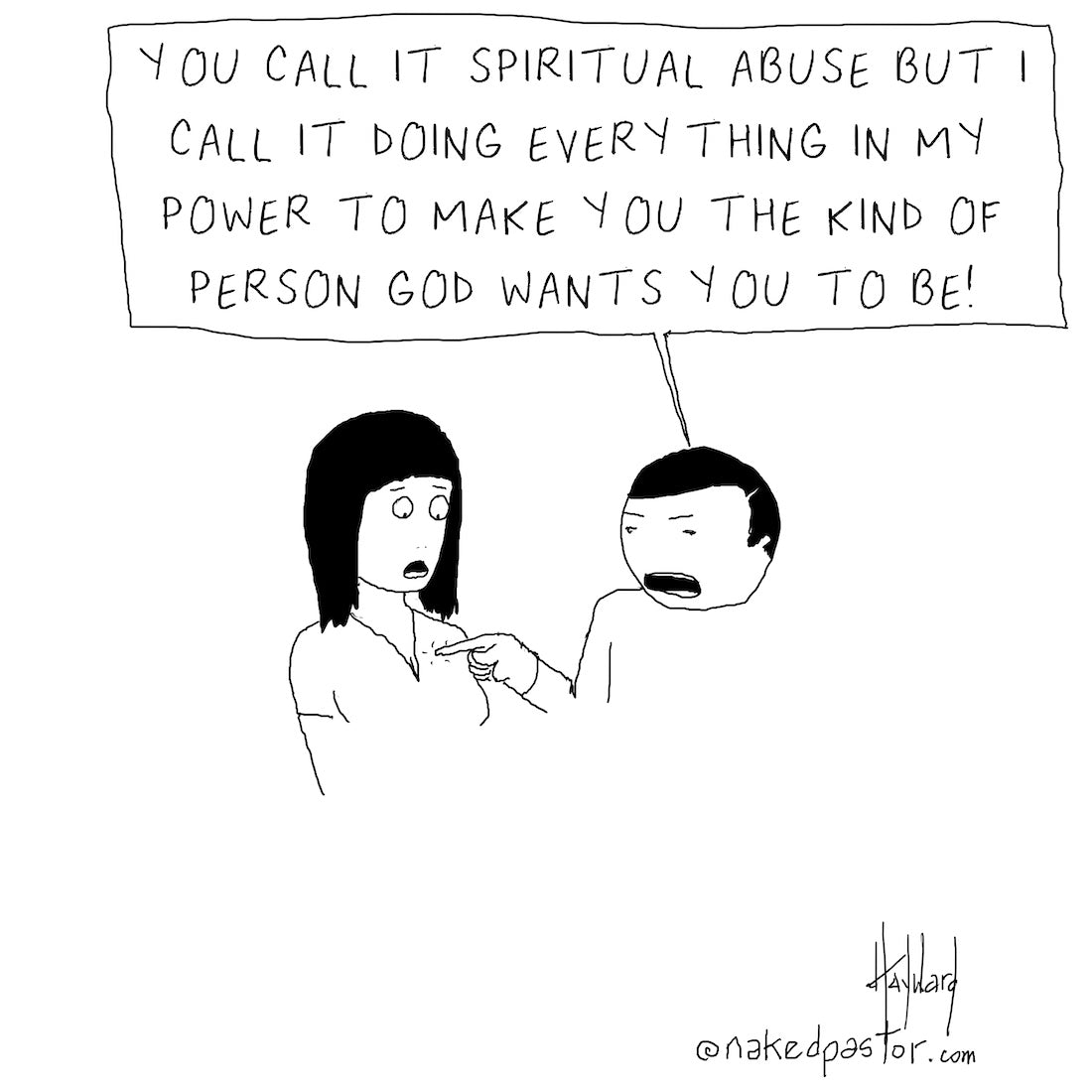
10 Ways Spiritual Abusers Think
What Is Spiritual Abuse? Spiritual abuse is when someone uses religion to control, manipulate, or harm others. It can happen in churches, religious groups, or personal relationships. This can include fear, guilt, shaming, or cutting people off from outside support. Victims often struggle with self-worth, faith, and emotional wounds. This cartoon on spiritual abuse reveals many of the dynamics of spiritual abuse. You may also like this cartoon illustrating a venn diagram on spiritual abuse 10 Ways Spiritual Abusers Think They think they are doing some good or at least what’s necessary. They think you are a deficient person. They think you should surrender your own personal agency. They think they are agents of God’s will. They don’t think you can or should guide your own life. They don’t think and don’t want you to think you can discern good from evil. They don’t want you to trust your own intuition, mind, or body. They want you to feel guilt and shame for resisting them. They will bully anybody, but especially women. They violate your space… physical, spiritual, sexual, etcetera. Have you experienced this? I have many times and I know so many others here have too. There are many reasons why we allow abusive leaders to continue. I hope my cartoons illustrating spiritual abuse make you feel seen and remind you that you are not alone in your experience. I wrote a blog post titled, 10 Reasons Why The Church Is The Perfect Culture For Abuse to highlight just how common this is in the church and why.
Read more
Can Women Be Pastors?
Can women be pastors? Of course! Here's something else I think: If we really want something, we will figure out how to find a way to do it. Therefore, I KNOW that if men really wanted women to be pastors, they would either say: 1. Paul was wrong.2. Paul didn't mean it the way it sounds.3. Paul is dated, just like stoning for working on the Sabbath is. Or some other way. Instead, they dig their heels in and find anything that justifies, validates, and endorses their sexism and misogyny... including Bible verses. Like I've always said... we all find a theology that suits our biases, and then that theology informs our biases, and then the biases informs our theology. That's how it always works. Period. This cartoon is titled Can Women Be Pastors. It's available as a digital download or you can purchase the original which comes with a letter of authenticity.
Read more
Honoring LGBTQIA+ Stories in Art
Sexy Sunday and Pride Month combine to bring you this cartoon. Many LGBTQIA friends and followers requested representation in my Sexy Sunday cartoons But I was reluctant because I feel their intimate sexual lives is NOT my lane. I see so many people, businesses, and institutions take advantage of the LGBTQIA+ community, and I will not participate in that. Exploiting, for example, gay- or trans- or bi- or whatever- sex for profit or popularity is vulgar and cruel, and I refuse to play that game. The fetishization of the private sex lives of my LGBTQIA+ friends is not cool. Also... and I will be vulnerable here... I was sexually assaulted by an older teenager when I was a kid, and also by an older man when I was a teenager. So imagery of men enjoying sex together is something I don't want to imagine or draw. I wish it wasn't so, because it is a perfectly valid expression of genuine love. But there it is. For me. For now. I'm working on it. All that being said, my friends persuaded me that they trusted me and urged me to draw some for them. Here it is, with two women. I personally know many people who have experienced this. You? Related Blog Posts Breaking Free from Purity Culture5 Ways Puriture Culture Can Affect Your Sex Life3 Helpful Resources for LGBTQ+ People Navigating Religion
Read more
Is The Church In Your Bed?
Is the Church in your bed? Like the Church is in your head? Lisa and I never suffered from that, for which I'm thankful but I know so many people so affected by purity culture and the Church's teachings on sex that they can't even enjoy themselves in bed. I want to break that and help people break free to enjoy themselves. In my opinion, the Church should stay out of your bed! This cartoon is titled, Is the Church in Your Bed? and it's available as a digital download. If this cartoon resonated with you then you might like to read this blog post, 5 Ways Religious Trauma Can Affect Your Sexuality (and how to heal).
Read more