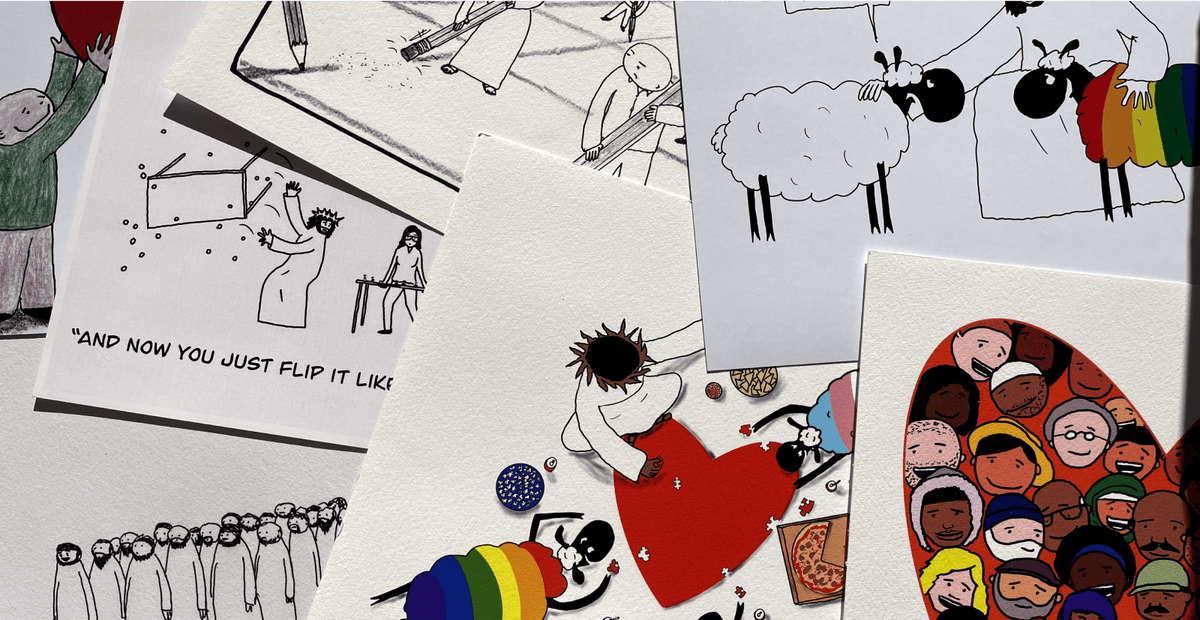
The Naked Journal
Thoughts, musings, and meanings behind NakedPastor Art.
The Naked Journal


Doing Life While Deconstructing
I think the intensity of our deconstruction from religion losing our religion, changing our beliefs, deconverting, etcetera, corresponds with the intensity of the religious devotion we had. (Click on image for a digital download of it, or click HERE!) If religion was a superficial hobby for you, then deconstruction might be mild and easy. If religion was your everything, then deconstruction might be intense and difficult.For some, it's just a crossroads. For others, it's a crisis.For some, it's a slight turn. For others, it is a tragic accident. I've also experienced and observed different kinds of deconstruction: social and philosophical. That is, there is a deconstruction from the church and all that goes with it: family, friends, spouses, activities, responsibility, loyalty, spiritual abuse, etc. Then, there is a deconstruction from the beliefs we held: purpose in life, destiny, meaning, hope, afterlife, a sense of being loved, protected, and cared for, etc. Both are hard. If you do them simultaneously, good luck! Just like belief and church overwhelms your life, so does the deconstruction from them. It affects your mental health, your body, your appetite, your relationships, your sense of meaning and purpose, and your worldview. Everything! Nothing goes untouched. Just trying to do life seems impossible. It feels like we're being birthed into a new world where there is no oxygen. Nothing's the same. The trauma is total! Many don't understand those of us who experience it as trauma. So what? The important thing is to take care of yourself. One of the things you are going to have to deconstruct from is that you always have to worry about offending other people. That came with the theological and church territory. We were told that we could never ever offend anyone. If anyone was offended" by us, it was our fault and we had to fix it. That's false, and you will learn this during your deconstruction. You have to take care of yourself no matter what other people think. You have to find your own way post-church and post-belief. I tell this to anyone who talks with me about it: take your own sweet time. Do it your way. You will learn how to best take care of yourself. You are your own best caregiver. It's now time to start employing that aspect of yourself. Take care of yourself. You have permission.
Read more
When You and Your Spouse Find Yourselves on Different Spiritual Pages
I see it happening all the time. And it makes me sad. I've had so many couple friends split up because of the deconstruction of their beliefs‚ of one or both of them. You already know my story. Lisa and I almost didn't make it. It took years to finally figure out how to love one another in fresh, new, and exciting ways. I've already written about this before because it's such a huge problem. And in a recent podcast, MindShift, we talked a lot about it. I can't count how many people I've coached through this traumatic process. I can't count how many members of The Lasting Supper are going through this and share it with our online community and find strength, support, and guidance through it. (I invite you to join us!) There are three basic ingredients you need to get through it, if you want to. 1. Memory: Remember what drew you together, what attracted you to each other, and what you loved about each other. That's the essence of your relationship. For me, I'll be honest, I was first attracted to Lisa because she was the hottest girl on campus. Then, when I started to get to know her, I was attracted to her feistiness, her strong will and independence, her deep wisdom, and her zest for life. Her beliefs weren't even on the list. Sure, we assumed a lot. But, forty years later, Lisa still possesses those same essential attributes, including still being hot, and that's what makes her so desirable to me and contributes to our sturdy relationship. Always has. Figuring out our different beliefs is a game played upon this sturdy board. Just remember why you're even together in the first place! 2. Grace: Have grace for yourself and grace for your spouse. Don't judge. You're not watching a snapshot, you're watching a movie. You're observing the wonderful unfolding of an individual's life in remarkable ways... yours and your spouse's. Trust that they know what's best for themselves, just like you're trusting yourself to know what's best for you. The journey of explorers is never in a straight line, but zigzagging all over the place, sometimes back, sometimes forward, but always towards the destination, whatever that is‚ which you don't know until you get there. We are strange and wonderful human beings. Appreciate that! Be as gracious as you were with each other in your earliest days. 3. Patience: When deconstruction set in for Lisa and me, it was frightening. We had never ever navigated these waters before. They were strange, dangerous, and completely unpredictable. We had to paddle by the seat of our pants because not much had been written about this stuff before. No one told us, for example, that it was going to be a couple of years before we would start feeling stable or even in love again. There were times, literally, when bags were packed and we were heading our separate ways. I hate recalling those moments because we really nearly ended a¬† really good thing. I had friends advising me to just do what made me happy. But I didn't trust myself though. I was confused. So, I made an important conclusion that I advise other people to follow too: Do NOT make a decision during confusing times. Wait for clarity! I'm so glad I did. Lisa and I waited for clarity. It took years, but it was so worth it. We're still together and better than we've ever been as a married couple. Get through this desert. There is an oasis on the other side of it. Promise. Be patient! I always provide a disclaimer with this topic: Some marriages don't make it. Some people decide they were never meant to be married in the first place, or realize that their marriage was never a good one to start with, or decide that there's just too much damage done to repair it. All these reasons, and more, are valid. I support people through these painful transitions as well. And I see many of them come through the other side of separation and divorce as happier and healthier people with a hopeful life ahead of them. Memory, grace, and patience. These will help your marriage survive deconstruction. Read more about Can A Marriage Survive Changing Beliefs?
Read more
Why Personal Change Can Lead to Losing Friends
I was fortunate to find churches in which I felt I had room to change and grow. However, inevitably, I discovered that I would change and grow beyond the box of their comfort zone. When you change, so do your relationships. You may lose friends. You may even lose family. Like this cartoon: 4 Reasons Why Personal Growth Can Cause You To Lose Friendships 1. They will say that you are the one who left, not them. No one would deny that personal change and growth is important. However, for many people, there's only so far they can or are willing to stretch to accommodate you. In the end, it will be your fault you lost your friends. 2. Many people are very uncomfortable hanging out with people who are not similar to them, especially in beliefs. They just don't know how to be, how to talk, how to relax and how to relate to someone very different from them. 3. On the extreme, some people refuse to fellowship with people who do not share their faith. I know that during my growth in the faith, it was emphasized over and over again that I should not mix with non-believers, except to evangelize them, because it would negatively affect me, pull me down from my heights of faith, and cause me to eventually backslide into sin. 4. Finally, when you shockingly and sadly discover the consequences of your personal change, you might find yourself branching out and making new acquaintances and friends. As I discovered, and as many of my friends also realize, this is hard work and must be intentional if you're going to succeed in rebuilding your social life. I've personally experienced this. It took me a while, first emotionally then practically, to rebuild my social life. I'm very satisfied with it now. I admire the many people I know who make put their own personal development a priority even though there are risks and costs for doing so. It takes incredible commitment and courage to accomplish, but people are doing it. Although the costs are complicated, the choice is simple: be fake in a crowd or authentic alone. But the good news is, if you work at it, you will find not only yourself but a new community of friends gathered around you. You can do it! Related Resources In this video, I talk about accepting your longing for the community and relationships that were harmful to you. You can’t overcome something if you haven’t accepted your true feelings about it. Don’t dismiss your feelings, embrace them.
Read more
10 Reasons Why Sexual Assault Thrives in the Church
We here so many stories of sexual assault happening in the church. People used to say it was rare. But I think the internet providing a voice for so many people who never had means or methods to amplify their stories has made all the difference in the world. Now anybody anywhere anytime can share their story of abuse or assault and be heard and maybe even see justice done! Churches still try to sweep it under the rug. Like this cartoon: (Click on image to get a digital download, or click HERE!) 10 Reasons Why Sexual Assault Thrives in the Church I think sexual assault thrives in the church for many reasons. But here are my top 10: The Bible assigns women and children as the property of men. Since men are the head of the house and all things, their needs are priority. It's biblically instituted that women are to be temptresses and stumbling blocks. Sexual sin is shameful, therefore buried and denied. It's explicit that women are to remain silent, so no reporting. Women can't be trusted, so don't believe them. Absolutely everything is to be forgiven and forgotten. Repentance fixes everything. Reconciliation with offenders is not just compulsory but noble. The church refuses to evict anyone with power. Read more about narcissism in the church in this post. If this is happening or has happened to you in the church, get out now, find someone to talk to, and decide whether legal action needs to be taken.
Read more
Ten Subtle Ways You Could Be Abused
I know abuse is being discussed a lot these days. Spiritual abuse is becoming a more recognized reality even in psychology circles. Religious PTSD is a newly recognized and legitimate field of study and therapy. Some might say that I'm using the word "abuse" too liberally because they would claim that it means a cruel and violent treatment of another person. Certainly this is abuse. But abuse also means the improper use of something or someone. When we don't respect people as they are and allow them to be who they are freely, this is a more subtle form of abuse, the logical conclusion of which leads to violence against the human spirit. In fact, this problem will increase. As we become more outspoken against obvious abuse and broadcast it without restraint, abusers will go underground and become less obvious and more subtle in ways that will require a more wisdom and honesty to discern. No, we don't tape people's mouths, cuff their wrists, shackle their feet, put them on a leash, or lock them in a cage. Not literally. Rather, how do we silence people, limit their influence, constrict their involvement, prevent their movement, manage their actions, and control their lives? How do we punish people for not conforming? These are the real questions that can expose where subtle abuse is happening. I get this response from people: "It's their own fault for being abused because they stay! All they have to do is leave and it's over!" Possibly. However, this is another dilemma people face: many want to be a part of a community, especially their religious community. There are many people who long to be a part of a church. They have this right. The choice is to stay and suffer some abuse or leave and suffer profound alienation. Ask yourself these questions: What strategies are being used, consciously or unconsciously, to keep you under control? What is being done to make you conform to being a legitimate member of the community? Here are the more subtle ways you may be being abused without you even knowing it. This can occur in any relationship from a spouse and a family, to a pastor and a church, a boss and a company, a leader and a group, or people of influence and a movement. You are not allowed to speak your mind honestly and truthfully. You can only play if you meet certain expectations. You can't apologize enough. You can still give but receiving is limited. Your loss of respect in their eyes can never be remedied. You live in constant fear of an outburst of anger against you. You're allowed to live but your benefits have been severely cut. To criticize them is wrong because you criticize the ultimate good they represent. They have a network of peers that will rally around them and protect them. You're warned that your life will get drastically worse if you leave. There may never be raised fists or voices. There may never be any overt threats or ultimatums. This can all happen behind close doors or in broad daylight with nice clothes and smooth voices. In fact, some people might think you're hearing and seeing things and maybe a little crazy and unwell. I always encourage people in such situations to trust their gut. Test it. Push that button a little harder or once more and see if it becomes more obvious and reveals its true abusive nature. I've heard many times that it is naive to expect a community to exist without controls. There is a sensitive dance between personal freedom and corporate responsibility. But I claim we have opted for subtler forms of crowd control at the grave expense of providing spaces for personal freedom. I've also heard that I'm being petty to critique so harshly. I'm encouraged to give people, particularly leaders, a break. I'm often reminded that I'm being merciless and trivial, and that I'm revealing my own resentment at not belonging the way I'd like to belong. I'm told I'm angry and throwing stones at a house and people I willingly abandoned and that I need to grow up, return penitent, or finally leave and shut up. But what if I believe in the value of community and want people to build, facilitate, and be a part of them in healthy ways? Find or build a healthy community starting with your healthy self. Until then, it is necessary to leave these kind of codependent and toxic relationships and systems. Yes, we will experience a period of alienation. But I'm convinced that over time we will find nomadic comrades who have suffered the same kind of abuse and rejection. We will discover that we are a part of a new tribe that accepts us as we are and gives us freedom to express it. Together we will withstand the powers that have cast us off and rescue others from them. We will be like a band of sojourners and prophets who live in the desert threatening the authorities that tried to control us.
Read more
The Pressure on Parents to Raise the Perfect Child
Are you a parent who feels a lot of pressure to raise the perfect child? This is my Annual Child Show cartoon. Click on the image to get a digital download that you can print! The pressure on parents to raise perfect kids is enormous. This is also true in the church. I know because Lisa and I raised three of them, and they grew up in the church. The judgmental eyes on our children, and therefore on us, were all-seeing. We were constantly on guard and frequently tempted to be embarrassed because of our kids. But we chose to let them grow up, experiment, make mistakes, and find their own way... because we wanted them to grow up strong, free, and independent. They did. But oh my I could tell stories from the journey that got us here.
Read more
Deconstructing and How to Change in Front of Your Kids
This is a letter I wrote for someone deconstructing with kids. Here's the letter (slightly edited): I'd been looking forward to working on this letter and sending it to you today. Many people have been asking me to write about this issue. Obviously it is an important one that occupies many of our minds and evokes concern in our hearts. It's about our children. How do we deconstruct with our kids? (***NOTE: This doesn't just apply to our kids. You can apply these principles to any loved one‚ a partner, a family member or a friend. One thing I've learned: The way you do one thing is the way you do everything. The way you treat anybody is the way you treat everybody.) I'm going to talk about how to deconstruct with your children. As parents we like to appear that we are in control of our lives and by inference the lives of our kids. We like to be responsible. So when we experience the deconstruction of our faith and beliefs and experience confusion, how do we take care of the spiritual lives of our own children? How do we oversee the spiritual development of our kids when we can't even oversee our own? Here are a few suggestions that are more about themes than advice. Relinquish Control But Not Responsibility Many people grow up in very tightly controlled homes where their spirituality is assigned. When I became a father I wanted to do it differently and help my children find their own selves and their own paths. We relinquished control. At the same time, we saw ourselves as gentle guides‚ like spiritual sherpas‚ showing our kids where the possible pitfalls and the safest pathways were, what foods were good and what wasn't, and who and what to trust or not. When Lisa and I left the church, our children were already in their older teens, so they were already well on their way. We could hold adult conversations with mature themes. When Lisa and I were talking about this topic the other day, she said our kids were already deconstructing before we were because we allowed them to question from an early age. They had the ability, without our baggage, to be honest about what was real, authentic and true, and the strength to reject what didn't pass that test. They were far more sensitive to control and nonsense than we were because they were raised differently than we were. So when we started deconstructing, they were already prepped for it. We had obviously raised our kids in the Christian faith. We still have a collection of children's bible story books that we used read from them every night. They grew up in the church so they knew the stories, the traditions and what church means. But we never required them to believe this or that. Like the sower with the seeds, we cast the seeds everywhere, knowing that what was good would stick and what wasn't wouldn't because it depended on what kind of soil their own hearts were. They'd develop their own spirituality and therefore find the special food that needed to feed it. In 2002 Lisa's father had come to live with us because he was dying of cancer. This was when we were in New Hampshire planting a church for a ministry. The day before Christmas, Lisa's father died. Our approach to it was to try to understand it theologically, and we had our long-held world-views and the ministry people to bolster this attempt. Not our kids! They loved their papa, and when they watched him die in our house despite all the prayers and promises, they immediately questioned what all those prayers and promises claimed to be. So they not only questioned that, but they went to the source: God! They realized that the idea of God everyone talked about and what actually is are completely different things. The ministry fired me the next day and the church I planted and all the staff ignored us. We never saw them again. This, for my kids, was inexcusable. So they saw the church for what it was: just another collection of disappointing human beings. Not to say that they don't think people and our groups can't be good, but that the church has no divine right to claim that it is good by default. If you say you're good, you have to walk the talk. So we continued relinquishing control, but kept our responsibility by allowing them to process this trauma in their own way. When our kids, who were very attached to papa, cried "I don't believe in God anymore!", we didn't try to correct or balance them or even affirm their developing belief. We just let them say it and deal with it in their own way. As a result, years later, they have their own spirituality that is uniquely theirs. It isn't the same as ours, and this is as it ought to be. We saw that they required a spirituality free of smoke and mirrors, magical thinking, and horse-and-pony shows. Acknowledge Their Intellectual Curiosity And Honesty Without Surrendering Yours: When our children asked hard questions we found it very tempting to give easy answers. Sometimes we're just too exhausted to explain everything. Sometimes we're just too confused. Sometimes we're afraid and just want them to believe the magical thinking that religion is so good at nurturing. Sometimes we just couldn't care. Lisa and I sometimes fought. We decided when they were young that we wouldn't pretend that our marriage was out of Disney, but the struggling union of two, real flesh and blood people. Lisa and I have been married 35 years. So our kids have seen us fight. Our strategy was to let them see us argue, but also let them see us resolve it. If I offended Lisa and the kids saw it, we would also let them watch me apologize and see us reconcile (yes, it was honestly usually my fault). So when we went through our own deconstructions, we let our kids watch. When our kids questioned the existence of the rescuing God that our Christianity promoted, this affected us. We didn't interpret it as a rebellion, backsliding or foolishness. We recognized the fear that their questions invoked in us. It's terrible to think your children are forsaking your path and taking their own instead. But we had to believe that they, like us, would find their way. We would continue to point out dangers and make suggestions, but primarily we trusted that if their intelligence had integrity, they would make it. Relationships are formed and transformed in a crucible. When one person changes, it forces the other to change. Otherwise the relationship will fail. It's the same with the relationship with our kids. If they change, it forces us to change. If we change, it forces them to change. It's a perpetual dance. So when our kids changed direction theologically, we had to in some ways go their way while at the same time not forsaking our own. When we changed, if they wanted to remain in relationship with us, they had to adjust their steps as well without forsaking their integrity. Unlike the homes many people grow up in, it wasn't My way or the highway! It was an intersection of our own highways weaving in and out of each other. As a result, we hopefully fostered a respect for their journeys and in them a respect for ours. That still holds. Respect Their Discoveries And Conclusion But Allow For Cross-pollination Our children formed opinions that differed from ours. So in our house their was the fascinating interplay of five different opinions. This isn't to say that the five world views blended together to become one syncretistic stew called Haywardism. Instead, our different beliefs were uniquely our own in a home that fostered a mutual respect for the other. And when I say different, this could even mean contradictory. It is like a United Nations of Spirituality. But Lisa and I learned early in our relationship that it wasn't compatibility of beliefs that held us together. It was a love that respected the other no matter where they were. Lisa and I believe very differently, but we love each other. That's the glue that binds us. There have been difficult times when our differences created sparks that could have possibly turned into a raging fire that might have incinerated us. But we learned how to negotiate those heated moments in ways that enabled us to put the fire out, divert it, or let it burn off the dross and change us. Without a doubt, our kids learned from us. Without a doubt, we learned from them. Perhaps our kids learned from us how to be persistent, steadfast and faithful through difficult times. Perhaps we learned from our kids how to be honest, independent and outspoken through times of pressure to conform. While we taught our kids to think for themselves and believe what they believe with integrity, they also forced us to do the same. We told them our version. They've told us theirs. We've told them our stories. They've told us theirs. We pollinated them. They pollinated us. Like a hardy apple that has developed over the years through cross-pollination, we have fed off each other and developed traits that hopefully help us to survive even in the harshest of conditions. Conclusion I don't want to give the impression that we are a perfect family. We are not perfect! We have our issues and problems as individuals and collectively. But there is a love and mutual respect that keep us together. There have been moments and seasons of unbelievable stress and confusion. There have been terrors and tensions. There have been separations and reconciliations. But so far we have survived them. I was tempted at first to give maybe a 10 point list of advice for parents going through deconstruction in front of their kids... things like let them see the books you read and answer their curiosities about them; teach your kids how to think, not how to believe; tell them everything you're going through and let them deal with what it means for them; ask them what they believe and listen objectively and engage in conversation about it; openly share your struggles with what you're going through with the church and let them process it themselves, and so on. Rather, I thought I would give the three points above as sturdy blocks that help build an authentic, honest and thoughtful life. I hope you find this helpful. Have a great day, and peace on your path and the path of your kids! David
Read more
The Church Should be the Safest Place for Question
Last night 7 people representing the LGBTQ community from New Direction with Wendy VanderWal Gritter came to my house, and along with some local friends we had over 20 people stuffed into my living room. We had wine and ordered in pizza. They arrived at 5:30pm and I expected them to stay only a few hours but it was almost 11pm by the time they left. It was an amazing evening full of deep discussion, tears and laughter. The love and sense of community was so thick you could cut it with a knife. The one issue that prevailed in our discussion was community. They had a lot of questions about our online community The Lasting Supper. All of them have experienced this cartoon. (Click on the cartoon Questions Changed for a digital download!) There are a lot of questions, but living in the question with questions is generally not a welcomed posture to take in the church. We all hunger for the kind of community where we can just be ourselves without being judged, segregated, separated or alienated. All we want is a safe space where we can learn to be who we authentically are and where we can learn to give that same respect and space to others. The philosopher Slavoj Žižek suggests that the purpose of philosophy is to ask the right questions. I believe that is the purpose of theology, and church ought to be the safest place to do that. But no. Rather, the church has become the most dangerous and even most fatal place to do it. Everyone in my home last night can attest to that. I personally am committed to providing safe spaces for questioners to thrive.
Read more
Creativity Should Not Be Controlled
Yesterday at church, instead of me speaking (since I'm taking a break from it for a while), we invited anybody to read something they'd written. For about an hour several people got up front and read what they'd written. Everyone was astounded. The quality of writing was amazing. There was poetry, journal entries, song lyrics, short stories, proverbs, and things that just can't be categorized. (Click on my painting "Together in the Midst of Life" to see it in my store.) The youngest to read was my daughter Casile, 15 years old, and the oldest was Joyce, in her 70s. There were people up there who are normally quite vocal and play a pretty visible and audible role in the life of the community. They weren't surprises. But there were others who never make a peep and hide in the shadows who got up and read some of the most amazing stuff. We were shocked! This is what I think: when you do something that doesn't follow the norm, like reading personal journal entries in a religious setting, then something happens. It's like all of a sudden things are being said that don't sound religious, don't have religious overtones and aren't even at all moralizing.Some of the poetry that was read had to do with physical abuse of a child. Another of the beating of a woman. Some had to do with our blatant disinterest in Darfur. Some had to do with love. One had to do with the death of a sister. One had to do with wanting to die. One had to do with atheism and doubting, questioning and abandoning a god that never seemed to exist to begin with. One had to do with a tubal pregnancy and grieving something that was never even seen. One had to do with wanting to stop this race and just enjoy the view from here. One was a friend's tribute to another woman in our congregation just diagnosed with Altzeimers. One had to do with depression. And I can fairly say that although they didn't contain religious vocabulary for the most part, they were very religious in the sense that they testified to something larger than themselves. We all left amazed, encouraged and filled with a sense of awe. Everyone left feeling more creative or the desire to be. (If you're looking for tips for igniting your creativity here's a post I wrote) Creativity cannot and should not be edited or controlled or directed. I don't think most of the people who read thought, when they were writing, "What would God want me to write?" They just wrote what was heavy on their hearts at the time. As a result, it was free, risky and incisive. But because of that it did something. It crossed boundaries. It walked through walls. It altered our reality. We left changed. Related Blog Posts on Creativity The Importance of Being Creative During Faith DeconstructionWhy You Need Nature in your Creative ProcessEmbracing Creativity: An Artist Trapped in a Pastor's BodyCan Art Help Improve Your Mental health?
Read more