The Naked Journal
Thoughts, musings, and meanings behind NakedPastor Art.
The Naked Journal

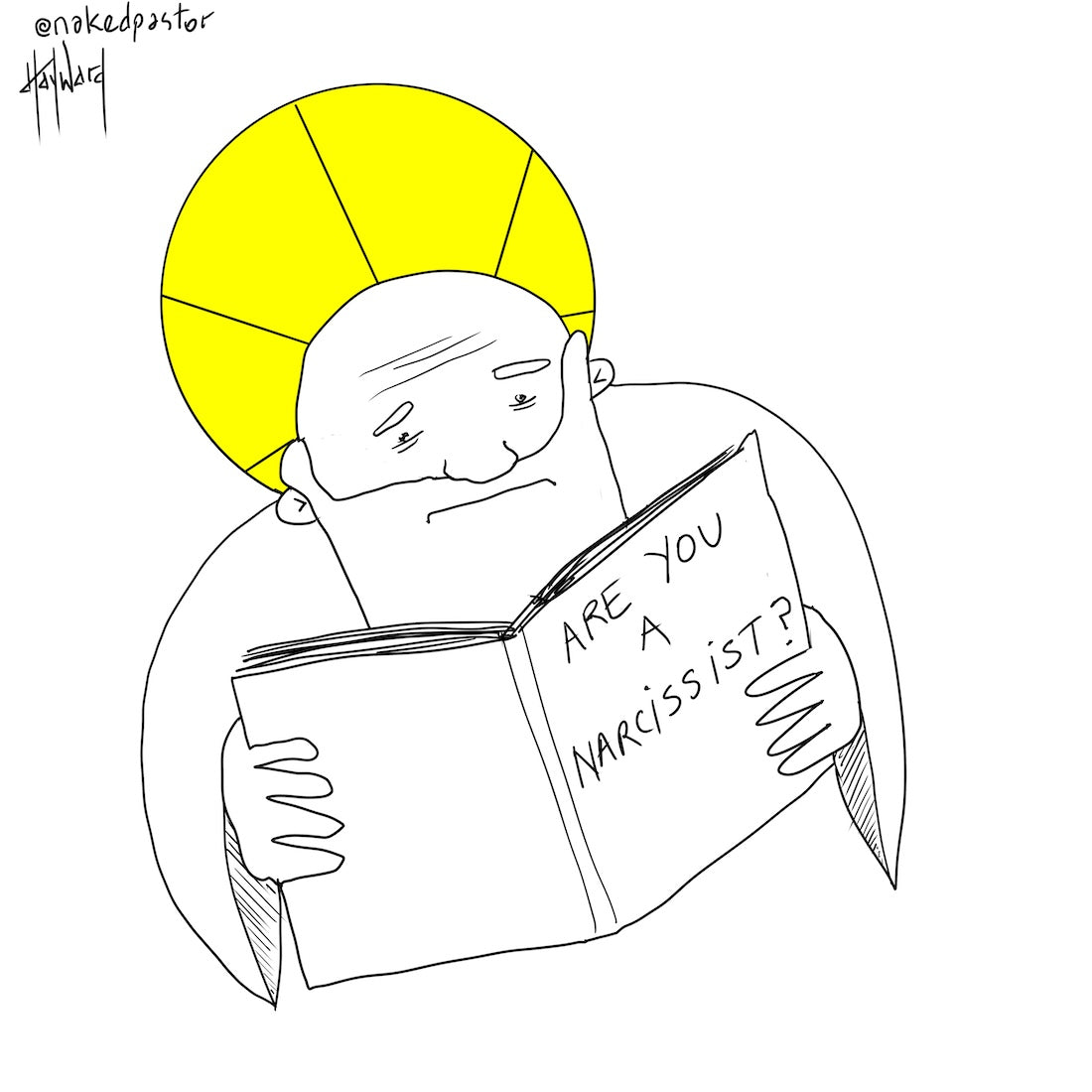
Is Your God a Narcissist?
This is kinda tongue-in-cheek. But also kinda true. Is your god a narcissist? Here are ten questions you can ask yourself. Frankly, if you can answer even one in the affirmative, there’s a chance he’s a narcissist. If you can answer more than half in the affirmative, then I’d say yes he is. If you can answer all ten in the affirmative, run! Does he need constant praise and adoration from you? Does he claim to be smarter than you? Does he believe he’s better than everybody else? Does he disappear for days without notice or explanation? When he hurts you, does he say you are weak and imaging things? When he hurts you, does he say you made him do it? When he hurts you, does he say you’ll be a better person for it? Does he always make you pay for everything? Do you feel like he’s always watching and micromanaging you? Does he belittle you, shame you, and make you apologize for every little thing? Like I said, these are meant to provoke… not only a smile, or even laughter... but also hopefully some thought. So much spirituality can be very unhealthy, especially if we are suffering narcissistic abuse in it. (Disclaimer: I am not a psychologist. But I know enough and have experienced enough about narcissism to be able to have an opinion or two on it. So here goes.)
Read more
The Z-Theory: Mystery, Discovery, and History
In 2009 I had a dream that relieved my theological anxiety and brought peace: "There is a huge waterfall. Oceans of water pour over the rim of the cliff. The water tumbles down and explodes at the bottom. The deluge spreads over the land covering and consuming everything."This blog unpacks my dream and how it comes together to form the theory known as the Z-theory. Mystery: "There is a huge waterfall. Oceans of water pour over the rim of the cliff." We can't see above the rim, but we can guess that it is an infinite source. There is no proof. Only evidence. We can't even say it exists. We just know it must be. It is. This is That-Which-We-Call-God, the Absolute, the Source, Wholly Other, Nirvana, Allah, Yahweh, the Unknowable, the Frontier, the closeted, the Undiscovered. History: "The water tumbles down and explodes at the bottom." This is the evidence we have of what is above the rim. The infinite and invisible are now finite and visible. This is the revelation of the Wholly Other, the exposure, the incarnation of the mystery, the transmission of truth, the manifestation of the unknown, and the discoveries of science. It is the encounter and reception of the unknown now known, the mysterious now perceived. This is what we call the Christ, the Torah, the Buddha, scientific discovery, revelation, the condescension, the incarnation, the transmission, the embodiment, the coming down, and the coming out. Religion: "The deluge spreads out over the land covering and consuming everything." This is the realm of time, history, and culture. This is where spirit and nature meet. It is the manifestation of the good in the muck of the human story. It is forgiveness, reconciliation, and love that find expression in community. Where truth, justice, and love abide, this is the working of spirit in the turmoil of history. This is what we call the spirit, the application of the revelation, the discovery, and the made known. This is the historical impact of the mess and beauty of this world. This is community, unity, peace, and justice amid suffering. Here scriptures are written that try to point to what's been revealed and seen. It spreads throughout the earth filling and fulfilling all living things, binding all together as one. Shared Realities This trinitarian structure describes the reality that everyone shares. No one has exclusive rights. Though our language articulates our own vantage points, they all describe the same thing from a superficial to a complex level.
Read more
Thinking about leaving your religion? Questions are the answer.
When I was considering leaving the ministry and the church, I felt incredibly guilty. You probably feel guilty just reading this, am I right? Put down the hot cup of guilt for a minute and hear me out. I’ve been there, done that, got the T-shirt (literally). Questions are natural. They will arise in the mind. Sure, there is one part of the mind, the fearful part, that wants to conform, fall in line, obey, and not stand out. However, there is another part of us, the wise part, that hungers for truth. Most of us are afraid to question our religion. Because our belief system is often something we grew up with rather than something we chose, we feel as though we cannot or shouldn’t disagree with it. It feels like we’re being traitors to our church, our family, our community, who we are. The thought of questioning your religion is not one that comes suddenly, or at least it wasn’t for me. It started with a few nagging questions or uneasy feelings that I pushed down and put a lid on. The fuller the “question jar” got, the harder it became to close the lid on my doubts. Then, one day, the jar became so jammed with questions that it burst open. They exploded, bred, and demanded answers. The thing is, these questions... such as the existence of Hell or even God... were life and death questions. They literally kept me awake at night. Finally, after a long journey and countless questions, peace of mind came and it's never left. I'm so grateful. It was such a relief to finally be honest with myself about what I really believe to be true versus what I’d been told to believe. I felt so light and free. Contrary to what a lot of religious leaders tell you, questioning your faith is natural and healthy. Whether you are thinking of leaving your religion or just delving deeper, questions help you grow. Questions lead to wisdom and fresh perspectives. Questioning what we believe allows us to step back and look at the bigger picture. If we choose to stick with what we believe in, then at least we know our belief is genuine and not from a place of fear. If we change our mind, at least we are being authentic and truthful with ourselves. There can be no personal peace without personal truth. (Click on image or here for a digital download.) I've come to believe that the only way to get to the truth is through questions. Knowledge can be gained by increments. Like stairs. Wisdom is gained by a series of deaths and resurrections. Like seeds bursting open to bear fruit. Dare to question. Even the hard ones. This is wisdom. Got more questions? One of my books, Questions Are The Answer, is a brutally honest confession of my life, and my struggle with theology and the church. If you've been questioning your beliefs, thinking of leaving your religion, or even struggling with the church or ministry, then this book might help you. I truly hope it does.
Read more
The Journey Of Healing Trauma and Embracing Wholeness
Let me try to explain these cartoons because I think it’s important. Concepts like this are crucial for your spiritual health and growth! Victor Frankl said, “Between stimulus and response there is a space. In that space is our power to choose our response. In our response lies our growth and our freedom.” I’ve also been reading Mattieu Ricard, considered the happiest man on earth. Through reading about him I discovered that he, through meditation, etc., trained himself to collapse this space between stimulus and response so that even auto-responses, like squinting the eyes at a loud noise, are controlled. It’s not that there isn’t a response, it’s that the space between stimulus and response collapses to almost imperceptibility. I think this is where love is, true love. I’m reminded of an ancient Tibetan monk who had many disciples. His son died, and he went into a cave to mourn. He didn’t come out for many weeks. His disciples were perplexed and challenged their master: “You taught us that all suffering is an illusion, yet you mourned for so long! Why?” He responded, “Because this illusion was very convincing.” I love is vulnerability, authenticity, and honesty! Sometimes collapsing that space, as well as integrating what we think or feel happened, takes what we perceive as time. (Click on the cartoon for a digital download of it!) This also relates to theories about time… that it is not real, but a human construct to help us cope with our experience of reality. One idea is that time is simply a series of nows. A series of nows, linked, we perceive as linear time. But the fullness of time is now. Now. Now. Forever, the space between nows, perceptibly collapsed, is all now. There is no past because it doesn’t exist now. There is no future because it doesn’t exist now either. Infinity is fully present now. So, the narrative may go like this: we feel we are not broken. But then we experience trauma, even trauma caused by spiritual abuse. Then we heal. Then we are back to the feeling of not broken. Our ability to collapse this space between feeling not broken to feeling not broken is an important process to learn, otherwise we get stuck in this in-betweenness of not feeling whole. I use the word “feeling” on purpose because I truly believe we are not broken, but we can certainly feel it when we are traumatized. I think this traumatization is a fluctuation in our mental state that can be temporary. Like Sinéad O’Connor’s therapist told her; the reason you go to therapy is to find out there’s nothing wrong with you. Sure, there's a ton of work that occurs in this space. Research. Writing. Theorizing. Therapy. Self-awareness. And so on. All to build or believe a narrative that makes sense to us of how we got from point A… not broken, to point B… not broken… but with an impressive in-between experience that seems to challenge this not-brokenness. What about all those feelings of loss, suffering, pain, struggle, alienation, grief, all of that, and feeling broken? So we build or believe a narrative that helps us make sense of it all. We choose a narrative that works. This is why I think collapsing that space is crucial to a speedy feeling of recovery, of not-brokenness. (Click on image or here for a digital download.) This reminds me of another story. In the film The Last Samurai, there is a Samurai lord who has spent his whole life searching for the perfect cherry blossom. Without success. (Spoiler alert!) On his last day, dying on the battlefield, a wind picks up and blows thousands of cherry blossoms across the field. Some land in his hand, and he says, “Perfect! They are all perfect!” I knew this to be true. But how did he get from point A… a beautiful cherry blossom is just a beautiful cherry blossom, to searching for the perfect one… to point B… all cherry blossoms are beautiful cherry blossoms? Because he finally knew that they are all perfect. Stay with me. I’m going somewhere with this that relates to the cartoon communicating that you’re not broken. This is how I view all salvation narratives. Yes, all of them! They are all attempts to explain what we think happens in the in-between of perfection and perfection that we call our life experience and all of history. Let’s take the Christian one, which is the one I grew up with. The narrative goes something like this: We start in the Garden whole. Then we fall. Then we are rescued, repaired, and reconciled. Then we are whole again! From not broken to not broken. This is the Christian salvation narrative. The collapsed version. What about all that happened and happens in between… all those feelings of temptations, sin, rejected by God, alienated from God, fear of punishment, enmity between people? All the Christian narratives attempt to do just this, all in their own unique ways. But the collapsed version of this is very simple… not broken to not broken. The space in between these two realties that are really one reality, is where the narrative tries to make sense of it. The seemingly long salvation narrative, collapsed into imperceptibly, collapsed into one now, is that we are not broken. I listened to Gabor Maté on a video where he says, “So healing is actually recognizing our wholeness… and when we do, and realize that nothing was ever broken, and that if nothing was ever broken, therefore there was nothing ever bad that ever happened to us… If our wholeness was never destroyed then there was no damage. And if there was no damage, then there’s no sinners, there’s no perpetrators.” (@raisethevibration on Tiktok). So my claim is that our salvation narratives as well as our therapy narratives are our ways of coming to this understanding of our wholeness, our unbrokenness. You are not broken. This is good self-love. Two disclaimers: This isn’t to devalue the narratives we construct to explain our pain, or the narratives we construct to explain our spiritual struggle. We value them. But we can learn to collapse them into imperceptibility. This also isn’t to assume that what I just wrote isn’t just another narrative I built and believe to attempt to explain something I think is true. Related Blog Posts The Healing Power of Acknowledging Spiritual HurtWhy We Need Companionship During Difficult Times
Read more
Can You Be Spiritual Abused In A Marriage?
Before we address what spiritual abuse in a marriage is we must first unpack the definition of spiritual abuse itself. What Is Spiritual Abuse? Spiritual abuse is when spiritual leaders abuse their power and spiritual ideas to create a toxic culture of shame and control to fulfill their own desires. Just like physical abuse uses physical means, or financial abuse uses financial means, or sexual abuse uses sexual means, etcetera, to achieve their ends, spiritual abuse uses spiritual means to achieve its ends... like positions of church power, the Bible, theological ideas such as the threat of excommunication or shunning or Hell, it uses these to terrify people into submission. It is both of these: abuse of power AND the self-serving use of spiritual ideas. Both of these are fueled by theology or dogma. I think this cartoon, Spiritual Abuse in a Picture, sums it up very well. What Is Spiritual Abuse In A Marriage? Spiritual abuse occurs in a marriage when one partner manipulates or controls the other by using their spirituality. Can You Be Spiritual Abused In A Marriage? So let's talk about spiritual abuse inside a marriage. Is it possible. Yes it is. Spiritual abuse can occur in any type of relationship, including a marital relationship. It is possible in a marriage, as in any relationship, due to a combination of factors related to power dynamics, manipulation, belief systems, and control. 5 Examples of Spiritual Abuse in Marriage and Relationships Examples of spiritual abuse in marriage and relationships can vary widely, but they all involve the misuse of religious or spiritual beliefs to control, manipulate, or harm the other person. Here are some specific examples: 1. Forced Religious Conversion This is when one partner pressures or coerces the other into converting to a different religion or spiritual belief system, disregarding their own beliefs and autonomy. They might say, "I can't marry you (or stay married to you) if you don't convert to my religion!" This person is uncomfortable with diversity in beliefs, and is requiring their partner to conform to their belief system with the threat of separation if they don't. 2. Manipulation Through Fear Using spiritual teachings to instil fear and control in the other person, making them believe that certain actions will lead to divine punishment or negative spiritual consequences. I knew a couple where the woman kept making her husband believe he must be demon-possessed when he made her unhappy or frustrated her in any way. She was using the fear of demons to control his behaviour and make him submit to her demands. 3. Isolation and Separation Demanding that the other person cut ties with friends, family members, or social circles that don't share the same spiritual beliefs, isolating them from sources of support and community. I've seen this a lot in some church communities I have observed or even be a part of. When one partner realizes that their partner's relationships outside of their marriage might have what they think is a negative influence on them, they will try to cut them off from those relationships to ensure that their partner stays on the straight and narrow of their expectations. We see this happen a lot in cults. 4. Control Over Spiritual Practices Dictating how the other person should pray, meditate, or engage in spiritual practices, and punishing them if they don't adhere to the abuser's prescribed rituals. Some people have very rigid ideas of what their religion should look like, and that everyone must do it the same way. If they bring this attitude into a marriage, it's going to cause tension, friction, and division, because it requires conformity over personal authenticity and uniqueness. If one partner feels they always have to sacrifice their own ideas and practices to prevent their partner from getting upset, this will make for a toxic marital relationship. 5. Emotional Blackmail Leveraging spiritual beliefs to emotionally manipulate the other person, using guilt, shame, or spiritual teachings to force compliance with the abuser's demands or desires. If a partner is constantly using the bible and theology to shame and guilt their partner into submission to their expectations, this will quickly lead to resentment and a shallow relationship that often won't last long.It's important to recognize these signs and seek help if you or someone you know is experiencing spiritual abuse. The Impact Of Spiritual Abuse In A Marriage The impact of spiritual abuse in a marriage can be as severe as any kind of spiritual abuse leading to religious trauma that has a profound and far-reaching effect on a person's well-being. We see this happen a lot in marriages concerning the issue of sex. The patriarchal culture of Christianity which demands that women submit to their husbands sexually, is particularly damaging. I've seen Christian husbands over and over again force their wives to have sex because the bible teaches that their wives' bodies belong to them and not their wives. Many women have equated this with marital rape, and they're not wrong. It’s so hard to identify or find validation that spiritual abuse has occurred or is occurring. We make excuses, we see issues swept under the rug, we experience our stories of abuse being invalidated again and again. Admitting that you that you were or are abused is an important first step in healing from spiritual abuse.
Read more
My Journey Through Theological Deconstruction
My theological deconstruction lasted decades. It began in seminary and culminated in a profound moment in 2009 that changed everything. Though the peace of mind I found that day has remained, the struggle to articulate what happened continues. The Epiphany That Changed Everything One afternoon, as I closed my eyes to rest, a vivid image unfolded before me: a magnificent waterfall. I stood at its base, gazing up at its overwhelming beauty. The water cascaded with a thunderous roar, endless streams of life flowing down. The sheer power and serenity of it engulfed me. In that instant, I understood something fundamental—we are all one. Beneath all our differences, we share a single reality. Yet, each of us perceives this reality through unique lenses and expresses it with our own words. This vision wasn’t just a moment of clarity; it was a complete paradigm shift. It dissolved years of theological and spiritual angst in an instant. The peace I’d longed for had arrived. But words failed to capture the depth and significance of what I experienced. They still do. The Challenge of Finding Words This cartoon captures the essence of the struggle perfectly. It feels like losing the ability to speak coherently about spirituality—an experience many of us endure during deconstruction. The words we once relied on fall short, leaving us grappling for new ways to articulate a transformed understanding. The struggle to articulate my new reality has been one of the most difficult aspects of deconstruction. The language I once used to describe my spirituality no longer sufficed. It felt like trying to speak in a dialect that no longer resonated with my soul. This is where many of us experience the greatest anxiety during deconstruction. Not only do we wrestle with understanding what’s happening to us, but we also lack the language to explain it to others. The words of our previous spiritual landscape fail to describe a completely new one. It’s not that the old words were wrong; they simply don’t work anymore. The Tension in Relationships The inability to articulate deconstruction can create tension in relationships, especially with those who remain within the frameworks we’ve left behind. If you're navigating deconstruction alongside changes in your relationships, you might find this post helpful: Can A Marriage Survive A Change In One Partner's Religious Beliefs?. Before deconstruction, I could confidently answer such questions. Now, even the questions themselves feel insufficient. They carry the weight of the questioner’s expectations, often making any answer feel like a compromise of authenticity. Embracing Mystery and Silence I’ve come to understand that the loss of words is a normal part of the deconstruction process. Deconstruction is not just a change in beliefs; it’s the dismantling of an entire framework of thought and the gradual emergence of something new. This requires not only patience but also a willingness to sit with mystery Advice for your deconstruction journey If you’re navigating deconstruction, here are four truths to hold onto: Realize this is normal. The loss of certainty and language is a natural part of the process. Abandon the need to explain yourself. You don’t owe anyone an explanation. Get comfortable with mystery and silence. These are fertile grounds for growth. Know you will find words to articulate your new reality. Give it time. A New Intelligence and Language In time, I’ve discovered that deconstruction doesn’t leave you empty. It clears space for a new intelligence and language to emerge. This language may be less certain, but it is more honest, nuanced, and reflective of the complexity of reality. Peace of mind will come. And so will the words. Until then, embrace the silence and trust the process.
Read more
An Ultimate Guide To Spiritual Independence
The first time I mentioned the idea of spiritual independence, I received quite a backlash from some of my readers. People preferred that I had said "interdependence" because we shouldn’t be alone. But independence doesn’t mean being alone. I can be independent while interdependent with another. In fact, healthy interdependence depends on healthy independence. The Different Reactions to My Call for Spiritual Independence One was that Christians are supposed to be in fellowship and not alone. Another reaction was that it is spiritually healthy and necessary to be in submission to someone in authority for guidance. Yet another one was that we all need to be accountable to someone. I believe these are all misunderstandings of spiritual independence. So I will address each one. Does Spiritual Independence Mean Being Alone? “Christians are supposed to be in fellowship and not alone.” We should not confuse independence with loneliness. They are two different things. Yes, it’s possible to be independent and alone. But it’s not necessary. For example, every country wants to be independent. But this does not mean it wants to be isolated. It wants to be autonomous, self-directing, and free, but it also wants to decide which countries to enter into a relationship with. It’s the same for you and for me. I want to be independent, autonomous, self-directing and free. However, I also want to decide who to be in a relationship with. No, I don’t want to be alone. But I’m willing to be if that’s the only way I can be independent. Do We Really Need to be in Submission to a Spiritual Authority? It is spiritually healthy and necessary to be in submission to someone in authority for guidance.” I do not disagree with this. But, we have to be very careful with what we mean by this. I’ve believed in spiritual independence for a long time. I’ve also put myself in submission to spiritual directors, guides, and coaches. But that’s the key: I put myself there. I chose them, and they decided to agree to help me. I insist that we should be able to choose who to receive our guidance from. Of course, when we are young in life and in our spirituality, it’s wise to listen to those who are in authority over us and to take good advice from trusted people. But they should be training us to learn how to choose for ourselves. Parents should teach children to be able to live without them. The best teachers are those who don’t teach their students a bunch of facts, but teach them how to study for themselves. Similarly, spiritual leaders should teach their people to be able to be spiritually healthy without them as well. Does Being Spiritually Independent Mean Not Being Responsible? “We all need to be accountable to someone.” When I first left the ministry and the church as a faithfully attending member, many people expressed their concern that I was no longer under an umbrella of protection or under the shepherding of a pastor or under a spiritual covering. They feared I was now vulnerable to demonic attack, error, and apostasy. Having been a pastor who hung out with other pastors for decades, I knew these ideas are carefully manicured and published by those in authority to fence the flock into the fold with fear. I agree that it’s true that when we are young in life or immature in our spirituality, we should willingly learn from those more mature. But you have the right to make yourself accountable to someone if you want to, and it’s your choice who that can be. To go out on your own is only dangerous if you’re not prepared for it. Preparing for independence is normal and healthy.When we talk about independence, we usually mean these things When we talk about independence, this is what we mean: free from outside control not dependent on another’s authority self-governing not dependent on another for subsistence free-standing We should agree that every person should aspire to this independence. We should also agree that every parent, teacher, and spiritual leader should aspire to guide their children, their students, and their people to this same independence. We can be the captains of our own ships, the masters of our own destiny, and the authorities over our own lives. This leads us to another reaction I often receive when I talk about spiritual independence. This one is important. Some people say that they prefer to be interdependent rather than independent. We Shouldn't Confuse Independence with Interdependence Independence and interdependence are two different things. They are related but mutually exclusive. You can’t be healthily interdependent unless you are first healthily independent. Yes, you can be independent while interdependent with others. A healthy person is able to move into an interdependent relationship without losing their independence. I use the relationship Lisa and I have as an example. We’ve been married for years. We have a healthy relationship. We’ve worked hard for it. It’s not easy, but the rewards make it worth it. It has required a ton of personal growth for each of us, as well as a ton of growth in how to form healthy relationships. We had to learn how to be independent adults who choose to love each other. I have to be healthy as an individual. Lisa has to be healthy as an individual. When these two healthy individuals choose to interrelate, then, it is functional and healthy, rather than toxic, codependent, and dysfunctional. We choose to be interdependent. There are different kinds of dependencies: There’s dependence. There’s codependence. There’s independence. There’s interdependence. I think it is healthy to move through these different kinds of dependencies. What is Dependence? We all start as children dependent upon our caregivers. This is not only natural, but necessary. But we gradually learn how to fend for ourselves as we are cared for. We grow up, hopefully under the wise and gentle oversight of those who care for us. But we shouldn’t stay there. (Unless we aren’t able.) What is Codependence? “Codependency is a relationship imbalance where one person enables another person’s addiction, poor mental health, immaturity, irresponsibility, or under-achievement. Among the core characteristics of codependency is an excessive reliance on other people for approval and a sense of identity.” (Wikipedia) This can start at a very early age. But unfortunately it can continue on into adulthood. Many parents have a codependent relationship with each other as well as with their children, and vice versa. If the children are raised well though, they learn self-confidence, autonomy, and their own healthy sense of identity. They can pass through or even avoid codependence and move on to the next stage. What is Independence? Independence is as mentioned previously. It means that you are free from outside control, that you are self-governing, that you are not dependent on another’s authority, and that you are not dependent on another for subsistence. Of course, we all should aspire to this. As codependence is closely related to dependence, so is independence closely related to interdependence. What is Interdependence? Healthy interdependent relationships depend on healthy independent individuals. This is as true in a church as it is true in a marriage. The first spiritual director I ever had was the best I ever had. I sought one out and found Sister Marie, an Abbess of a monastery who was willing to meet with me once a week. We met for two years. The reason why she was the best was because even though I willingly submitted myself to her spiritual direction, she taught me how to become spiritually independent. She taught me how to think for myself, make decisions for myself, and decide for myself how I wanted to be spiritual. Even though she suggested what I should read, how I could meditate, who to study and contemplate, and how to be spiritual, at every moment I was free to walk away or free to accept her guidance and obey it or free to say that particular suggestion wasn’t for me. I remember one day, with deep exasperation, I said to her, “I feel like such a stick in the mud!” She gently responded, “What does it feel like to be a stick in the mud?” No judgment.No need to harness me into her spiritual style.No obsession with aligning me with her idea of perfection or progress. For her, what was most important and what she respected most was my autonomy and my ability to explore and find my own way to be spiritual. Actually, what I mean is she encouraged me to find my own way to be me! I did find it. I’m still finding it. And I’m living my own life now. I’m also free to choose who I am in a relationship with, how to recognize unhealthy relationships and how to form and nurture healthy ones. I’m able to decide how to be spiritual not only for myself, but for those I choose to be interdependent with. This is healthy. This is what I mean by spiritual independence.
Read more
How To Overcome Your Fear of Hell
One of the most common and terrifying parts of changing and deconstructing your beliefs is letting go of the fear of Hell. I’ve walked with many people through their spiritual transition, letting go of old beliefs, questioning long-held doctrines, and trying to find peace on the other side. And time after time, this fear shows up. Even when people no longer believe in Hell, the anxiety remains. I know the feeling well. That’s why I drew my cartoon “Literal Hell” to capture just how real and overwhelming this fear can be. Anxiety and a fear of hell What is Stygiophobia?Stygiophobia is the irrational fear of Hell or the afterlife, particularly the fear of eternal punishment or condemnation. This fear manifests itself in very real ways including anxiety, panic attacks and even depression. Although stygiophobia can stem from a variety of sources, for those who know my work, it most likely comes from an experience in a very strict religious setting, often in childhood. Why Being Terrified of Hell Is So Difficult To Shake If you've been raised your whole life to believe in a literal Hell after death, it is so enmeshed in your brain that the belief itself is cellular. If your brain has been soaked in the belief that if you don't believe in Hell then you'll spend eternity there, how do you recover from that? It's very real. Not Hell, but the fear of it. I remember finally deciding that Hell was a metaphor and not a literal place. I also remember lying in bed in the darkness of my room that night terrified that I’d made a terrible mistake. A cold wave of fear swept over me.What if I’m going to Hell because I don’t believe in it anymore?What a mindf*ck that was.But that’s a lot of what theology is. It’s a tool used to control us, to make us behave, conform, fall in line, and stay in place. For me, theology often felt like a long and exhausting way to explain why I was suffering. And the answer always seemed to be that something was wrong with me. When life got hard, I didn’t just feel sad or stressed. I felt terror. I believed God was punishing me. I believed I had done something wrong, even when I had no idea what it was.That fear made my fear of Hell even worse. It felt like I was being watched and judged all the time, just waiting for punishment to drop out of nowhere. This is one of my many cartoons about the fear of hell. How To Overcome A Fear Of Hell Of course, we’re going to feel fear when we transgress those boundaries because that’s exactly what we’re supposed to feel when we do. That’s what they were designed for! People often ask me how to get over this hell anxiety. I say give it time. I've worked with enough people now to know that given a listening ear, a gracious and spacious space to question their religious beliefs and vent, as well as time, people recover and achieve peace of mind where they are no longer anxious about Hell. It becomes a non-issue of no concern. We can grow to understand that the idea of Hell was useful for a while to keep us in line and to keep us perpetually afraid of punishment for our disobedience and faithlessness. You see, time is a mental construct, and concepts like eternity and afterlife are parts of this construct. This is where fear and suffering thrive. All there is is now. Always. And this is where there is peace. Related Leaving Religion and Questioning Beliefs Resources I Used to Make Worship Music and Now I'm Triggered by My GuitarMy Story: From Churched Christian to Unchurched CartoonistYes, It’s Okay to Google “Leaving my Religion”The Art Of Finding Yourself After Leaving Your Religion5 Stages Of The Deconstruction Of Your Beliefs
Read more
Embracing the Unknown: Swimming Against Certainty
In my cartoons my question marks represent mystical mystery and unknowing, whereas my exclamation marks represent the zeal of certainty. I remember growing up in church and in youth group always being pressured to go against the flow of the world. We were taught that the whole world hated us and persecutes us for our faith and that we needed courage to believe even in the face of martyrdom. This is cartoon is titled "Go Against The Flow" and is available as an art print and a digital download. Now I know that where true courage is needed is in distrusting the comfort and security of propositional truth and embracing mystery. Mystery and unknowing and uncertainty aren't steps to facts and knowing and certainty. No! Rather, they are a way of life. If this resonates with you then I think you'll love my Sophia Flow Art Print.
Read more