The Naked Journal
Thoughts, musings, and meanings behind NakedPastor Art.
The Naked Journal

4 Similarities Between Your Relationship with Religion and Your Relationship with Your Parents
I think a lot about religion and how it affects us. Religion, I claim, is a human invention, and it reflects our fears and fantasies more than anything else. Religion positions itself as an authority in our lives. And as an authority, it resembles other authorities that exert control over our lives. So, therefore, I draw parallels between religion, as a power over our lives, and our parents... also a power over our lives. (CLICK ON IMAGE FOR A DIGITAL DOWNLOAD) Here are 4 ways our relationship with religion is like our relationship with our parents. 1. Dependence As children we depend on our parents. We need them. They shape our worldview. Same with religion. We’re dependent on it. It nurtures us and shapes our worldview. 2. Interdependence My parents and I are different, but we love each other. They’re free to be who they are and so am I. We all just want a basically healthy, functional relationship so that we can live without the presence of conflict and sadness. 3. Codependence As adolescents, we test boundaries and authority. We need our parents and wish we didn’t. They assume they have control but our rebellion creates tension. It's the same with religion. We test its authority. It tries to control us but we realize it may not. There’s confusion as we find our way beyond its authority. 4. Independence This is early adulthood. Or should be. We leave. Sometimes we need help. But we’re basically on our own and we like it. We explore our independence from religion. We might conclude we don’t need religion the same way. Religion assumes we should still obey. But we choose to shape our own spiritual lives. Same with religion. I don’t hate it. I see its value. I appreciate it for what it is. It helped me grow up. But I will never let it control me again or negatively affect my life. I determine how religion relates to me and how I relate to it. Like independent, autonomous, self-determining adults… we care for ourselves and decide what role religion does or does not play in our lives. And we’re not going to feel guilty about it. As with religion, same with my parents. I choose how to relate with them. That's maturity.
Read more
How My Wife and I Survived Religious Deconstruction
What do you do when you and your partner no longer agree on fundamental spiritual beliefs? I know all about it. Lisa (my wife) and I were there. This is our story. Maybe it can help you. For years, even decades, we were pretty much on the same page. Then, as deconstruction set in and our beliefs and theology began to undergo a dramatic and traumatic shift, we drifted apart. We used to be so much on the same page we were indiscernible. There was never any thought about feeling different. There was no concern about arguing things through to an agreeable position. There was never the effort to compromise our beliefs or values. It really hit us when we left the ministry and the church in 2010. It was then we realized we were no longer on the same page spiritually. Sometimes it felt like she went her way and I went mine. She went to get her nursing degree and I went to teach at a university. We used to share the same beliefs, spirituality, and church life. We were joined at the hip. Then we weren't. It felt strange and scary! We didn’t know how to be together. We didn’t even know how to talk. The glue we assumed held us together (a mixture of being on the same page of belief, being in ministry together, and being a part of a community of believers) disintegrated. We had to figure out, if we wanted our marriage to survive, how to stay together. What was the real glue of our relationship that had lasted over 30 years? There are some basic ingredients that helped our marriage survive spiritual deconstruction 1. Memory and positivity We remembered the good things. We recalled what drew us together, what attracted us to each other, and what we loved (and still love) about each other. That's the essence of a relationship. For me, I'll be honest, I was first attracted to Lisa because she was the hottest girl on campus. Then, when I started to get to know her, I was attracted to her feistiness, her strong will and independence, her deep wisdom, and her zest for life. Her beliefs weren't even on the list.Even though we’ve changed so much since then, Lisa still possesses those same essential attributes, including still being hot, and that's what makes her so desirable to me and contributes to our sturdy relationship. Always has. Figuring out our different beliefs is a game played upon this sturdy board. 2. Help and support We got help. Counselors, therapists, coaches. You name it, we did it. We read good books on marriage (I even wrote one). Get my favorite here. We hung out with other healthy couples and supportive friends who model real, judgement-free love. We learned how to renegotiate and to communicate openly and without judgement. And now that we’re in a good place, we realise that a shift in our beliefs was actaully a good and natural thing. Perhaps before deconstruction, we were so enmeshed that we weren't really individuals? Maybe before, even though we were very happy, we were kind of codependent on one another and lacked a healthy autonomy? (Click on image for a digital download of it, or click here.) 3. Communication and effort We embraced change as not only inevitable but preferable. And to do that meant consistently making an effort. We tried to explain and communicate what we we going through, even when we didn’t understand it ourselves. We helped eachother process the unpacking of our crumbling beliefs and through it all we had to show appreciation in whatever little ways we could. We kept romance alive even when the fire wasn't there. We went on dates. I bought flowers. We set up times to discuss things. And it’s ongoing. For me, it means getting treats for Lisa even in the midst of apparent disagreement. It means going for walks together. It means sitting down and intentionally having a difficult conversation. It means enjoying sex‚ where theology isn't invited. 4. Grace and trust Even though it was hard, I had grace for myself and grace for Lisa. We tried and tried again not to judge eachother. Why? Because in marital storms, you need to remeber that you're not watching a snapshot, you're watching a movie. You're observing the wonderful unfolding of an individual's life in remarkable ways... yours and your spouse's. Trust that your partner knows what's best for themselves, just like you're trusting yourself to know what's best for you. The journey of explorers is never in a straight line, but zigzagging all over the place, sometimes back, sometimes forward, but always towards the destination, whatever that is‚ which you don't know until you get there. We are strange and wonderful human beings. Appreciate that! Be as gracious as you were with each other in your earliest days. Patience and hope When deconstruction set in for Lisa and me, it was frightening. We had never navigated these waters before. They were strange, dangerous, and completely unpredictable. We had to paddle by the seat of our pants because not much had been written about this stuff before. No one told us, for example, that it was going to be a couple of years before we would start feeling stable or even in love again. There were times, literally, when bags were packed and we were heading our separate ways. I hate recalling those moments because we nearly ended a really good thing. I had friends advising me to just do what made me happy. But I didn't trust myself. I was confused. So, I cam to an important realisation that I share with others: Do NOT make a decision during confusing times. Wait for clarity! I'm so glad I did. Lisa and I waited for clarity. It took years, but it was so worth it. We held out in hopes that things would get better. And they did. Nurturing our marriage through religious deconstruction was hard but worth it One of the most difficult challenges I ever undertook was to deconstruct my beliefs and stay married. Honestly, there were many times Lisa and I didn't think we were going to make it. But we did. And I'm so grateful.We're still together and better than we've ever been as a married couple. We got through the desert and found an oasis on the other side of it. We're good. Really good. We've been married 37 years and the romance is still alive! Through our deconstruction, we have gained the wisdom to realize that love keeps us together, not compatibility. We have found humility to embrace the other in all their profound complexity. And we rediscovered the power of love, the glue that joined us together so many years ago and keeps us together still. I always provide a disclaimer with the topic of religious deconstruction and marriage Some marriages don't make it. Some people decide they were never meant to be married in the first place, or realize that their marriage was never a good one to start with, or decide that there's just too much damage done to repair it. All these reasons, and more, are valid. I support people through these painful transitions as well. And I see many of them come through the other side of separation and divorce as happier and healthier people with a hopeful life ahead of them. Only you can decide if your marriage is worth saving. Read more about Can A Marriage Survive Changing Beliefs?
Read more
How Purity Culture Creates A Fear Of Sex
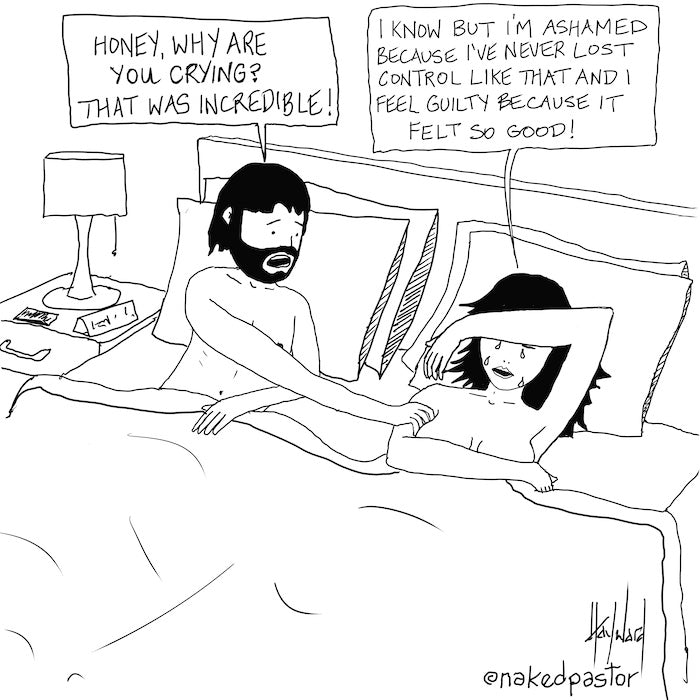
Some were or are so immersed in purity culture that the bedroom is a haunted room. It's very complicated, full of verses and sermons and warnings and threats. Instead of a place or rest and recreation, it's a place of anxiety and shame. I hope you break free from it all and that's why I've started this series of cartoons about Purity Culture, called "Sexy Sunday". Purity Culture Resources What Is Purity Culture and Why Is It Harmful?Breaking Free from Purity Culture5 Ways Purity Culture Can Affect Your Sex Life
Read more
Honoring LGBTQIA+ Stories in Art
Sexy Sunday and Pride Month combine to bring you this cartoon. Many LGBTQIA friends and followers requested representation in my Sexy Sunday cartoons But I was reluctant because I feel their intimate sexual lives is NOT my lane. I see so many people, businesses, and institutions take advantage of the LGBTQIA+ community, and I will not participate in that. Exploiting, for example, gay- or trans- or bi- or whatever- sex for profit or popularity is vulgar and cruel, and I refuse to play that game. The fetishization of the private sex lives of my LGBTQIA+ friends is not cool. Also... and I will be vulnerable here... I was sexually assaulted by an older teenager when I was a kid, and also by an older man when I was a teenager. So imagery of men enjoying sex together is something I don't want to imagine or draw. I wish it wasn't so, because it is a perfectly valid expression of genuine love. But there it is. For me. For now. I'm working on it. All that being said, my friends persuaded me that they trusted me and urged me to draw some for them. Here it is, with two women. I personally know many people who have experienced this. You? Related Blog Posts Breaking Free from Purity Culture5 Ways Puriture Culture Can Affect Your Sex Life3 Helpful Resources for LGBTQ+ People Navigating Religion
Read more
Gratifying the Desires of the Flesh
For many people, Bible verses were so pounded into our head that it seems impossible to shut out or even dial down their voices. This couple wants to explore how to give each other pleasure... inside and out. This includes their bodies. Their flesh. How can they surrender to pleasure and not feel gratified? These are some of the conundrums purity culture provides.
Read more
Purity Culture's Impact in the Bedroom
For the past several months I’ve been posting what I call my Sexy Sunday cartoons that challenge Purity Culture. This cartoon about the impact of purity culture on one's sex life is one of them and is titled, A Cloud of Many Witnesses. Many people who grew up in church, Christianity, and purity culture, can't enjoy themselves in bed because they've been convinced that there is a huge invisible crowd watching them. Even though many no longer believe it, they still can't shake the feeling that they're being judged while they enjoy pleasure. Is this you? Related Purity Culture Blog Posts What Is Purity Culture and Why Is It Harmful?5 Ways Religious Trauma Can Affect Your Sexuality (and how to heal)Breaking Free from Purity Culture
Read more
Is The Church In Your Bed?
Is the Church in your bed? Like the Church is in your head? Lisa and I never suffered from that, for which I'm thankful but I know so many people so affected by purity culture and the Church's teachings on sex that they can't even enjoy themselves in bed. I want to break that and help people break free to enjoy themselves. In my opinion, the Church should stay out of your bed! This cartoon is titled, Is the Church in Your Bed? and it's available as a digital download. If this cartoon resonated with you then you might like to read this blog post, 5 Ways Religious Trauma Can Affect Your Sexuality (and how to heal).
Read more
Grief During the Festive Season
This is to be a festive time of year. But for many, the festivities intensify our grief. I call this cartoon, Grief. Even during a season of giving and receiving, experiencing loss feels even more pronounced. Let's remember that for one another. If this speaks to you and you'd like to own a NakedPastor original this original Grief cartoon is available.
Read more
Can Christians Date Non Believers?
I get asked this question a lot: Can Christians date non-believers? The simple answer is yes — but like everything in life, it’s complicated. Description: A woman stands between two men. One man says, “Pick me! I might be an asshole but at least I’m a believer!” The other says, “I may not be a believer but I promise to treat you right and spend the rest of my life learning how to love you.” She looks endearingly towards the guy on the right. We’ve been told for years that faith should be the foundation of any relationship. That dating someone who doesn’t share your beliefs is risky, or even wrong. But I’ve met many couples who didn’t follow that rule. They’re believers and non-believers, together and happy. And honestly? Their love is real, passionate, and messy just like all love is. Too much emphasis is placed on belief as if it’s the only thing that matters. But belief can be a shaky ground. People’s faith can change. Doubt lives in all of us. And when beliefs don’t line up perfectly, love doesn’t have to suffer. Differences in belief can spark something electric. Like opposite poles of a battery, the tension can create energy that keeps the relationship alive and growing. It pushes you to learn, listen, and expand your understanding not just of each other, but of what love really means. In my own marriage, my wife Lisa and I come from different places spiritually. That doesn’t stop us from loving fiercely. If anything, it’s made our connection deeper. Because love isn’t about agreeing on every idea. It’s about being willing to show up for each other, even when things get complicated. So yes, Christians can date non-believers. And if you’re in one of those relationships, or thinking about it, focus less on whether your beliefs match perfectly, and more on whether you treat each other with respect, kindness, and honesty. I would rather my kids be loved by someone who made them happy, and I wish the same for you. Love isn’t perfect theology. Love is messy, beautiful, and sometimes, it asks us to let go of what we think should be so we can embrace what is. Related Blog Posts When You and Your Spouse Find Yourselves on Different Spiritual PagesCan A Marriage Survive A Change In One Partner's Religious Beliefs?
Read more