The Naked Journal
Thoughts, musings, and meanings behind NakedPastor Art.
The Naked Journal
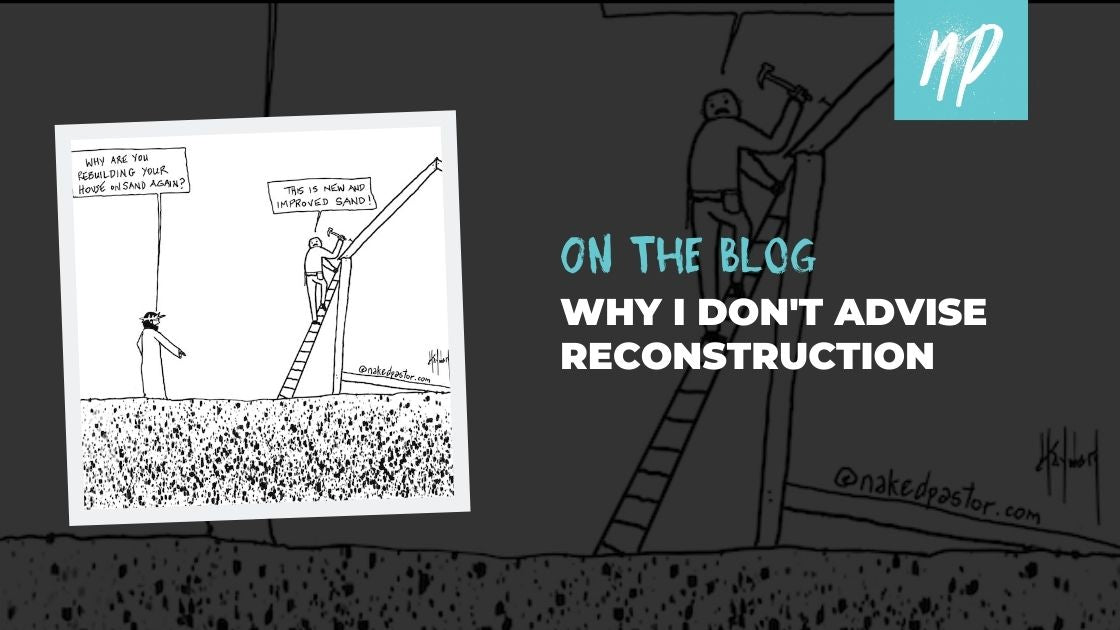

Jesus as the Embodiment of Deconstruction
Whether you believe in the historical Jesus or the Savior Jesus or not, we can glean plenty of insights from the gospels’ depiction of him. A man begs Jesus: "Jesus! My beliefs are changing. I have tons of questions and feel like I'm losing my faith. I'm afraid I'm deconstructing. Please help me!" Jesus replies, "But I AM deconstruction!" Here are a few things we can discern: He challenged the accepted idea of righteousness.He challenged the accepted idea of family.He challenged the accepted idea of who’s in and who’s out.He challenged the accepted idea of who is loved.He challenged the accepted idea of societal norms.He challenged the accepted idea of justice.He challenged the accepted idea of authority.He challenged the accepted idea of fellowship.He challenged the accepted idea of illness and disability.He challenged the accepted idea of demons.He challenged the accepted idea of women.He challenged the accepted idea of foreigners.He challenged the accepted idea of enemy.He challenged the accepted idea of what it means to be religious.He challenged the accepted idea of prayer.He challenged the accepted idea of scripture.He challenged the accepted idea of life after death.He challenged the accepted idea of ageism.He challenged the accepted idea of what it means to be wise.He challenged the accepted idea of nationalism.He challenged the accepted idea of economics. I could go on. Jesus challenged the accepted idea of pretty much everything. This is just from the gospel accounts. It can’t be avoided: everything must be questioned. Like I said, whether you believe in the historical Jesus or the Savior Jesus or not, the Jesus of the gospels IS deconstruction.
Read more
Why I Advocate For Swearing During Your Deconstruction Of Faith
Description: A boy says to his mom, “Mom, since we stopped going to church you’ve gotten really good at swearing!” 1. Release: Swearing releases. Venting emotions by swearing can be effective and safe. Research shows it even decreases pain. 2. Freedom: When we leave controlling cultures, swearing is an easy expression of our freedom. Liberated from a culture where even our words are policed, swearing is a declaration of our independence. 3. Adulting: This is how many adults talk. We swear because we can. It’s everyday speech. Some swear a lot. Others less. Some judge people who swear as stupid and lazy. But I know intelligent people who swear and less intelligent people who don’t. 4. Word: Sometimes no word expresses what we want better than a swear word. Other words fail to convey our thoughts or feelings. 5. Humor: Swearing can be comic relief. It can lighten things up in humorous ways. Watching a guru swear is just funny. We appreciate comic relief in the middle of crises. 6. Spirituality: Jesus did the equivalent of swearing by calling his opponents names and telling them to do this or that. We’ve sanitized spirituality to where we’re no longer human. Swearing is an expression of flesh and blood people rather than disembodied spirits. Why police our words? Sure, I want to say things that are helpful, honest, and true. I want to speak in ways that build up the good and bring down the bad. But if swearing helps me do that, I will. Out of the fullness of the heart the mouth speaks. Swearing can be a healthy part of that process.
Read more
Shame-Free Free Shame
Cartoon Description: Jesus is walking with a sign that says, "Shame-Free". He passes a man who is carrying, along with a bible, a sign that says, "Free Shame". I despise shame. Some people think shaming is a legitimate method to control others. They think it's okay to shame people into doing what they think they should do or to stop doing what they think they shouldn't be doing. Always remember this: if you are being shamed to do or not do something, the intention is that you will comply to please them. Shaming intends to embarrass you back into submission. But, shame sucks as a motivator because its primary drive is the need to be accepted... ... rather than saying, "Here's how I can grow and become an even better person", then doing it.
Read more
Your Theology Doesn't Even Come Close: Change My Mind
Cartoon Description: God is sitting at a table drinking a coffee. The sign in front of God's table says, "Your theology doesn't even come close. CHANGE MY MIND." I do remember the exact moment when I realized my thoughts are not what they think about. It was one of the most terrifying moments of my life. The word is not the thing. Neither is the thought.
Read more
Suffering and Theology
Description: There is a huge ball labeled "your suffering". Outside is a little dot labeled "their theological explanation". When you suffer, there's no amount of theologizing that will comfort you or remove the pain. Some people don't realize that. Which is why Job's "comforters" are still going strong today.
Read more
Living in the Now: The Essence of Heaven
I'm frequently asked if I believe in Heaven. The historical Jesus, I believe, did not talk about an afterlife, but rather emphasized the kingdom as manifested within us in our freedom. The logic seems to be that if you don't believe in Hell, maybe you don't believe in an afterlife at all, which includes Heaven. This often creates a struggle for many who are trying to overcome the fear of hell. I always find this difficult to respond to. I feel like a Buddhist when asked if there's a soul. Yes or no. Yes and no. The middle path between the two poles of dialectical thought. Description: A man asks Jesus, "Can you tell us about Heaven?" Jesus responds, "Why can't this be Heaven, right here, right now?" I think there's a wisdom that transcends the opposing thoughts of heaven and hell. What does "after life" even mean? Life is life. Fulness of life means the fulness of the moment. The moment is now. The fulness of now is always now. Now. Now. Now. Time is an illusion. We think time flows linearly, when it is only a connection of moments. Each moment is full. Each moment is now. Each moment is eternal. Infinite! Living fully in the moment now is the eternal now.
Read more
Exploring Religious Microaggressions and Their Effects
I've been talking with friends and doing research about microaggressions. Microaggressions are insults against a certain group of people that come off as a joke or even a compliment. Often they’re not even thought about… the aggressor sometimes doesn’t even know what they’re doing. They’re automatic comments that are often made in passing. Description: A MicroAggressive Christian t-shirt with the words, "God Loves Even You!" Here are some examples of microaggressions “You don’t seem gay, though!” “You’re the whitest black person I know!” “Figures your family is rich, being Jews.” “You’re actually pretty cool for a Christian.” “You look like you’re from China.” “Have you gained weight?” Or this one: "God loves even you!" The accumulation of microaggressions in the daily life of the ones receiving them is exhausting. I get them all the time, usually in reference to my art and my beliefs or lack of them. I AM unique and different, and I'm okay with who I am, even though others think they're superior to me because of how they believe or choose to live their lives. But the microaggressions I suffer are nothing in comparison to the those suffered by others because of things they didn't choose... like the color of their skin or their sexuality or gender or where they're from or their shape, etcetera. Microaggressions are committed by people who consciously or unconsciously think they are superior to the one they are offhandedly insulting. They may not know it, but their language betrays it. Let's not do that to each other. And if we do, let's call each other out on it! Microaggressions deserve macrocorrections! I'm up for it. You? Related Religious Trauma Blog Posts Here is a list of other blog posts I've written on religious trauma and spiritual abuse. What is Religious Trauma and How To Recognize It? The Power of Vulnerability for Healing Religious Trauma What is Spiritual Abuse? And how to recognize when it is happening to you. 5 Steps to Recover from Spiritual Abuse
Read more
Loving Relationships and Changing Beliefs
Description: A woman comforts her husband who is crying, “Honey, I didn’t say I was dying, I just said I’m questioning my beliefs!” LOVING RELATIONSHIPS AND CHANGING BELIEFS If you are one of the people in this cartoon, I have a warning and some good news. It’s very scary when the person you love changes. The person you’ve always loved has always been a certain way. Now they’re not. They are becoming someone else! Maybe someone you didn’t sign up for. I think pre-marital counseling must include warnings that the person you love right now, sitting right here in front of you, that you are absolutely head over heels over, is going to change. This includes their beliefs. Your partner may one day not be the steadfast believer you know, love and respect today. Lisa and I have been married for 40 years. Our beliefs have changed so dramatically that back then we wouldn’t have recognized ourselves now. But here’s the good news: we’re not just different, we’re better! Why? Because we’ve grown. We’ve developed. We’re more independent and authentic. We’re more ourselves than ever before. We are evolving into who we really are. We’ve courageously stepped up to personal growth. It’s like a blossoming. Yes, we’ve changed. But we’ve also burst open and are more beautiful than ever. Yes, it can be sad, shocking, and grievous to say goodbye to the former selves. But it can be exciting to say hello to the newer selves. When we say “I do promise to love this person”, you’re not just saying it to the person you see now, but to the person they will fully become that you haven’t even had a glimpse of yet.
Read more
Do You Believe as You are Told?
(Description: Baby being baptized. Mom, dad, and pastor think, "We'll make him believe and live just like us." Baby is giving them the finger.) DO YOU BELIEVE AS YOU ARE TOLD? Parents teach their children what they believe to be true and train them how to live what they think is a good life. We did for our kids. Our parents did for us. But at some point we need to decide that whatever theology we inherited, it is our right and responsibility to keep it, change it, or reject it. It’s so much easier just to believe and live how we're instructed to. Many if not most never question what they believe or how they live. It’s easier to live unconsciously. It’s easier because our ancestors were told what to believe, our parents inherited it from them, and then we inherited it. So a rejection of our parents’ beliefs is a rejection of our ancestors and our religion. There’s enormous pressure to keep the ball rolling. Which, unfortunately, is why so many people are rejected by their parents and their church when they refuse to obey the rules, drop the ball, stop playing the game, and disappoint the team. Any theology worth anything has emerged out of a profound event. First there is the experience, then the transmission of it. The revelation then the theology. Apprehension then articulation. Experience then text. Now, instead, we believe the theology and hope to have the experience. Not many dare go beyond the beliefs to see what’s behind them, what’s actually there, what’s actually true. Few explore what might be beyond belief.
Read more